Biltmore Forest in Buncombe County, North Carolina — The American South (South Atlantic)
Frederick Law Olmsted
The Genius behind Biltmore's gardens

Photographed by Darren Jefferson Clay, October 25, 2022
1. Frederick Law Olmsted Marker
Growing millions of plants
One of Olmsted's first priorities was establishing a nursery to grow the millions of trees, shrubs, and other plants needed for the estate. In 1890, he hired horticulturist Chauncey Beadle as nursery superintendent. Beadle remained at Biltmore for 60 years, becoming estate superintendent, guiding Olmsted's plan to maturity, and contributing his extensive collection of azaleas to the Azalea Garden.
The Rebirth of Forestry
Unlike the beautiful forests you see today, much of the land Vanderbilt purchased had been cleared. Olmsted began a program of reforesting former overworked farmlands and trained foreman how to improve the existing patches of woodland by removing poorly formed and damaged trees, thus giving the best trees
this page online
In 1892, Olmsted persuaded Vanderbilt to hire a trained forester named Gifford Pinchot. Pinchot implemented a unique management plan, designed to improve the forest while returning profit to the landowner. The plan was the first of its kind in America and served as a national model.
Pinchot eventually left the estate to head the Division of Forestry that later became the U.S. Forest Service. German forester Dr. Carl A. Schenck took charge of Biltmore's forest of more than 100,00 acres in 1895. In 1898, he established the Biltmore Forest School, the first of its kind in the country.
Edith Vanderbilt sold 86,700 acres of the estate's forested mountain land to the U.S. Government in 1914, requesting it be used to establish a national forest named Pisgah. In 1968, 6,500 acres of Pisgah National Forest were designated The Cradle of Forestry in America.
Photo captions:
1 - Landscape architect Frederick Law Olmsted
2 - Chauncey Beadle among his beloved azaleas, 1949
3 - The men who made Biltmore possible, from left: Edward Bennett, purchasing agent and agricultural consultant; Richard Morris Hunt, architect;
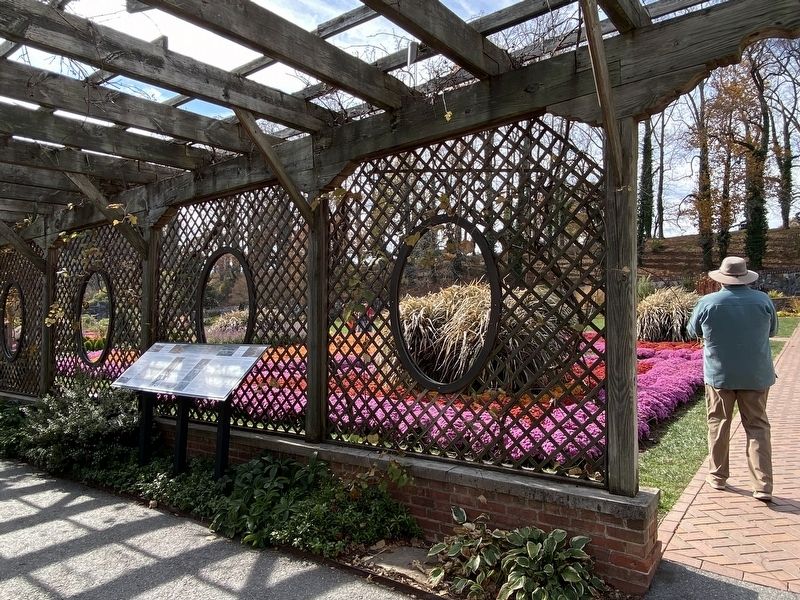
Photographed by Darren Jefferson Clay, October 25, 2022
2. Frederick Law Olmsted Marker
4 - Gifford Pinchot, c. 1893
5 - Dr. Carl A. Schenck
6 - Official dedication of Pisgah National Forest, 1920. From left: Edith Vanderbilt; N.C> Governor Locke Craig; Cornelia Vanderbilt; George Powell, secretary of the Appalachian Park Association.
Topics. This historical marker is listed in this topic list: Horticulture & Forestry.
Location. 35° 32.331′ N, 82° 33.128′ W. Marker is in Biltmore Forest, North Carolina, in Buncombe County. It can be reached from Approach Road. Touch for map. Marker is at or near this postal address: Biltmore Walled Garden, Asheville NC 28803, United States of America. Touch for directions.

Regionally, this marker is in the Mountains and in Greater Asheville. It is also in the American South, specifically in the Upper South, in Appalachia, and specifically in Southern Appalachia. Globally, it is in North America, the Western Hemisphere, the Western World, and the Anglosphere. Historically, it finds itself in what was once the original Cherokee Nation, the territory of the Mississippian Culture, one of the original Thirteen Colonies, one of the Confederate States of America, and the Antebellum South.
Other nearby markers. At least 8 other markers are within walking distance of this marker: Shrub Garden (within shouting distance of this marker); Exploring Deer Park Trail (about 300 feet away, measured in a direct line); The Italian Garden (about 500 feet away); Welcome to Biltmore's Historic Gardens (about 500 feet away); a different marker also named Frederick Law Olmsted (about 600 feet away); Birthplace of American Forestry (about 600 feet away); Olmsted at Biltmore (about 700 feet away); Siting Biltmore House and Stables (about 800 feet away). Touch for a list and map of all markers in Biltmore Forest.
Credits. This page was last revised on February 25, 2025. It was originally submitted on November 8, 2022, by Darren Jefferson Clay of Duluth, Georgia. This page has been viewed 236 times since then and 36 times this year. Photos: 1, 2. submitted on November 10, 2022, by Darren Jefferson Clay of Duluth, Georgia. • Bill Pfingsten was the editor who published this page.
