Zephyr Cove in Douglas County, Nevada — The American Mountains (Southwest)
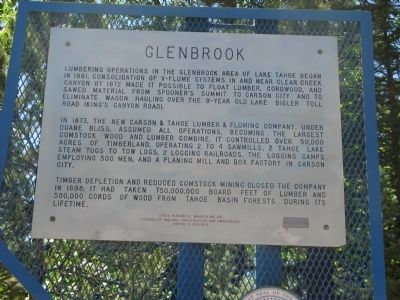
Glenbrook
Photographed by Syd Whittle, July 7, 2009
1. Glenbrook Marker
In 1873, the new Carson & Tahoe Lumber & Fluming Company, under Duane Bliss, assumed all operations, becoming the largest Comstock wood and lumber combine. It controlled over 50,000 acres of timberland, operating 2 to 4 sawmills, 2 Tahoe Lake steam tugs to tow logs, 2 logging railroads, the logging camps employing 500 men, and a planing mill and box factory in Carson City.
Timber depletion and reduced Comstock mining closed the company in 1898; it had taken 750,000,000 board feet of lumber and 500,000 cords of wood from the Tahoe Basin Forests during its lifetime.
Division of Historic Preservation and Archeology
Victor O. Goodwin
Erected by Division of Historic Preservation and Archeology, Victor O. Goodwin. (Marker Number 219.)
Topics. This historical marker is listed in these topic lists: Horticulture & Forestry • Industry & Commerce. A significant historical year for this entry is 1861.
Location. 39° 4.86′ N, 119° 56.52′ W. Marker is in Zephyr Cove, Nevada, in Douglas County. It is on U.S. 50, on the right when traveling west. Touch for map. Marker is at or near this postal address: 1928 US-50, Zephyr Cove NV 89448, United States
this page online

Regionally, this marker is in the Sierra Nevada, in the Lake Tahoe Basin, and in Greater Reno Area. It is also in the American Mountain West. Globally, it is in North America, the Western Hemisphere, the Western World, and the Anglosphere. Historically, it finds itself in what was once New Spain and also Mexico’s Alta California.
Other nearby markers. At least 8 other markers are within 3 miles of this marker, measured as the crow flies: Spooner Area (approx. 2.2 miles away); Johnson Cutoff – Spooner Summit (approx. 2.9 miles away); Hiking the Tahoe Rim Dream (approx. 2.9 miles away); Marlette Lake Trail (approx. 2.9 miles away); The Flume Trail (approx. 2.9 miles away); Tahoe Rim Trail (approx. 2.9 miles away); Tomb of the Sierras (approx. 3 miles away); Riding the Flume (approx. 3 miles away).
Additional keywords. Comstock Lode
Photographed by Syd Whittle, July 7, 2009
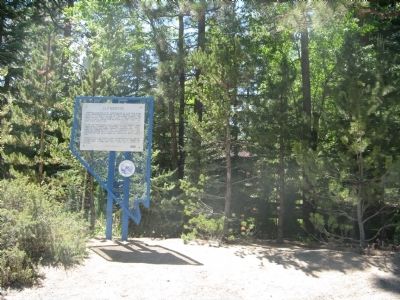
2. Glenbrook Marker
Historic American Engineering Record (Library of Congress)
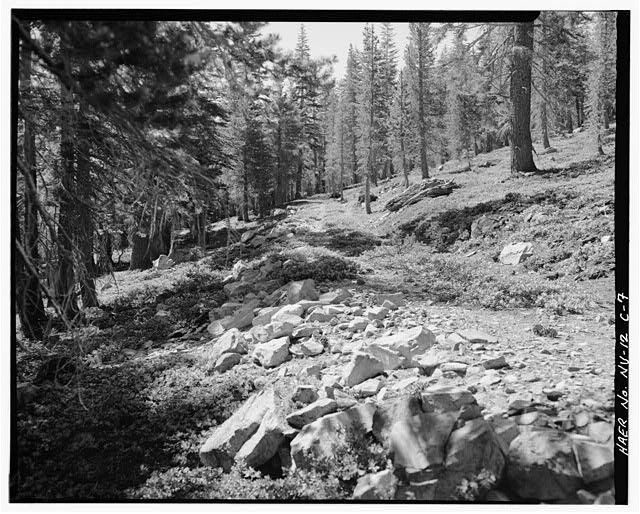
3. View of Rock Alignment on Spur Road
Survey number HAER NV-12-C
Building/structure dates: 1869 initial construction.
Significance: The Genoa Peak Road spur segments were part of a major log transport network associated with the Comstock mining era. This secondary spur segment once interconnected with an elaborate network of primary and lesser skid roads. The network was the main arterial system for wood transport to Spooner Summit, the key lumberyard for the C&TL&F Co. The period of significance for this lumbering activity is 1873-1898. The spur road has retained its integrity and its overall character as a 19th century Comstock-era haul road.
Click for more information.
Building/structure dates: 1869 initial construction.
Significance: The Genoa Peak Road spur segments were part of a major log transport network associated with the Comstock mining era. This secondary spur segment once interconnected with an elaborate network of primary and lesser skid roads. The network was the main arterial system for wood transport to Spooner Summit, the key lumberyard for the C&TL&F Co. The period of significance for this lumbering activity is 1873-1898. The spur road has retained its integrity and its overall character as a 19th century Comstock-era haul road.
Click for more information.
Credits. This page was last revised on October 25, 2020. It was originally submitted on July 22, 2009, by Syd Whittle of Mesa, Arizona. This page has been viewed 3,759 times since then and 60 times this year. Photos: 1, 2, 3. submitted on July 22, 2009, by Syd Whittle of Mesa, Arizona.
