Damascus in Washington County, Virginia — The American South (Mid-Atlantic)
Transition from Rail to Trail
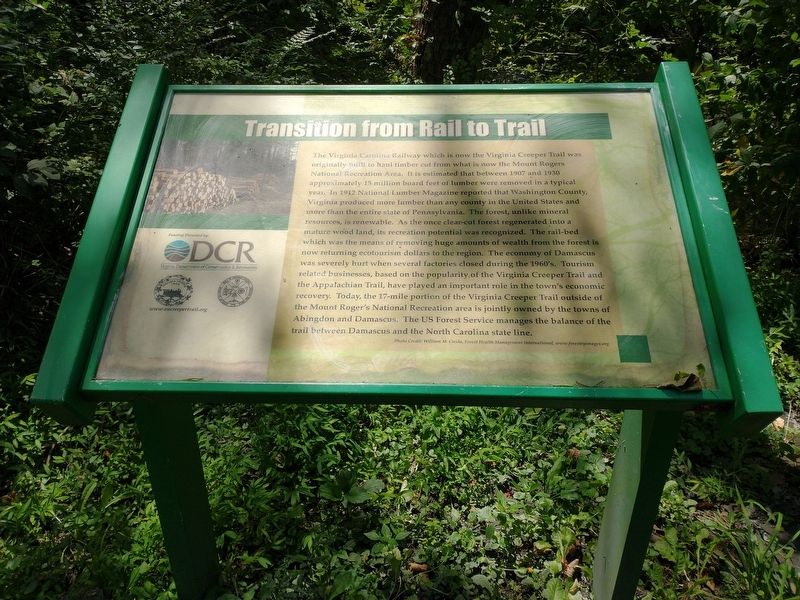
Photographed by Tom Bosse, September 3, 2022
1. Transition from Rail to Trail Marker
this page online
Erected by Virginia Department of Conservation & Recreation.
Topics. This historical marker is listed in these topic lists: Industry & Commerce • Parks & Recreational Areas • Railroads & Streetcars. A significant historical year for this entry is 1907.
Location. 36° 37.773′ N, 81° 46.714′ W. Marker is in Damascus, Virginia, in Washington County. It is on Virginia Creeper National Recreation Trail west of Mountain View Drive, on the left when traveling west. Touch for map. Marker is in this post office area: Damascus VA 24236, United States of America. Touch for directions.

Regionally, this marker is in the Tri-Cities Area, in Southwest Virginia, and in the Blue Ridge Highlands. It is also in the American South, specifically in the Upper South, in Appalachia, and specifically in Southern Appalachia. Globally, it is in North America, the Western Hemisphere, the Western World, and the Anglosphere. Historically, it finds itself in what was once the territory
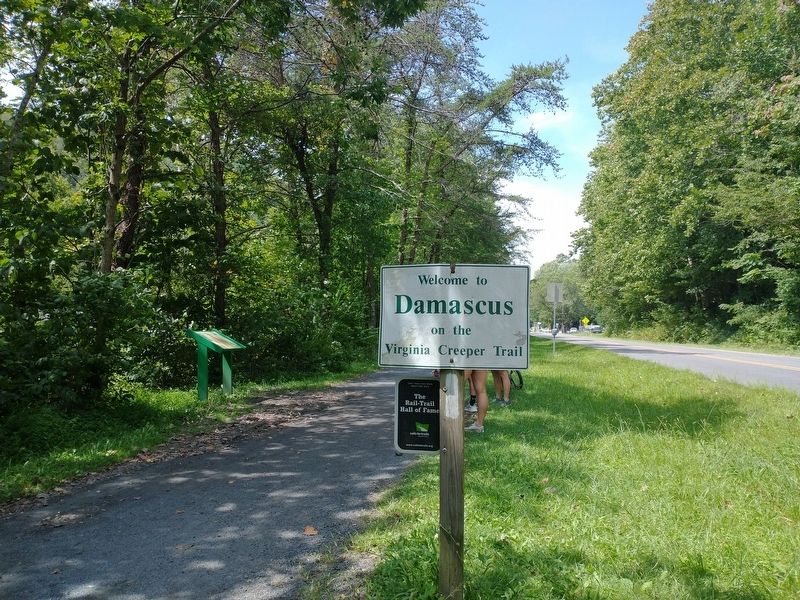
Photographed by Tom Bosse, September 3, 2022
2. Transition from Rail to Trail Marker
Other nearby markers. At least 8 other markers are within walking distance of this marker: Legion Island (approx. half a mile away); Virginia Creeper Trail (approx. 0.6 miles away); Churches of Damascus (approx. 0.7 miles away); Damascus Presbyterian Church (approx. 0.7 miles away); Electricity Comes to Damascus (approx. ¾ mile away); Damascus Old Mill (approx. ¾ mile away); Laurel Avenue, The Main Street of Damascus (approx. 0.8 miles away); Founders of Damascus (approx. 0.8 miles away). Touch for a list and map of all markers in Damascus.
Also see . . . The Virginia Creeper National Recreation Trail. (Submitted on November 23, 2022.)
Credits. This page was last revised on February 2, 2023. It was originally submitted on November 22, 2022, by Tom Bosse of Jefferson City, Tennessee. This page has been viewed 215 times since then and 17 times this year. Photos: 1, 2. submitted on November 22, 2022, by Tom Bosse of Jefferson City, Tennessee. • Bernard Fisher was the editor who published this page.
