
Faribault in Rice County, Minnesota — The American Midwest (Upper Plains)
Flour Milling & Woolen Milling

Photographed by Cosmos Mariner, September 3, 2022
1. Flour Milling & Woolen Milling Marker (left panel)
Flour Milling
Milling industry icons life LaCroix, Sheffield, and Bean took advantage of the waterpower, abundant timber and fertile soil to establish a milling center in Faribault. LaCroix's Middling Purifier and the New Process style of milling tinkered with here helped revolutionize flour milling around the world.
Woolen Milling
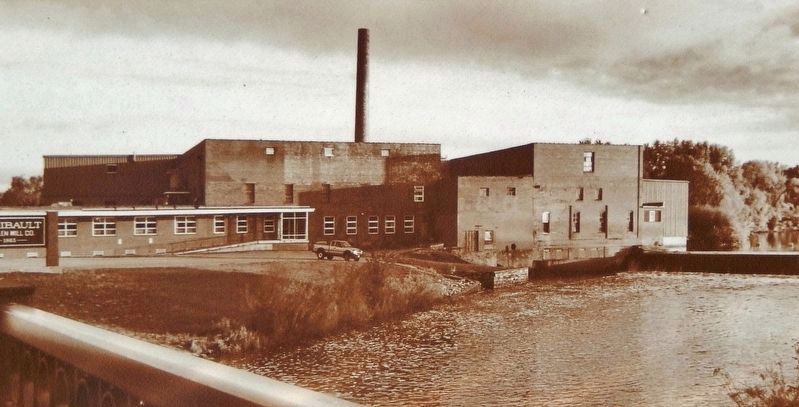
Led initially by German ingenuity, the Faribault Woolen Mill owes its longevity to a loyal workforce, superior products, and conservative growth. To date, the mill has been credited with numerous innovations like the washable wool blanket, mothproofing, and blending of wool with other fibers.
Topics. This historical marker is listed in this topic list: Industry & Commerce.
Location. 44° 17.761′ N, 93° 16.099′ W. Marker is in Faribault, Minnesota, in Rice County. It is at the intersection of 5th Street Northeast and Central Avenue North, on the right when traveling west on 5th Street Northeast. Marker is mounted on a bench at the northeast corner of the intersection. Touch for map. Marker is in this post office area: Faribault MN 55021, United States
this page online

Regionally, this marker is in Southeast Minnesota. It is also in the American Midwest and in the Corn Belt. Globally, it is in North America, the Western Hemisphere, the Western World, and the Anglosphere. Historically, it finds itself in what was once Rupert’s Land, the territory of the Mississippian Culture, and the Louisiana Purchase.
Other nearby markers. At least 8 other markers are within walking distance of this marker: Minnesota State Academy for the Deaf (a few steps from this marker); The Faribault Fur Trade (within shouting distance of this marker); Downtown Faribault 1888 (within shouting distance of this marker); Ochs Building (within shouting distance of this marker); Seabury Divinity School & Taopi "Wounded Man" (about 300 feet away, measured in a direct line); Faribault Riverfront 1880 (about 300 feet away); KDHL Radio (about 300 feet away); Faribault Supports the Military (about 400 feet away). Touch for a list and map of all markers in Faribault.
Also see . . .
1. Cannon Valley Mills of Minnesota.
In the early 1860’s, Edmund and Nicholas LaCroix built a Middling(Submitted on December 10, 2022, by Cosmos Mariner of Cape Canaveral, Florida.)Purifier prototype which would single-handedly revolutionize the world’s flour milling industry by creating a demand for local wheat which was notoriously difficult to process decent flour from. Cannon Valley millers were quick to adopt the new invention as it fit into their “New Process” method they had perfected. This new way of milling made superior flour out of the despised Minnesota spring wheat, and the smooth white product made many more loaves of bread per barrel, and topped all others in price on the New York and London Stock Exchanges for a period of time.Photographed by Cosmos Mariner, September 3, 20222. Flour Milling & Woolen Milling Marker (right panel)

2. Faribault Mill — Our Story.
In 1865, Carl H. Klemer created what would ultimately become the Faribault Woolen Mill Company. The original horse powered mill initially operated as a wool carding factory, turning local wool into wool batting. Faribault Mill endures as one of the last vertical woolen mills in America. Here, fifth generation craftspeople take raw wool and create blankets, throws, scarves and accessories of remarkable comfort and quality. Irreplaceable century-old machinery(Submitted on December 10, 2022, by Cosmos Mariner of Cape Canaveral, Florida.)stands side by side with modern technology in our "new" mill, which was built in 1892. 3. Marker detail: LaCroix Mill 1866

4. Marker detail: Sheffield Mill 1895
Photographed by Cosmos Mariner
5. Marker detail: Faribault Woolen Mill 1865

Photographed by Cosmos Mariner, September 3, 2022
6. Flour Milling & Woolen Milling Bench
Credits. This page was last revised on December 10, 2022. It was originally submitted on December 9, 2022, by Cosmos Mariner of Cape Canaveral, Florida. This page has been viewed 424 times since then and 22 times this year. Photos: 1, 2, 3, 4, 5, 6. submitted on December 10, 2022, by Cosmos Mariner of Cape Canaveral, Florida.
