Parris Island in Beaufort County, South Carolina — The American South (South Atlantic)
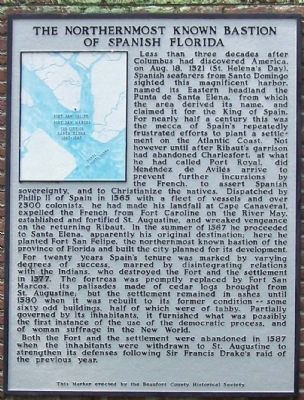
Northern Most Known Bastion of Spanish Florida
Photographed by Mike Stroud, June 26, 2009
1. Northern Most Known Bastion of Spanish Florida Marker
this page online
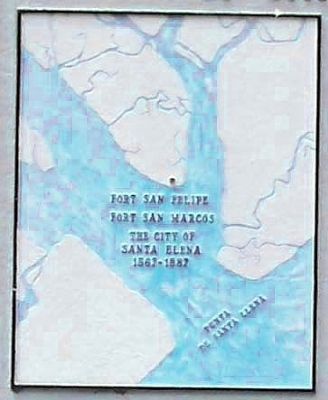
For twenty years Spain's tenure was marked by varying degrees of success, marred by disintegrating relations with the Indians, who destroyed the Fort and the settlement in 1577. The fortress was promptly replaced by Fort San Marcos, its palisades made of cedar logs brought from St. Augustine; but the settlement remained in ashes until 1580 when it was rebuilt to its former condition - - some sixty odd buildings, half of which were tabby. Partially governed by its inhabitants, it furnished what was possibly the first instance of the use of the democratic process, and of woman suffrage in the New World.
Both the Fort and the settlement were abandoned in 1587 when the inhabitants were withdrawn to St. Augustine to strengthen its defenses following Sir Francis Drake's raid of the previous year.
Erected by Beaufort County Historical Society.
Topics and series. This historical marker is listed in these topic lists: Exploration • Forts and Castles • Settlements & Settlers. In addition, it is included in the South Carolina, Beaufort County Historical Society series list. A significant historical date for this entry is August 18, 1521.
Location. 32° 18.381′ N,
Photographed by Northern Most Known Bastion Marker, June 26, 2009
2. Northern Most Known Bastion of Spanish Florida Marker

Regionally, this marker is in the Lowcountry and on the Sea Islands. It is also in the American South, specifically in the Deep South, and on the Eastern Seaboard. Globally, it is in the North Atlantic Region, North America, the Western Hemisphere, the Western World, and the Anglosphere. Historically, it finds itself in what was once New Spain, the territory of the Mississippian Culture, one of the original Thirteen Colonies, one of the Confederate States of America, and the Antebellum South.
Other nearby markers. At least 8 other markers are within walking distance of this marker: Charlesfort-Santa Elena Site (a few steps from this marker); Fort San Marcos & The Ribaut Monument (a few steps from this marker); Fort San Marcos (a few steps from this marker); Jean Ribault Monument (a few steps from this marker);
Photographed by Mike Stroud, June 26, 2009
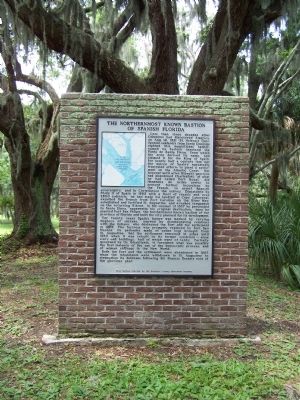
3. Northern Most Known Bastion of Spanish Florida Marker
Photographed by Mike Stroud, June 26, 2008
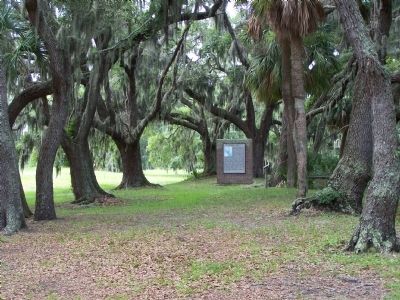
4. Northern Most Known Bastion of Spanish Florida Marker
seen at north hiking trail, from Balleau Wood Rd. Circle
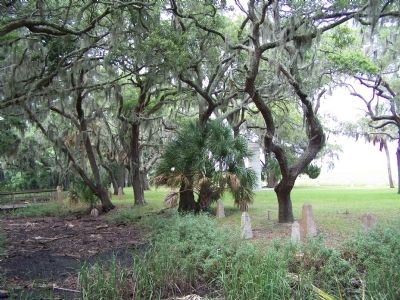
Photographed by Mike Stroud, June 26, 2008
5. Marked area of known Fort Marcos
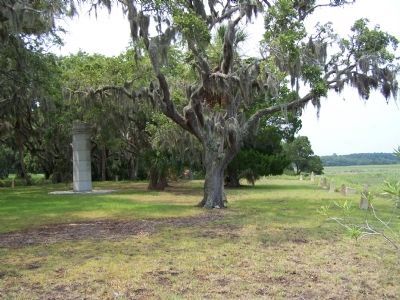
Photographed by Mike Stroud, June 26, 2009
6. partial outline of Fort Marcos marked by pylons
French Memorial at left
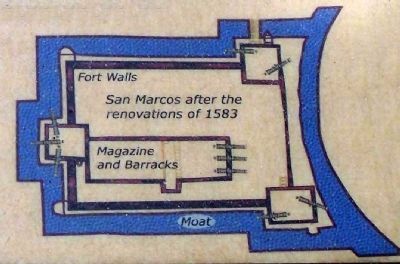
Photographed by Mike Stroud, June 26, 2009
7. San Marcos
Credits. This page was last revised on June 16, 2016. It was originally submitted on July 30, 2009, by Mike Stroud of Bluffton, South Carolina. This page has been viewed 2,122 times since then and 293 times this year. Photos: 1, 2, 3, 4, 5, 6, 7. submitted on July 30, 2009, by Mike Stroud of Bluffton, South Carolina. • Craig Swain was the editor who published this page.
