Clear Lake City in Houston in Harris County, Texas — The American South (West South Central)
Mercury-Redstone: Putting the First Americans in Space
Photographed by J. Makali Bruton, October 5, 2019
1. Mercury-Redstone: Putting the First Americans in Space Marker
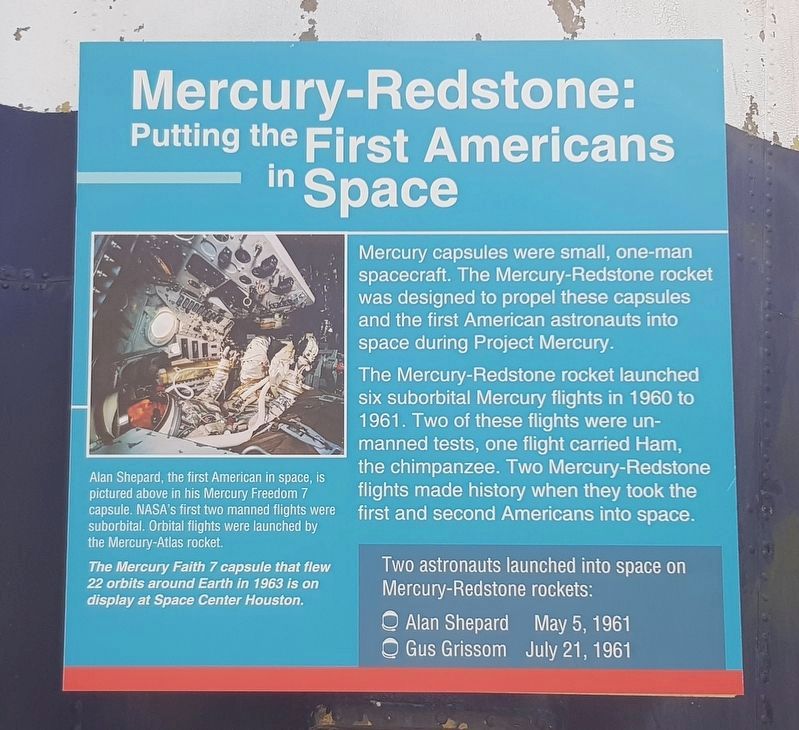
Mercury-Redstone: Putting the First Americans in Space
Mercury capsules were small, one-man spacecraft. The Mercury-Redstone rocket was designed to propel these capsules and the first American astronauts into space during Project Mercury.
The Mercury-Redstone rocket launched six suborbital Mercury flights in 1960 to 1961. Two of these flights were un-manned tests, one flight carried Ham, the chimpanzee. Two Mercury-Redstone flights made history when they took the first and second Americans into space.
Alan Shepard, the first American in space, is pictured above in his Mercury Freedom 7 capsule. NASA's first two manned flights were suborbital. Orbital flights were launched by the Mercury-Atlas rocket.
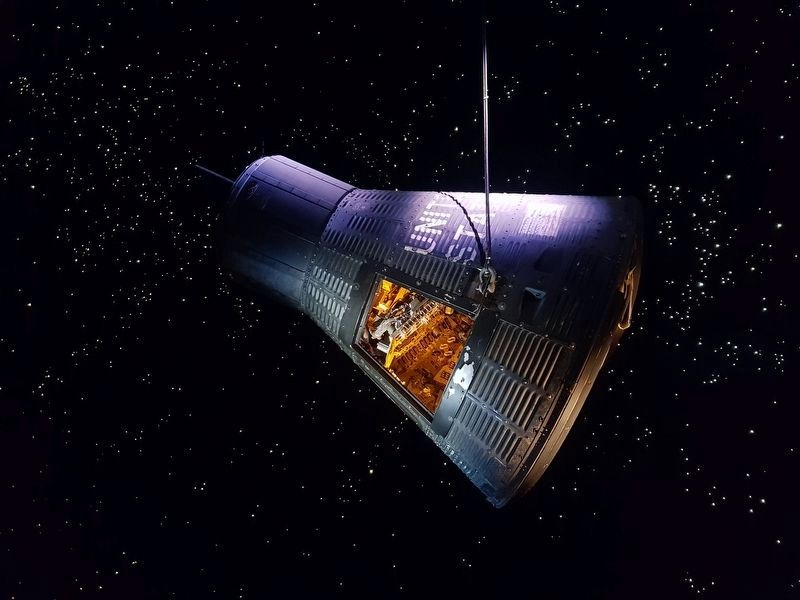
The Mercury Faith 7 capsule that flew 22 orbits around Earth in 1963 is on display at Space Center Houston.5
Two astronauts launched into space on Mercury-Redstone rockets:
Alan Shepard May 5, 1961
Gus Grissom July 21, 1961
Topics. This historical marker is listed in this topic list: Air & Space.
Location. 29° 33.271′ N, 95° 5.623′ W. Marker is in Houston, Texas, in Harris County.
this page online

Regionally, this marker is in the American South and on the Gulf Coast. Globally, it is in North America, a Gulf of Mexico state, the Western Hemisphere, the Western World, and the Anglosphere. Historically, it finds itself in what was once New Spain, the Republic of Texas, one of the Confederate States of America, and the Antebellum South.
Other nearby markers. At least 8 other markers are within walking distance of this marker: F-1 Engine: Power for the Rocket (here, next to this marker); J-2 Engine: Versatile Sidekick (here, next to this marker); H-1 Engine: A Powerful Start (a few steps from this marker); Little Joe II (a few steps from this marker); Little Joe II and BP-22: Safety First (a few steps from this marker); Saturn V Rocket (about 400 feet away, measured
Photographed by Michael Herrick, March 31, 2017
2. The previous Mercury-Redstone Marker
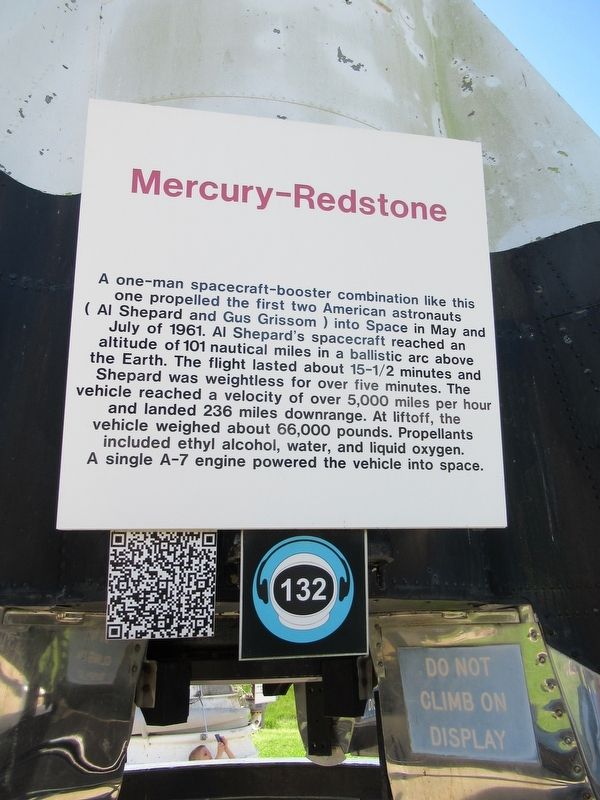
This previous marker read:
A one-man spacecraft-booster combination like this one propelled the first two American astronauts (Al Shepard and Gus Grissom) into Space in May and July of 1961. Al Shepard's spacecraft reached an altitude of 101 nautical miles in a ballistic arc above the Earth. The flight lasted about 15-1/2 minutes and Shepard was weightless for over five minutes. The vehicle reached a velocity of over 5,000 miles per hour and landed 236 miles downrange. At liftoff, the vehicle weighed about 66,000 pounds. Propellants included ethyl alcohol, water, and liquid oxygen. A single A-7 engine powered the vehicle into space.
A one-man spacecraft-booster combination like this one propelled the first two American astronauts (Al Shepard and Gus Grissom) into Space in May and July of 1961. Al Shepard's spacecraft reached an altitude of 101 nautical miles in a ballistic arc above the Earth. The flight lasted about 15-1/2 minutes and Shepard was weightless for over five minutes. The vehicle reached a velocity of over 5,000 miles per hour and landed 236 miles downrange. At liftoff, the vehicle weighed about 66,000 pounds. Propellants included ethyl alcohol, water, and liquid oxygen. A single A-7 engine powered the vehicle into space.
More about this marker. This marker is in Rocket Park on the grounds of the Johnson Space Center. Rocket Park and this marker are open to the public through paid access to the Space Center Houston.
Also see . . . NASA Johnson Space Flight Center. (Submitted on April 12, 2017, by Michael Herrick of Southbury, Connecticut.)
Photographed by Michael Herrick, March 31, 2017
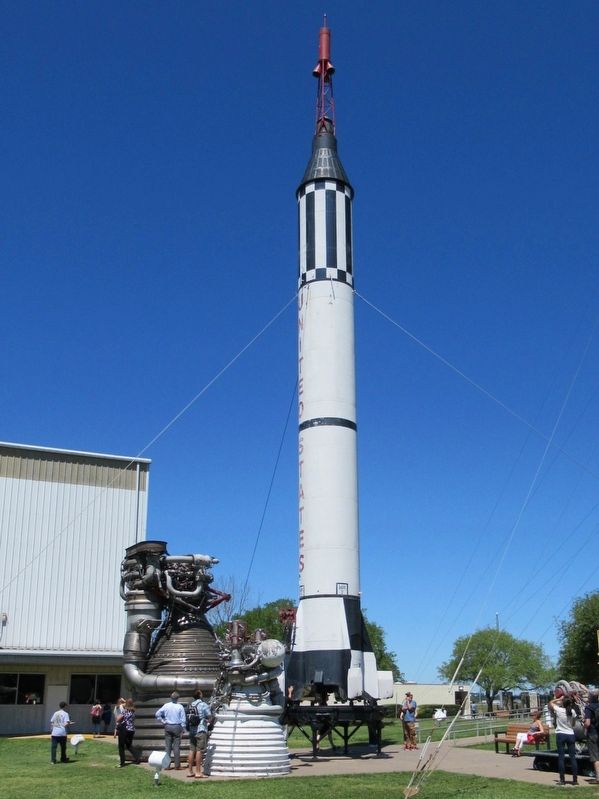
3. Mercury-Redstone Rocket
Photographed by J. Makali Bruton, October 5, 2019
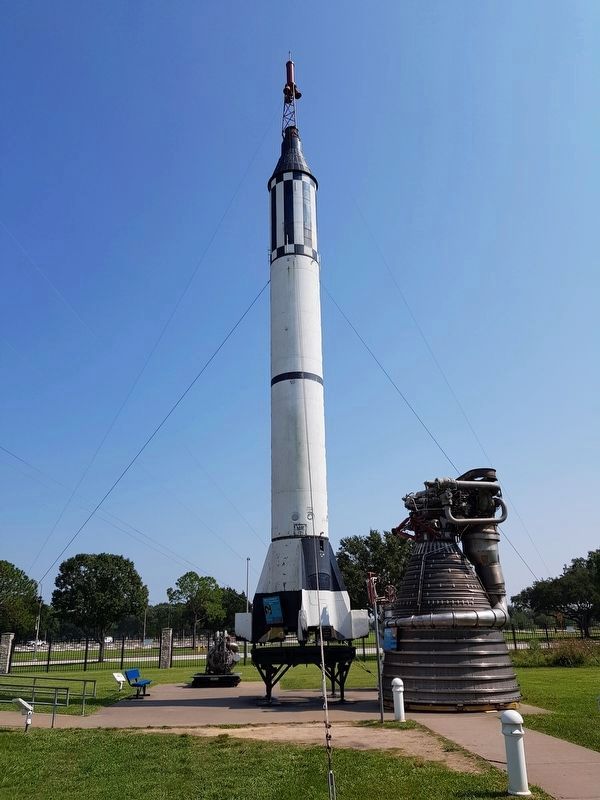
4. Mercury-Redstone: Putting the First Americans in Space Marker
Note the marker on the rocket's base in this view.
Photographed by J. Makali Bruton, October 5, 2019
5. The Mercury Faith 7 (MA-9) capsule at NASA Johnson Space Center
Credits. This page was last revised on February 1, 2023. It was originally submitted on April 12, 2017, by Michael Herrick of Southbury, Connecticut. This page has been viewed 1,048 times since then and 58 times this year. Last updated on December 21, 2022, by Carl Gordon Moore Jr. of North East, Maryland. Photos: 1. submitted on October 17, 2019, by J. Makali Bruton of Washington, District of Columbia. 2, 3. submitted on April 12, 2017, by Michael Herrick of Southbury, Connecticut. 4, 5. submitted on October 17, 2019, by J. Makali Bruton of Washington, District of Columbia. • J. Makali Bruton was the editor who published this page.
