Bos en Lommer in Amsterdam, North Holland, Netherlands — Northwestern Europe
Hendrik Conscience: De Leeuw van Vlaanderen
⎯⎯⎯
The Lion of Flanders
Photographed by Andrew Ruppenstein, November 1, 2022
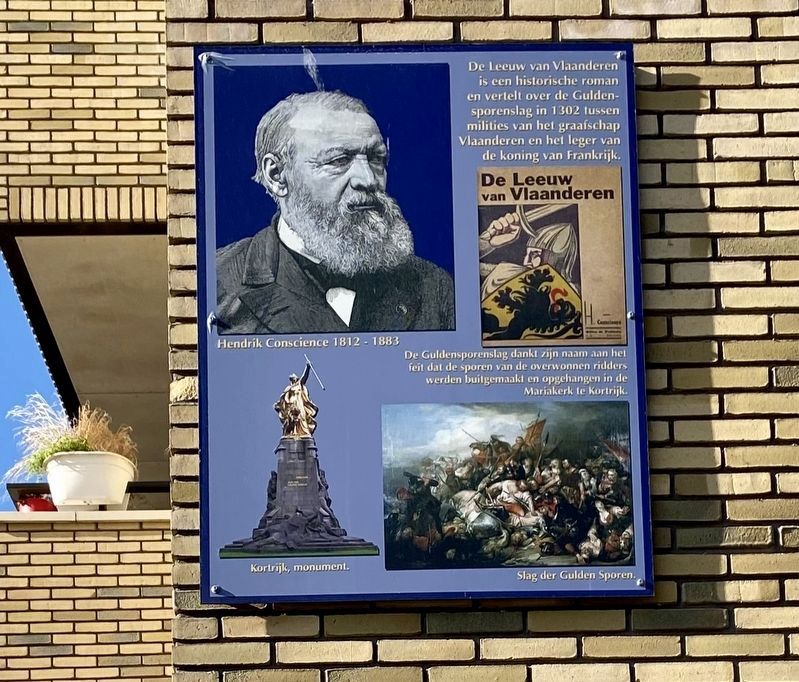
1. Hendrik Conscience: De Leeuw van Vlaanderen / The Lion from Flanders Marker

De Leeuw van Vlaanderen is een historische roman en vertelt over de Gulden- sporenslag in 1302 tussen milities van het graafschap Vlaanderen en het leger van de koning van Frankrijk.
De Guldensporenslag dankt zijn naam aan het feit dat de sporen van de overwonnen ridders werden buitgemaakt en opgehangen in de Mariakerk te Kortrijk.
The Lion of Flanders is a historical novel and tells of the Battle of the Golden Spurs in 1302 between militiamen from the County of Flanders and the army of the King of France.
(Main caption:)
The Battle of the Golden Spurs owes its name to the fact that the spurs of the vanquished knights were captured and hung in the Mariakerk in Kortrijk.
Erected by Geef Straten Een Gezicht.
Topics and series. This historical marker is listed in these topic lists: Arts, Letters, Music • Entertainment. In addition, it is included in the Dutch Literature (GSEG), and the Give Streets a Face / Geef Straten Een Gezicht series lists.
Location. 52° 22.555′ N, 4° 50.526′ E. Marker is in Amsterdam,
this page online

Regionally, it is in Europe, the European Union, Atlantic Europe, the Benelux Low Countries, the Schengen Area, Western Europe, and the Western World. Historically, it finds itself in what was once the Holy Roman Empire.
Other nearby markers. At least 8 other markers are within walking distance of this marker: Hendrik Conscience: Jacob van Artevelde (about 90 meters away, measured in a direct line); Anton Bergmann: Ernest Staas (about 120 meters away); Fanny Blankers-Koen (about 150 meters away); Erasmus (about 150 meters away); James Clark Ross (about 150 meters away); Bep Bakhuys (about 180 meters away); Eduard Douwes Dekker: Woutertje Pieterse / Little Walter Pieterse (about 210 meters away); Albrecht Rodenbach: De Blauwvoet (about 210 meters away). Touch for a list and map

Photographed by Andrew Ruppenstein, November 1, 2022
2. The Lion of Flanders Marker - wide view
Also see . . .
1. Hendrik Conscience (Wikipedia).
Excerpt: Henri (Hendrik) Conscience (3 December 1812 – 10 September 1883) was a Belgian author. He is considered the pioneer of Dutch-language literature in Flanders, writing at a time when Belgium was dominated by the French language among the upper classes, in literature and government. Conscience fought as a Belgian revolutionary in 1830 and was a notable writer in the Romanticist style popular in the early 19th century. He is best known for his romantic nationalist novel, The Lion of Flanders (1838), inspired by the victory of a Flemish peasant militia over French knights at the 1302 Battle of the Golden Spurs during the Franco-Flemish War.(Submitted on December 24, 2022.)
2. The Lion of Flanders (novel) (Wikipedia).
Excerpt: The Lion of Flanders, or the Battle of the Golden Spurs (Dutch: De Leeuw van Vlaenderen, of de Slag der Gulden Sporen) is a major novel first published in 1838 by the Belgian writer Hendrik Conscience (1812–1883) and is an early example of historical fiction. The book focuses on the medieval Franco-Flemish(Submitted on December 24, 2022.)War and the Battle of the Golden Spurs of 1302 in particular. It is written in Conscience's typical stylistic romanticism and has been described as the "Flemish national epic". Unusually for its time, The Lion of Flanders was written in Dutch. It is considered one of the founding texts of Flemish literature and became a significant work for the emerging Flemish Movement, reviving popular interest in the Battle of the Golden Spurs and Flemish medieval history as part of a modern political agenda. Despite its importance, the work has become little-read in modern times. It has nonetheless been the subject of various adaptations, including several cartoons, a television series, and a film.Photographed by Andrew Ruppenstein, November 1, 20223. The Lion of Flanders Marker - wider view

Credits. This page was last revised on December 31, 2023. It was originally submitted on December 24, 2022, by Andrew Ruppenstein of Lamorinda, California. This page has been viewed 331 times since then and 24 times this year. Photos: 1, 2, 3. submitted on December 24, 2022, by Andrew Ruppenstein of Lamorinda, California.
