New Braunfels in Comal County, Texas — The American South (West South Central)
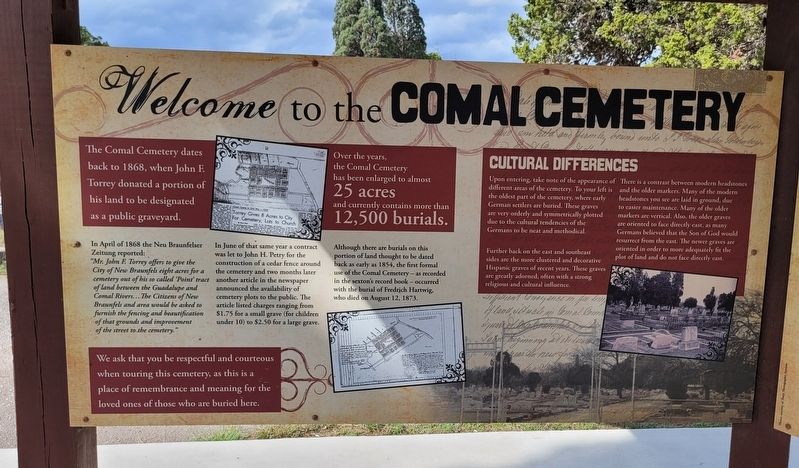
Welcome to the Comal Cemetery
Photographed by James Hulse, November 9, 2022
1. Welcome to the Comal Cemetery Marker
In April of 1868 the Neu Braunfelser Zeitung reported:
"Mr. John F. Torrey offers to give the City of New Braunfels eight acres for a cemetery out of his so called 'Point' tract of land between the Guadalupe and Comal Rivers... The Citizens of New Braunfels and area would be asked to furnish the fencing and beautification of that grounds and improvement of the street to the cemetery."
In June of that same year a contract was let to John H. Petry for the construction of a cedar fence around the cemetery and two months later another article in the newspaper announced the availability of cemetery plots to the public. The article listed charges ranging from $1.75 for a small grave (for children under 10) to $2.50 for a large grave.
Although there are burials on this portion of land thought to be dated back as early as 1854, the first formal use of the Comal Cemetery
this page online
Cultural Differences
Upon entering, take note of the appearance of different areas of the cemetery. To your left is the oldest part of the cemetery, where early German settlers are buried. These graves are very orderly and symmetrically plotted due to the cultural tendencies of the Germans to be neat and methodical.
Further back on the east and southeast sides are the more clustered and decorative Hispanic graves of recent years. These graves are greatly adorned, often with a strong religious and cultural influence.
There is a contrast between modern headstones and the older markers. Many of the modern headstones you see are laid in ground, due to easier maintenance. Many of the older markers are vertical. Also, the older graves are oriented to face directly east, as many Germans believed that the Son of God would resurrect from the east. The newer graves are oriented in order to more adequately fit the plot of land and do not face directly east.
We ask that you be respectful and courteous when touring this
Photographed by James Hulse, November 9, 2022
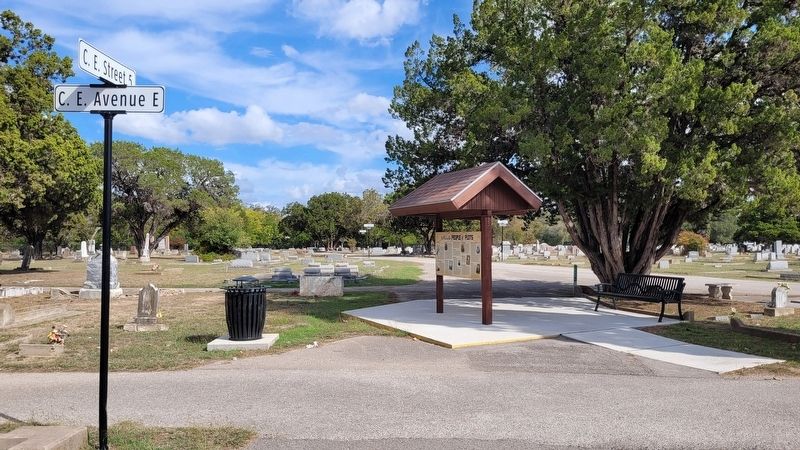
2. The reverse side of the Welcome to the Comal Cemetery Marker
Topics. This historical marker is listed in this topic list: Cemeteries & Burial Sites. A significant historical year for this entry is 1868.
Location. 29° 42.797′ N, 98° 6.538′ W. Marker is in New Braunfels, Texas, in Comal County. It is at the intersection of Peace Avenue and Dittlinger Street, on the left when traveling south on Peace Avenue. The marker is located in the central section of the cemetery. Touch for map. Marker is at or near this postal address: 301 Peace Avenue, New Braunfels TX 78130, United States of America. Touch for directions.

Regionally, this marker is in the Hill Country and in the San Antonio Metropolitan Area. It is also in the American South. Globally, it is in North America, a Gulf of Mexico state, the Western Hemisphere, the Western World, and the Anglosphere. Historically, it finds itself in what was once New Spain, the Republic of Texas, and one of the Confederate States of America.
Other nearby markers. At least 8 other markers are within walking distance of this marker: Notable People & Plots (here, next to this marker); Comal Cemetery (here, next to this marker); Heinrich Mordhorst (within shouting distance of this marker); Ferdinand J. Lindheimer (about 300 feet away, measured in a direct line); Ferdinand Jacob Lindheimer (about 300 feet away); Panteón Hidalgo (Hidalgo Cemetery) (about 400 feet away); Our Lady of Perpetual Help Cemetery (about 500 feet away); Cypress Bend Park (approx. 0.2 miles away). Touch for a list and map of all markers in New Braunfels.
Credits. This page was last revised on December 29, 2022. It was originally submitted on December 28, 2022, by James Hulse of Medina, Texas. This page has been viewed 633 times since then and 82 times this year. Photos: 1, 2. submitted on December 29, 2022, by James Hulse of Medina, Texas.
