Wieden in Wien, Austria — Central Europe (Eastern Alps)
Rudolf Kassner
Photographed by Andrew Ruppenstein, November 10, 2023
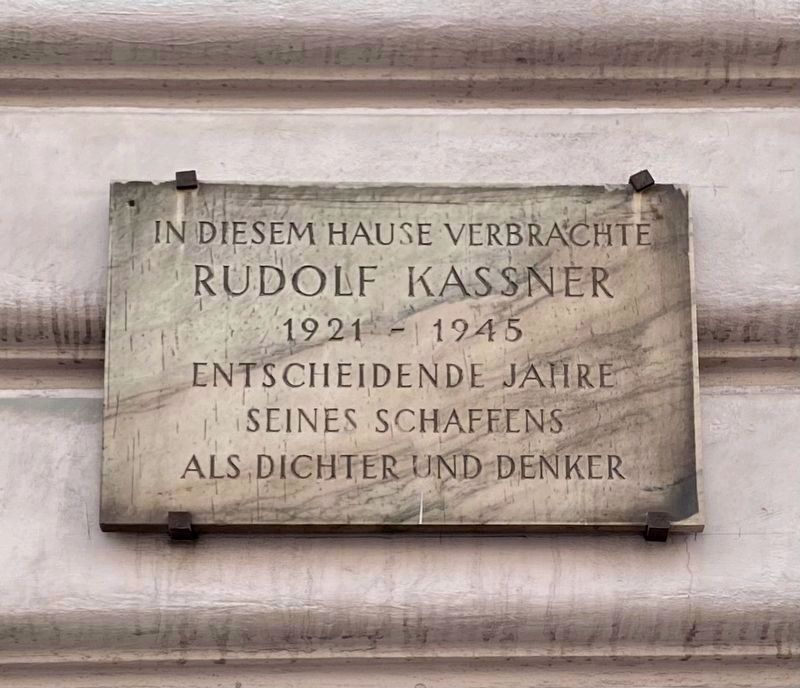
1. Rudolf Kassner Marker

Rudolf Kassner
1921-1945
entscheidende Jahre
seines Schaffens
als Dichter und Denker
In this house from 1921 to 1945 lived Rudolph Kassner, a time that was crucial to his work as a poet and thinker.
Topics. This historical marker is listed in this topic list: Arts, Letters, Music.
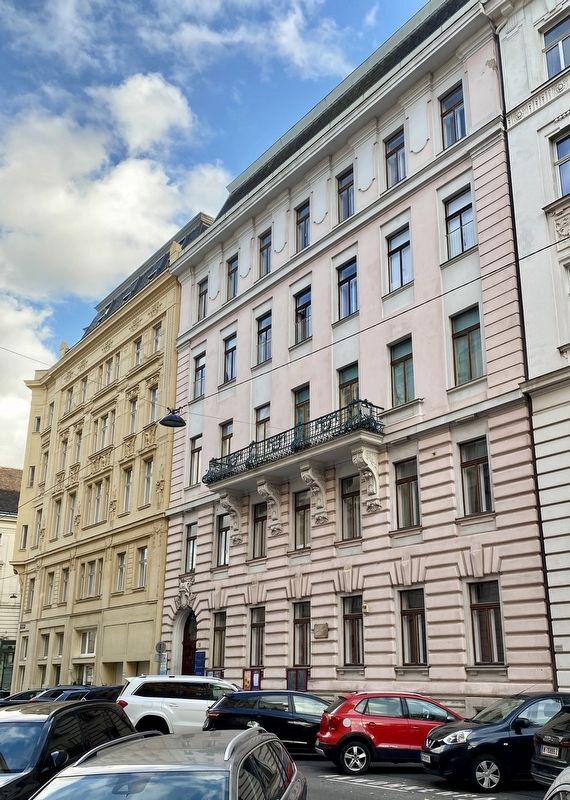
Location. 48° 11.622′ N, 16° 22.189′ E. Marker is in Wien. It is in Wieden. It is on Tilgnerstraße west of Favoritenstraße, on the right when traveling east. Touch for map. Marker is at or near this postal address: Tilgnerstraße 3, Wien 1040, Austria. Touch for directions.

Regionally, it is in Europe, the European Union, Central Europe, the Schengen Area, Western Europe, and the Western World. Historically, it finds itself in what was once the Roman Empire and specifically also the Holy Roman Empire.
Other nearby markers. At least 8 other markers are within walking distance of this marker: Jean Sibelius (about 240 meters away, measured in a direct line); Albert Lortzing (approx. 0.2 kilometers away); Veterinärmedizinische Universität Wien / University of Veterinary Medicine of Vienna
this page online
Also see . . . Rudolf Kassner (Wikipedia).
Excerpt: Rudolf Kassner (11 September 1873 Velké Pavlovice – 1 April 1959 Sierre Switzerland) was an Austrian writer, essayist, translator and cultural philosopher. Although stricken as an infant with poliomyelitis, Kassner traveled widely to northern Africa, the Sahara, India, Russia, Spain, and throughout Europe. His translations of William Blake introduced this English romantic poet to German-speaking audiences. His literary career covered six decades, including a period of isolation during the Nazi years in Vienna. His writings on physiognomy reflect his effort to understand the problems of modernity and Man's subsequent disconnectedness from time and place. His later autobiographical writings suggest a brilliant literary mind(Submitted on January 1, 2023.)attempting to make sense of a chaotic post-nuclear world. He was nominated for the Nobel prize for literature thirteen times.Photographed by Andrew Ruppenstein, November 10, 20232. Rudolf Kassner Marker - wide view
Credits. This page was last revised on January 1, 2023. It was originally submitted on January 1, 2023, by Andrew Ruppenstein of Lamorinda, California. This page has been viewed 207 times since then and 27 times this year. Photos: 1, 2. submitted on January 1, 2023, by Andrew Ruppenstein of Lamorinda, California.
