Wieden in Wien, Austria — Central Europe (Eastern Alps)
Josef Frank (1885–1967)
Photographed by Andrew Ruppenstein, November 9, 2022
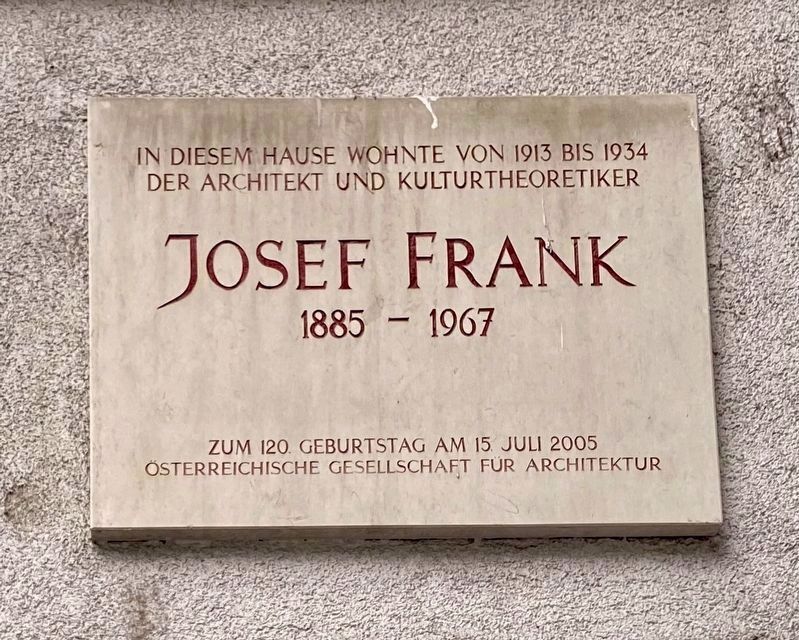
1. Josef Frank (1885-1967) Marker

In diesem Hause wohnte von 1913 bis 1934 der Architekt und Kulturtheoretiker
Josef Frank
1885 - 1967
(English translation:)
In this building from 1913 until 1934 lived the architect and cultural theoretician Josef Frank (1885-1967).
Erected 2005 by Österreichische Gesellschaft für Architektur.
Topics. This historical marker is listed in these topic lists: Architecture • Arts, Letters, Music. A significant historical year for this entry is 1913.
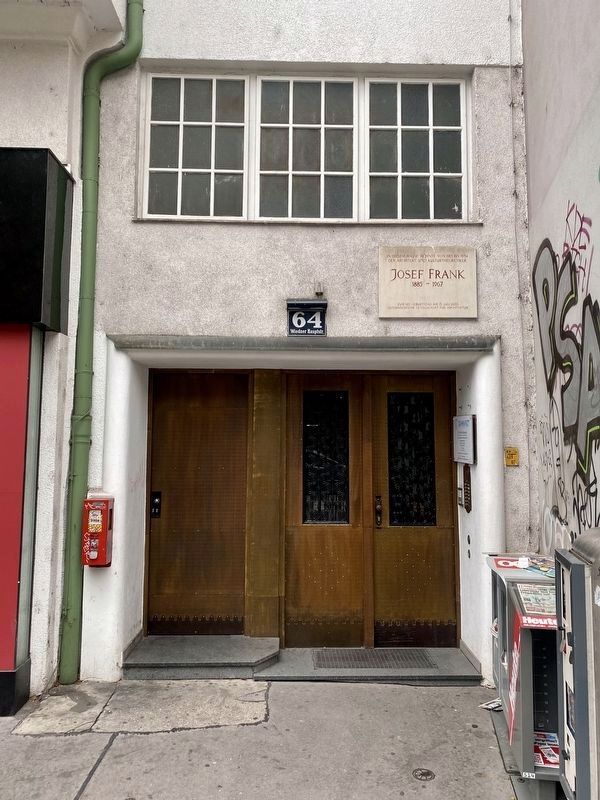
Location. 48° 11.433′ N, 16° 21.979′ E. Marker is in Wien. It is in Wieden. It is on Wiedner Hauptstraße. Touch for map. Marker is at or near this postal address: Wiedner Hauptstraße 64, Wien 1040, Austria. Touch for directions.

Regionally, it is in Europe, the European Union, Central Europe, the Schengen Area, Western Europe, and the Western World. Historically, it finds itself in what was once the Roman Empire and specifically also the Holy Roman Empire.
Other nearby markers. At least 8 other markers are within walking distance of this marker: Sir Josef Edgar Böhm (about 90 meters away, measured in a direct line); Pater Joseph Misson (approx.
this page online
Also see . . .
1. Josef Frank (architect) (Wikipedia).
Excerpt: Josef Frank (July 15, 1885 – January 8, 1967) was an Austrian-born architect, artist, and designer who adopted Swedish citizenship in the latter half of his life. Together with Oskar Strnad, he created the Vienna School of Architecture, and its concept of Modern houses, housing and interiors.(Submitted on January 2, 2023.)
2. A Look Back at the Fanciful Fabrics of Josef Frank (Architectural Digest, 12/14/2016).
Excerpt: Josef Frank, the Austrian-born Swedish architect and designer, never believed that a house was a machine for living. “It doesn’t matter if you mix old and new, or different styles, colors, and patterns,” he advised in 1958. “The things you like will always blend,(Submitted on January 2, 2023.)by themselves, into a peaceful whole.” Though not a star like Le Corbusier or Mies van der Rohe, Frank thrilled with his furniture, lighting, and textiles for Stockholm retailer Svenskt Tenn. But it’s the fabrics…that have won him cult status. “The freer the pattern, the better,” Frank said of his high-wire creations, dense with flowers, fruits, birds, mountains, and waterways in surreal color combinations.Photographed by Andrew Ruppenstein, November 9, 20222. Josef Frank (1885–1967) Marker - wide view
Photographed by Andrew Ruppenstein, November 9, 2022
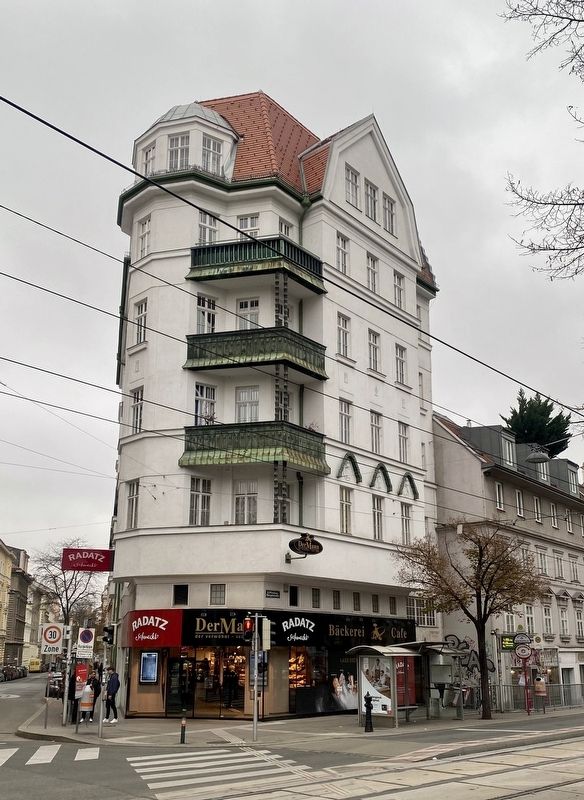
3. Josef Frank (1885–1967) Marker - wider view
The marker is (barely) visible here just to the right of the word “cafe” on the sign on the building.
Credits. This page was last revised on January 2, 2023. It was originally submitted on January 2, 2023, by Andrew Ruppenstein of Lamorinda, California. This page has been viewed 109 times since then and 6 times this year. Photos: 1, 2, 3. submitted on January 2, 2023, by Andrew Ruppenstein of Lamorinda, California.
