Near Elba in Winona County, Minnesota — The American Midwest (Upper Plains)
Geology of Minnesota
Whitewater State Park
November 13, 2022
1. Geology of Minnesota Marker
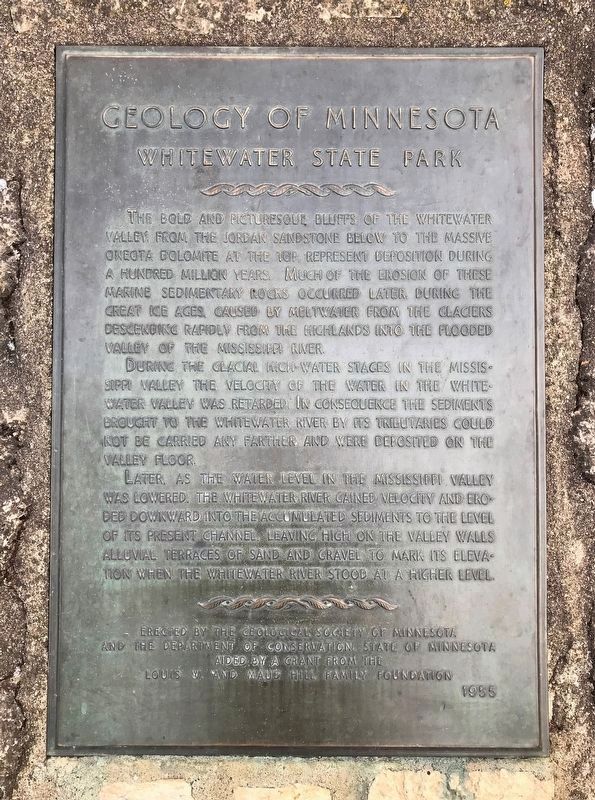
During the glacier high-water stages of the Mississippi Valley the velocity of the water in the Whitewater Valley was retarded. In consequence the sediments brought to the Whitewater River by its tributaries could not be carried any farther, and were deposited on the valley floor.
Later, as the water level in the Mississippi Valley was lowered, the Whitewater River gained velocity and eroded downward into the accumulated sediments to the level of its present channel, leaving high on the valley walls alluvial terraces of sand and gravel to mark its elevation when the Whitewater River stood at a higher level.
Erected 1955 by the Geological Society of Minnesota and the Department of Conservation, State of Minnesota
this page online
Topics and series. This historical marker is listed in this topic list: Natural Features. In addition, it is included in the Minnesota: Geological Society of Minnesota series list.
Location. 44° 3.207′ N, 92° 2.705′ W. Marker is near Elba, Minnesota, in Winona County. It can be reached from State Highway 74 1.9 miles north of Quincy Drive, on the right when traveling north. Located in Whitewater State Park near the North Picnic Area. Touch for map. Marker is at or near this postal address: 19041 Highway 74, Saint Charles MN 55972, United States of America. Touch for directions.

Regionally, this marker is in Southeast Minnesota. It is also in the American Midwest, in the Corn Belt, in the Driftless Area — Bluff Country, and in the Great River Road Region. Globally, it is in North America, the Western Hemisphere, the Western World, and the Anglosphere. Historically, it finds itself in what was once Rupert’s Land, the territory of the Mississippian Culture, and the Louisiana Purchase.
Other nearby markers. At
November 13, 2022
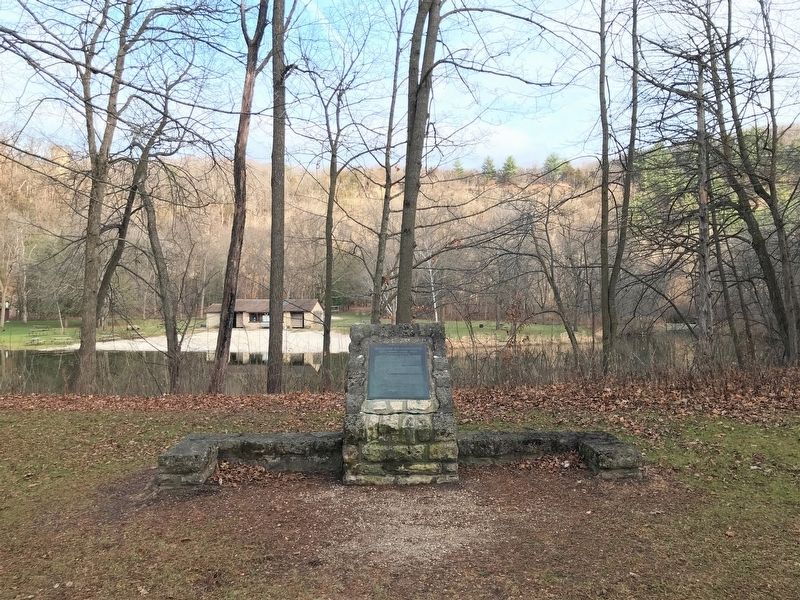
2. Geology of Minnesota Marker, from the west
Credits. This page was last revised on January 4, 2023. It was originally submitted on January 3, 2023. This page has been viewed 292 times since then and 31 times this year. Photos: 1, 2. submitted on January 3, 2023.
