
Cortes in Madrid, Spain — Southwestern Europe (Iberian Peninsula)
Lope de Vega

Photographed by Andrew Ruppenstein, November 8, 2022
1. Lope de Vega Marker

En esta casa
vivio y murio
Lope de Vega
1610-1635
In this house lived and died Lope de Vega, 1610-1635.
Erected by La Academia Española.
Topics. This historical marker is listed in these topic lists: Arts, Letters, Music • Entertainment. A significant historical date for this entry is August 27, 1635.
Location. 40° 24.863′ N, 3° 41.845′ W. Marker is in Madrid. It is in Cortes. It is on Calle de Cervantes when traveling west. Touch for map. Marker is at or near this postal address: Calle de Cervantes 11, Madrid 28014, Spain. Touch for directions.

Regionally, it is in the North Atlantic Region, in Europe, in the European Union, in Atlantic Europe, on the Iberian Peninsula, in the Schengen Area, in a coastal Mediterranean country, and in the Western World. Historically, it finds itself in what was once the Roman Empire.
Other nearby markers. At least 8 other markers are within walking distance of this marker: José Echegaray (within shouting distance of this marker); Don Francisco de Quevedo Villegas (within shouting distance of this marker); Miguel Cervantes Saavedra (within
this page online
Also see . . . Lope de Vega (Wikipedia).
Overview: Félix Lope de Vega y Carpio (25 November 1562 – 27 August 1635) was a Spanish playwright, poet, and novelist. He was one of the key figures in the Spanish Golden Age of Baroque literature. His reputation in the world of Spanish literature is second only to that of Miguel de Cervantes, while the sheer volume of his literary output is unequalled, making him one of the most prolific authors in the history of literature. He was nicknamed "The Phoenix of Wits" and "Monster of Nature" (in Spanish: Fénix de los Ingenios, Monstruo de Naturaleza) by Cervantes because of his prolific nature.(Submitted on January 16, 2023.)
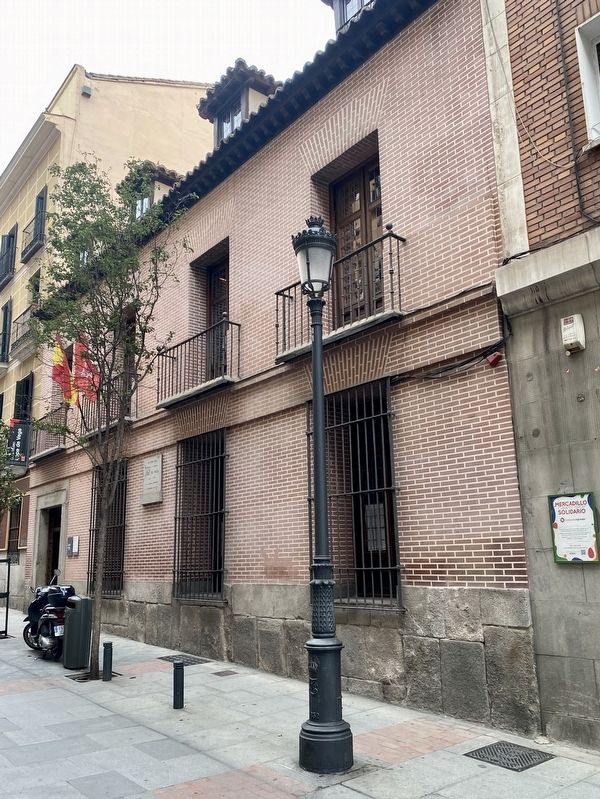
Photographed by Andrew Ruppenstein, November 8, 2022
2. Lope de Vega Marker - wide view

Photographed by Andrew Ruppenstein, November 8, 2022
3. Lope de Vega Marker - wider view, looking west on Calle de Cervantes
Credits. This page was last revised on February 2, 2023. It was originally submitted on January 16, 2023, by Andrew Ruppenstein of Lamorinda, California. This page has been viewed 198 times since then and 24 times this year. Photos: 1, 2, 3. submitted on January 16, 2023, by Andrew Ruppenstein of Lamorinda, California.
