Watergraafsmeer in Amsterdam, North Holland, Netherlands — Northwestern Europe
Gallileï
⎯⎯⎯
Galileo
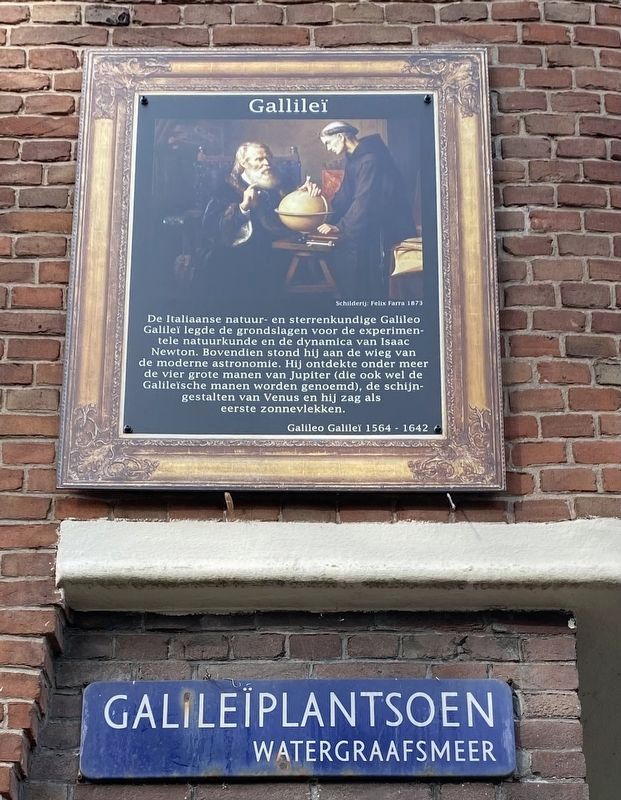
Photographed by Andrew Ruppenstein, November 3, 2022
1. Gallileï / Galileo Marker

Galileo Galileï 1564-1642
De Italiaanse natuur- en sterrenkundige Galileo Galileï legde de grondslagen voor de experimentele natuurkunde en de dynamica van Isaac Newton. Bovendien stond hij aan de wieg van de moderne astronomie. Hij ontdekte onder meer de vier grote manen van Jupiter (die ook wel de Galileische manen worden genoemd), de schijngestalten van Venus en hij zag als eerste zonnevlekken.
The Italian physicist and astronomer Galileo Galileï laid the foundations for experimental physics and the dynamics of Isaac Newton. Moreover, he stood at the cradle of modern astronomy. He discovered, among other things, the four large moons of Jupiter (also called the Galilean moons), the phases of Venus and he was the first to see sunspots.
Erected by Geef Straten Een Gezicht.
Topics and series. This historical marker is listed in this topic list: Science & Medicine. In addition, it is included in the Give Streets a Face / Geef Straten Een Gezicht, and the Scientists (GSEG) series lists. A significant historical date for this entry is February 15, 1564.
Location. 52° 21.18′ N, 4° 56.222′ E.
this page online

Regionally, it is in Europe, the European Union, Atlantic Europe, the Benelux Low Countries, the Schengen Area, Western Europe, and the Western World. Historically, it finds itself in what was once the Holy Roman Empire.
Other nearby markers. At least 8 other markers are within walking distance of this marker: Herschel (about 150 meters away, measured in a direct line); Linnaeushof (court) (about 240 meters away); Kepler (approx. 0.2 kilometers away); Copernicus (approx. 0.3 kilometers away); Isaac Newton (approx. 0.3 kilometers away); Linnaeus (approx. 0.3 kilometers away); Archimedes (approx. 0.4 kilometers away); Johannes van der Waals (approx. 0.4 kilometers away). Touch for a list and map of all markers in Amsterdam.
Also see . . . Galileo Galilei (Wikipedia).
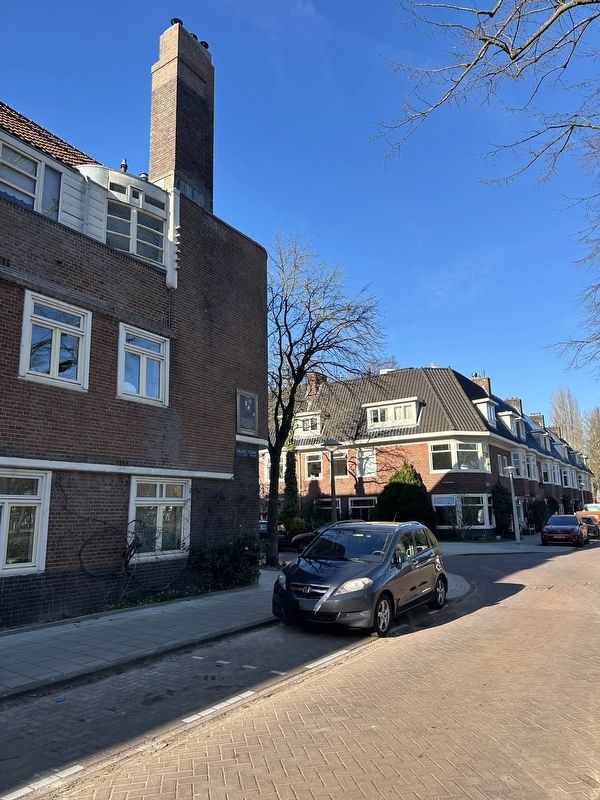
Photographed by Andrew Ruppenstein, March 17, 2025
2. Gallileï / Galileo Marker - wide view
The marker is visible here on the corner of the building.
Overview: Galileo di Vincenzo Bonaiuti de' Galilei (15 February 1564 – 8 January 1642) was an Italian astronomer, physicist and engineer, sometimes described as a polymath. Commonly referred to as Galileo…He was born in the city of Pisa, then part of the Duchy of Florence. Galileo has been called the "father" of observational astronomy, modern physics, the scientific method, and modern science.(Submitted on January 17, 2023.)
Additional keywords. Astronomy
Credits. This page was last revised on November 11, 2025. It was originally submitted on January 17, 2023, by Andrew Ruppenstein of Lamorinda, California. This page has been viewed 134 times since then and 9 times this year. Photos: 1, 2. submitted on January 17, 2023, by Andrew Ruppenstein of Lamorinda, California.
