Innere Stadt in Wien, Austria — Central Europe (Eastern Alps)
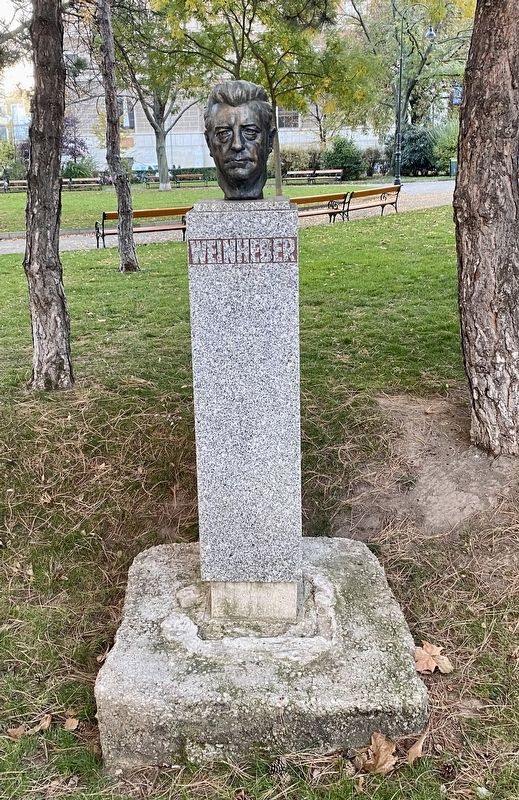
Weinheber- Memorial/Denkmal
Photographed by Andrew Ruppenstein, November 13, 2022
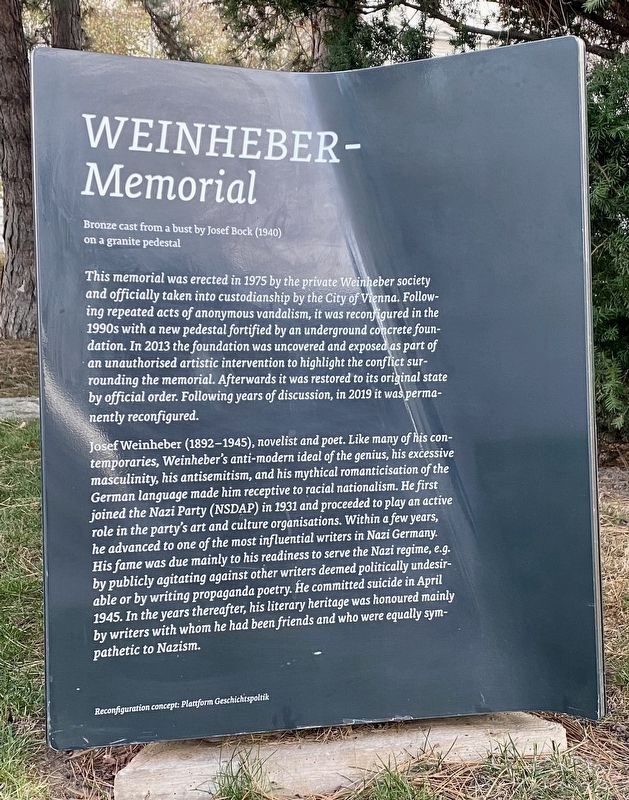
1. Weinheber- Memorial/Denkmal Marker - English Version

Bronze cast from a bust by Josef Bock (1940) on a granite pedestal
This memorial was erected in 1975 by the private Weinheber society and officially taken into custodianship by the City of Vienna. Following repeated acts of anonymous vandalism, it was reconfigured in the 1990s with a new pedestal fortified by an underground concrete foundation. In 2013 the foundation was uncovered and exposed as part of an unauthorised artistic intervention to highlight the conflict surrounding the memorial. Afterwards it was restored to its original state by official order. Following years of discussion, in 2019 it was permanently reconfigured.
Josef Weinheber (1892-1945), novelist and poet. Like many of his contemporaries, Weinheber's anti-modern ideal of the genius, his excessive masculinity, his antisemitism, and his mythical romanticisation of the German language made him receptive to racial nationalism. He first joined the Nazi Party (NSDAP) in 1931 and proceeded to play an active role in the party's art and culture organisations. Within a few years, he advanced to one of the most influential writers in Nazi
this page online
Reconfiguration concept: Plattform Geschichtspoltik
=============
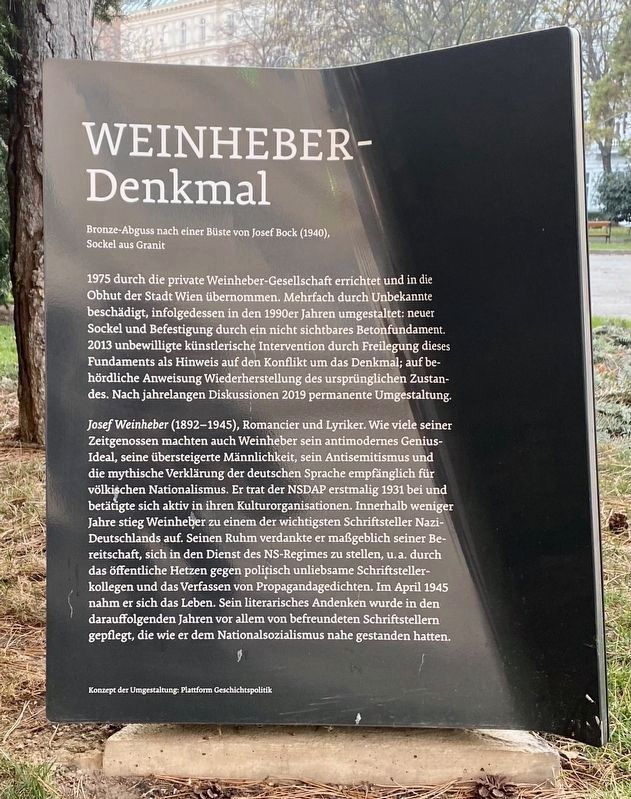
1975 durch die private Weinheber-Gesellschaft errichtet und in die Obhut der Stadt Wien übernommen. Mehrfach durch Unbekannte beschädigt, infolgedessen in den 1990er Jahren umgestaltet: neuer Sockel und Befestigung durch ein nicht sichtbares Betonfundament. 2013 unbewilligte künstlerische Intervention durch Freilegung dieses Fundaments als Hinweis auf den Konflikt um das Denkmal; auf behördliche Anweisung Wiederherstellung des ursprünglichen Zustandes. Nach jahrelangen Diskussionen 2019 permanente Umgestaltung.
Josef Weinheber (1892-1945), Romancier und Lyriker. Wie viele seiner Zeitgenossen machten auch Weinheber
Photographed by Andrew Ruppenstein, November 13, 2022
2. Weinheber- Memorial/Denkmal Marker - German version
Konzept der Umgestaltung: Plattform Geschichtspolitik
Erected 2019.
Topics. This historical marker is listed in this topic list: War, World II. A significant historical month for this entry is April 1945.
Location. 48° 12.14′ N, 16° 21.953′ E. Marker is in Wien. It is in Innere Stadt. It is on Elisabethstraße, on the right
Photographed by Andrew Ruppenstein, November 13, 2022
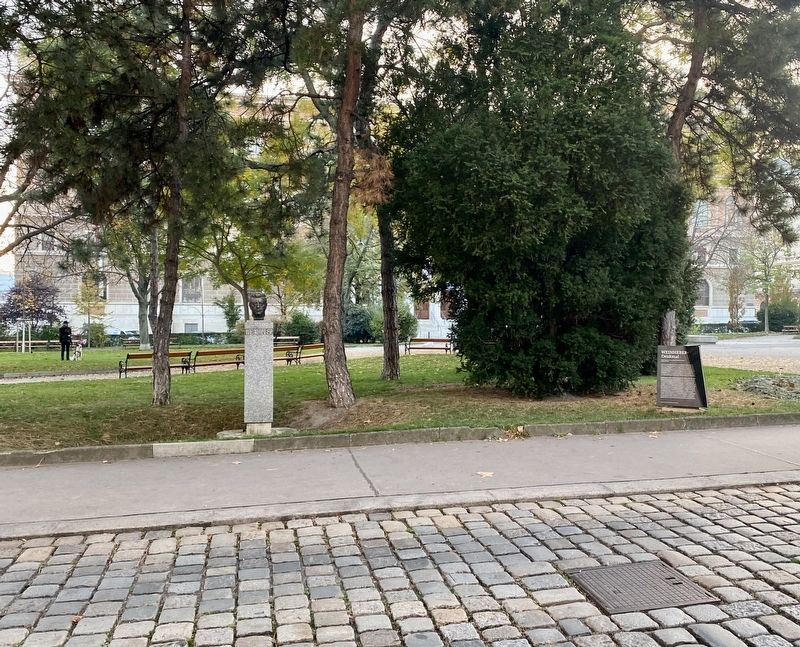
3. Weinheber- Memorial/Denkmal Marker - wide view
Memorial is visible on the left, marker on the right.

Regionally, it is in Europe, the European Union, Central Europe, the Schengen Area, Western Europe, and the Western World. Historically, it finds itself in what was once the Roman Empire and specifically also the Holy Roman Empire.
Other nearby markers. At least 8 other markers are within walking distance of this marker: Robert Stolz (within shouting distance of this marker); Staatsoper (about 240 meters away, measured in a direct line); Adolf Loos (approx. 0.3 kilometers away); Mahnmal Gegen Krieg und Faschismus / Monument against War and Fascism (approx. 0.3 kilometers away); Ottoman Siege of 1529 (approx. 0.4 kilometers away); Christopher Columbus (approx. 0.4 kilometers away); Adam Smith (approx. 0.4 kilometers away); Siegfried Marcus (approx. 0.4 kilometers away). Touch for a list and map of all markers in Wien.
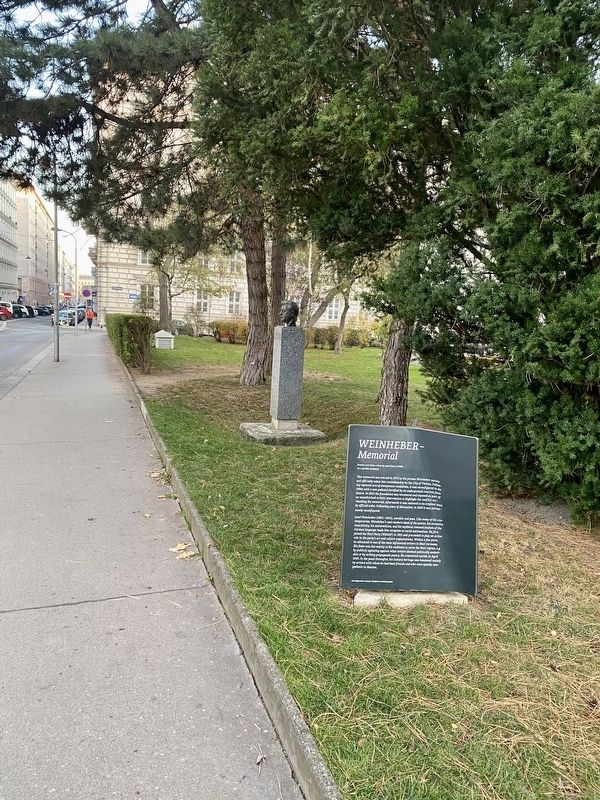
More about this marker. The memorial and marker are next to the sidewalk on the northern edge of Schiller Park.
Also see . . . Josef Weinheber (Wikipedia).
Overview: Josef Weinheber(Submitted on January 22, 2023.)(9 March 1892 in Vienna – 8 April 1945 in Kirchstetten, Lower Austria) was an Austrian lyric poet, narrative writer and essayist.Photographed by Andrew Ruppenstein, November 13, 20224. Weinheber- Memorial/Denkmal Marker
Career highlights and Nazi legacy: With the publication of his volume of poems Adel und Untergang (Nobility and Ruin), he became one of the most distinguished poets of his time. Especially admired was the volume Wien wörtlich (Vienna Verbatim), which is partially written in Viennese dialect. However, the forty odes comprising the cycle "Zwischen Göttern und Dämonen" (Between Gods and Demons) of 1938 are considered his poetical masterpiece.
The NSDAP publishers Langen-Müller introduced Weinheber to the lucrative German market, and he was invited on extensive reading tours in the Altreich and awarded a prize for foreign German writers. After 1938 he wrote numerous Nazi propaganda poems, such as "Hymnus auf die Heimkehr" ("Hymn to Austria's return"), "Dem Führer" ("To the führer"), and "Ode an die Straßen Adolf Hitlers" ("Ode to the streets of Adolf Hitler"), and became the most-read contemporary poet in Nazi Germany. He received numerous honors and awards, and was included by Adolf Hitler on the listof 1,041 Gottbegnadeten or "divinely gifted" Nazi artists who were exempt from war service on account of their cultural importance.Photographed by Andrew Ruppenstein, November 13, 20225. Weinheber- Memorial/Denkmal
Credits. This page was last revised on April 7, 2023. It was originally submitted on January 22, 2023, by Andrew Ruppenstein of Lamorinda, California. This page has been viewed 279 times since then and 34 times this year. Photos: 1, 2, 3, 4, 5. submitted on January 22, 2023, by Andrew Ruppenstein of Lamorinda, California.
