Canton in Stark County, Ohio — The American Midwest (Great Lakes)
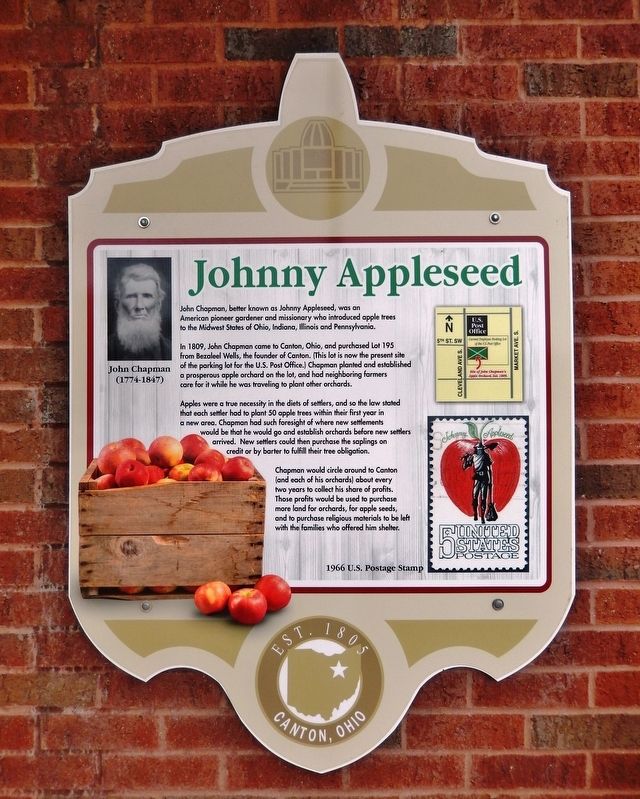
Johnny Appleseed
John Chapman
| — | 1774-1847 | — |
Photographed by Cosmos Mariner, July 30, 2018
1. Johnny Appleseed Marker
John Chapman, better known as Johnny Appleseed, was an American pioneer gardener and missionary who introduced apple trees to the Midwest States of Ohio, Indiana, Illinois and Pennsylvania.
In 1809, John Chapman came to Canton, Ohio, and purchased Lot 195 from Bezaleel Wells, the founder of Canton. (This lot is now the present site of the parking lot for the U.S. Post Office.) Chapman planted and established a prosperous apple orchard on the lot, and had neighboring farmers care for it while he was traveling to plant other orchards.
Apples were a true necessity in the diets of settlers, and so the law stated that each settler had to plant 50 apple trees within their first year in a new area. Chapman had such foresight of where new settlements would be that he would go and establish orchards before new settlers arrived. New settlers could then purchase the saplings on credit or by barter to fulfill their tree obligation.
Chapman would circle around to Canton (and each of his orchards) about every two years to collect his share of profits. Those profits would be used to purchase more land for orchards, for apple seeds, and
this page online
Topics. This historical marker is listed in these topic lists: Agriculture • Industry & Commerce • Religion & Religious Structures • Settlements & Settlers. A significant historical year for this entry is 1809.
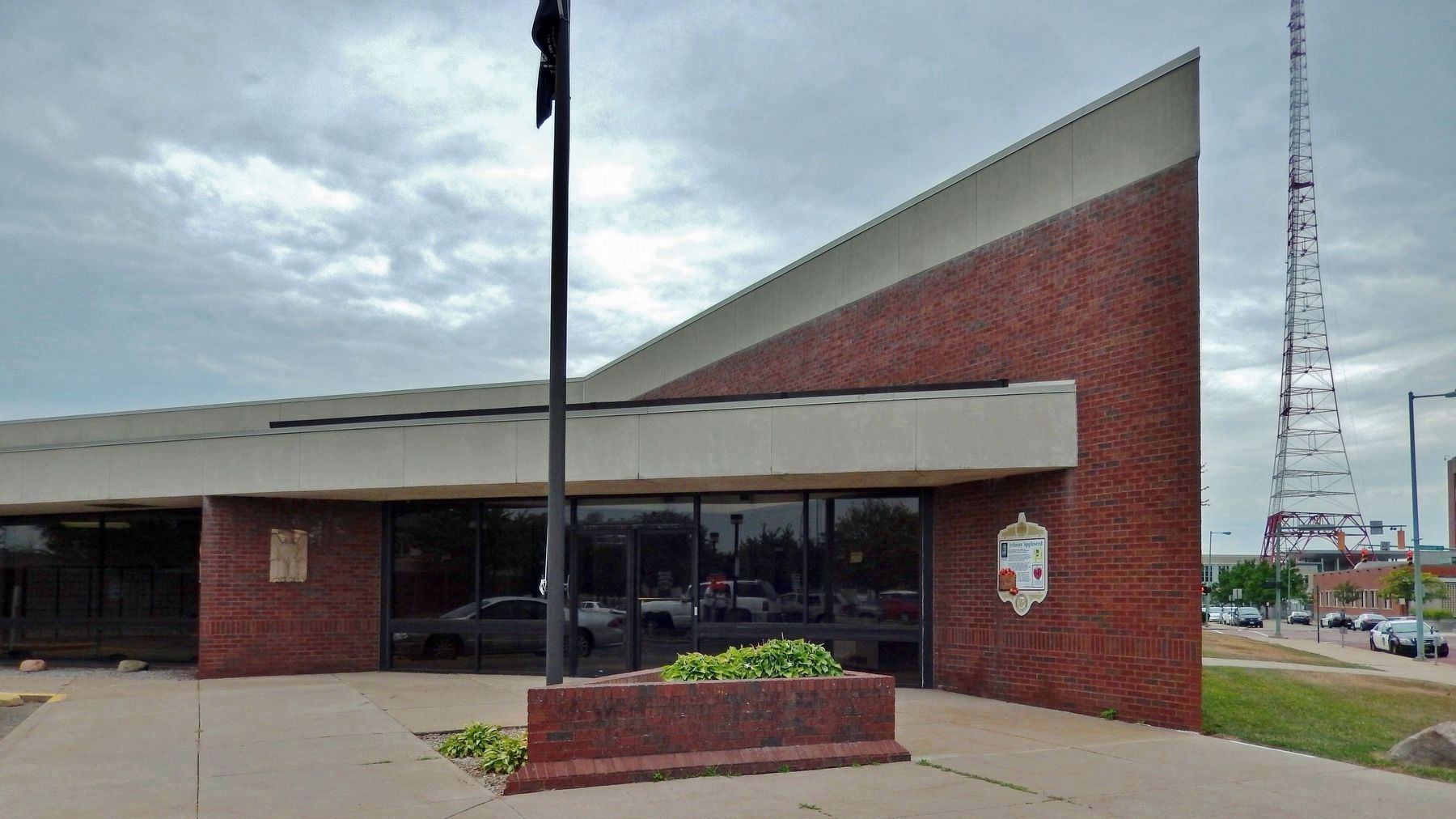
Location. 40° 47.779′ N, 81° 22.602′ W. Marker is in Canton, Ohio, in Stark County. It is at the intersection of 4th Street Southwest and Court Avenue Southwest, on the left when traveling west on 4th Street Southwest. Marker is mounted at eye-level on the east wall of the U.S. Post Office at this address, near the main entrance. Touch for map. Marker is at or near this postal address: 220 4th Street Southwest, Canton OH 44702, United States of America. Touch for directions.

Regionally, this marker is in Amish Country and in Greater Cleveland. It is also in the American Midwest. Globally, it is in North America, the Western Hemisphere, the Western World, and the Anglosphere. Historically, it finds itself in what was once the Haudenosaunee (Iroquois) Confederacy, the territory of the Mississippian Culture, and the Northwest
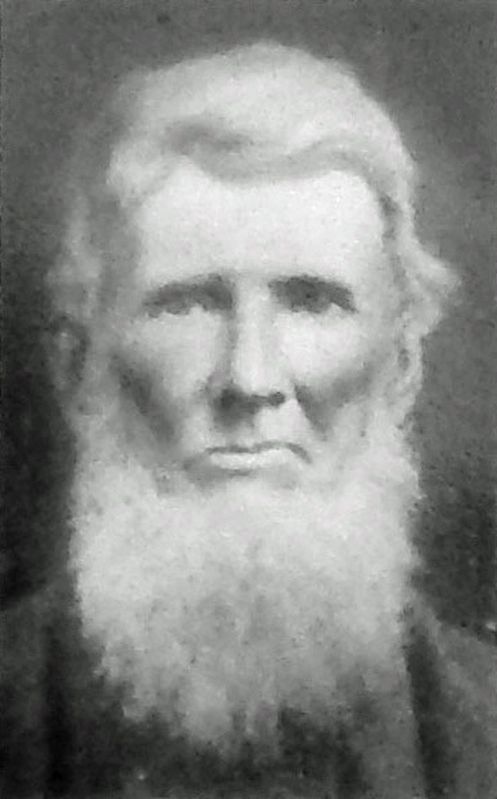
2. Marker detail: John Chapman
(1744-1847)
(1744-1847)
Other nearby markers. At least 8 other markers are within walking distance of this marker: The Saxton House (about 300 feet away, measured in a direct line); Carnegie Library (about 400 feet away); Corinthian Column (about 500 feet away); Birth of the NFL (about 600 feet away); The National Football League Was Born Here on September 17, 1920 (about 600 feet away); Ralph Hay / Jim Thorp (about 600 feet away); Ralph Hay Way (about 700 feet away); Monday Night Football (about 700 feet away). Touch for a list and map of all markers in Canton.
Also see . . .
1. Johnny Appleseed.
Jonathan Chapman was an eccentric American pioneer nurseryman who introduced apples to large parts of Ohio. During his lifetime (1774 - 1845) he became an American legend because of his journeys across Ohio and other areas as a missionary for the Swedenborgian Church.(Submitted on January 26, 2023, by Cosmos Mariner of Cape Canaveral, Florida.)During the early formative years, Jonathan Chapman learned about the culture of growing apple trees as an apprentice in New England. Here he learned the importance of pollination, fertilization, amending the soil, all of the requirements a vibrant orchard required. When he turned 18, Chapman and his younger brother left home to seek their own fortunes in the west. They wandered through Pennsylvania. Along the way they met many families that were heading even further west, into the rugged Ohio Territory to establish homesteads. He knew that these migrating families would be ideal prospects for buying apple trees.
2. Johnny Appleseed.
The popular image is of Johnny Appleseed spreading apple seeds randomly everywhere he went. In fact, he planted nurseries rather than orchards, built fences around them to protect them from livestock, left the nurseries in the care of a neighbor(Submitted on January 26, 2023, by Cosmos Mariner of Cape Canaveral, Florida.)who sold trees on shares, and returned every year or two to tend the nursery. He planted his first nursery on the bank of Brokenstraw Creek, south of Warren, Pennsylvania. Next, he seems to have moved to Venango County, along the shore of French Creek, but many of these nurseries were in the Mohican River area of north-central Ohio.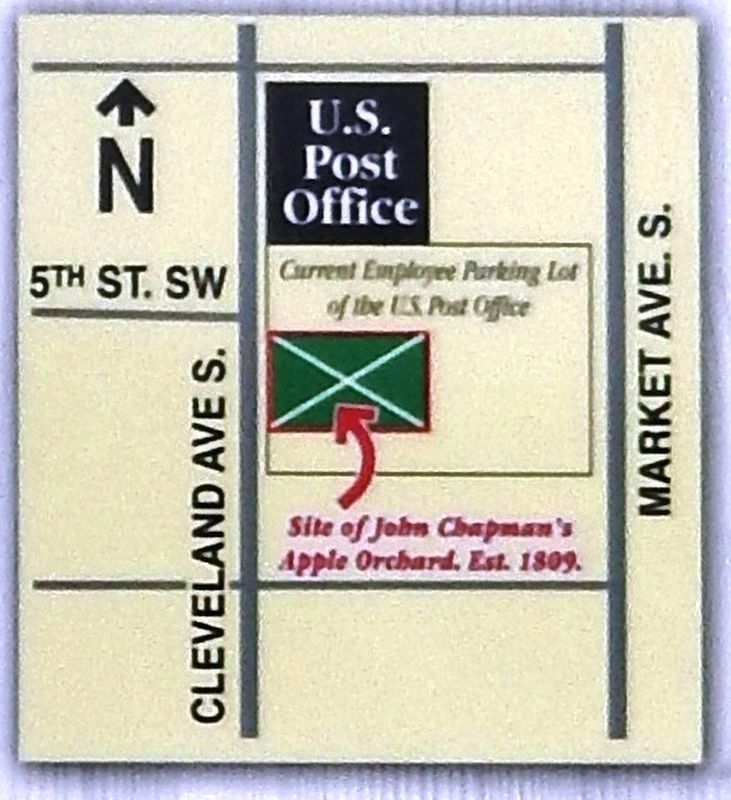 3. Marker detail: John Chapman Apple Orchard Site
Est. 1809
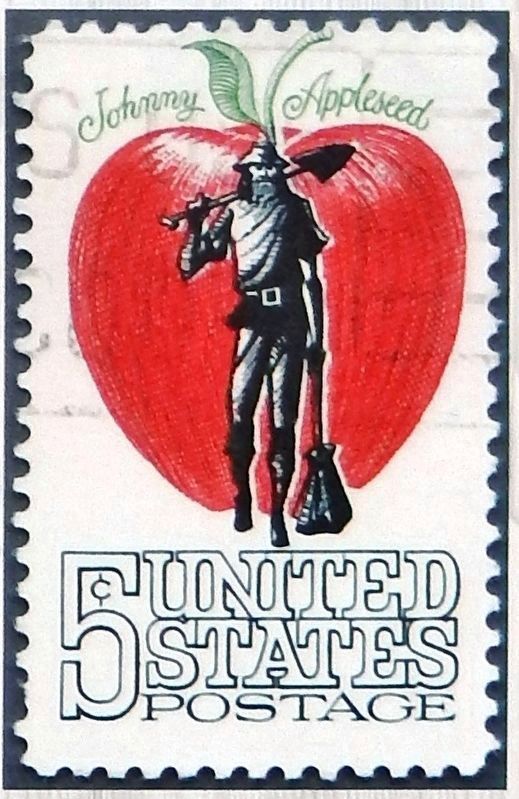
4. Marker detail: U.S. Postage Stamp
1966
1966
Photographed by Cosmos Mariner, July 30, 2018
5. U.S. Post Office, Newmarket Station, Canton, Ohio 44702
Credits. This page was last revised on October 29, 2024. It was originally submitted on January 25, 2023, by Cosmos Mariner of Cape Canaveral, Florida. This page has been viewed 1,060 times since then and 134 times this year. Photos: 1, 2, 3, 4, 5. submitted on January 26, 2023, by Cosmos Mariner of Cape Canaveral, Florida.
