Midtown in San Antonio in Bexar County, Texas — The American South (West South Central)
San Antonio Zoo
Photographed by James Hulse, December 30, 2022
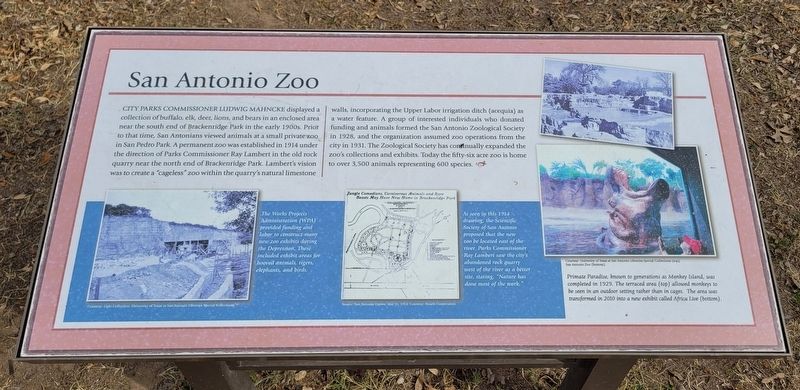
1. San Antonio Zoo Marker
Captions
Lower Left: The Works Projects Administration (WPA) provided funding and labor to construct many new zoo exhibits during the Depression. These included exhibit areas for hooved animals, tigers, elephants, and birds.
Courtesy: Light Collection, University of Texas at San Antonio Libraries Special Collections.
Middle Lower: As seen in this 1914 drawing, the Scientific Society of San Antonio proposed that the new zoo be located east of the river. Parks Commissioner Ray Lambert saw the city's abandoned rock quarry west of the river as a better site, stating, "Nature has done most of the work."
Source: San Antonio Express, May 31, 1914
Courtesy: Hearst Corporation.
Lower Right: Primate Paradise, known to generations as Monkey Island, was completed in 1929. The terraced area (top) allowed monkeys to be seen in an outdoor setting rather than in cages. The area was transformed in 2010 into a new exhibit called Africa Live (bottom).
Courtesy: University of Texas at San Antonio Libraries Special Collections (top); San Antonio Zoo (bottom).
Topics.
this page online
Location. 29° 27.715′ N, 98° 28.396′ W. Marker is in San Antonio, Texas, in Bexar County. It is in Midtown. It is at the intersection of North Saint Mary's Street and Tuleta Drive, on the right when traveling north on North Saint Mary's Street. The marker is located at the southeast corner of the entrance to the San Antonio Zoo. Touch for map. Marker is at or near this postal address: 3903 North Saint Mary's Street, San Antonio TX 78212, United States of America. Touch for directions.

Regionally, this marker is in South Texas. It is also in the American South. Globally, it is in North America, a Gulf of Mexico state, the Western Hemisphere, the Western World, and the Anglosphere. Historically, it finds itself in what was once New Spain, the Republic of Texas, and one of the Confederate States of America.
Other nearby markers. At least 8 other markers are within walking distance of this marker: Wildlife Trail (about 400 feet away, measured in a direct line); Flag Pole Memorial
Photographed by James Hulse, December 30, 2022
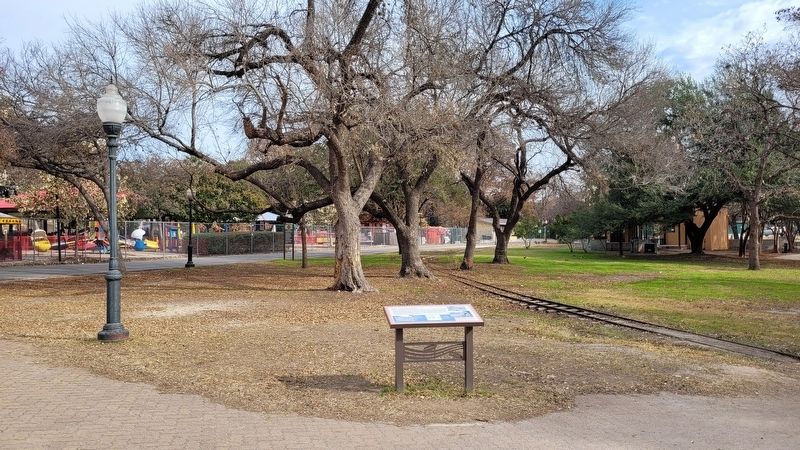
2. The view of the San Antonio Zoo Marker from the street
Also see . . . Brackenridge Park Conservancy. Website homepage:
The casual visitor to Brackenridge Park is totally unaware that the 349-acre park, with its picnic areas, ball fields, museum, zoo, and golf course, occupies some of the most historically rich land in the City of San Antonio. Traffic and pavement abound, urban congestion and noise intrude, and interpretation is virtually nil. Nothing tells the visitor that the park represents a long timeline reaching back at least 12,000 years. It is a rich tapestry of history linked by the San Antonio River that rises from springs above and in the park and flows through the park on its southerly course.(Submitted on January 27, 2023, by James Hulse of Medina, Texas.)

Photographed by James Hulse, December 30, 2022
3. The view of the San Antonio Zoo from the marker
Photographed by James Hulse, December 30, 2022
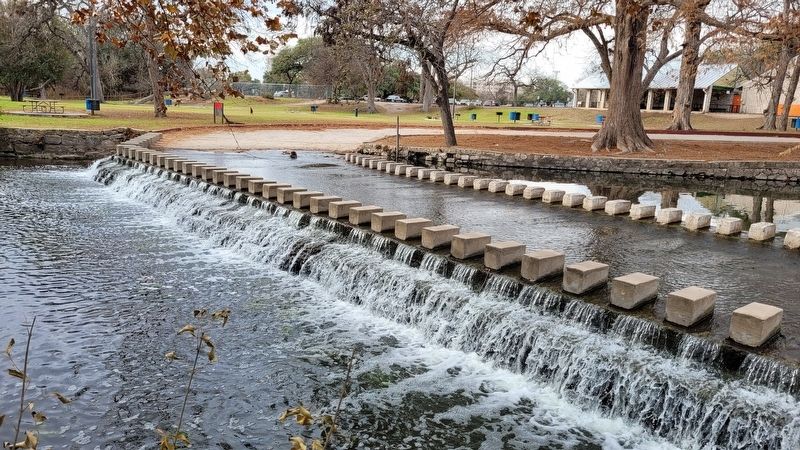
4. The crossing of the San Antonio River near the zoo entrance
Credits. This page was last revised on July 9, 2025. It was originally submitted on January 27, 2023, by James Hulse of Medina, Texas. This page has been viewed 630 times since then and 53 times this year. Photos: 1, 2, 3, 4. submitted on January 27, 2023, by James Hulse of Medina, Texas.
