
Exchange District in Winnipeg, Manitoba — Canada’s Prairie Region (North America)
Early Skyscrapers in Winnipeg
⎯⎯⎯
Les gratte-ciel de Winnipeg

Photographed by Cosmos Mariner, June 16, 2022
1. Early Skyscrapers in Winnipeg Marker

The skyscraper was a by-product of technological advances and increased urbanization of the late 19th century. Steel-frame construction, the elevator and rising land values made multi-storeyed buildings structurally and economically feasible. Between 1900 and 1916 twelve skyscrapers were built in Winnipeg, imposing on the city the verticality and high density of a modern urban core. All were monolithic structures decorated in a variety of styles. The classicized Bank of Hamilton (1916) and the Italianate style of the Union Trust (1912), located directly across the street, typify Winnipeg's early skyscrapers.
Le gratte-ciel est le produit de la technologie et de l'urbanisation. A la fin du XIXe siècle, la valeur croissante de la propriété le rendit nécessaire, et on put le réaliser grâce à la charpente en acier et à l'ascenseur. Entre 1900 et 1916, on construisit douze gratte-ciel à Winnipeg, ce qui donna au centre-ville une silhouette verticale. Chacun de ces bâtiments monolithiques avait son style et son ornementation propres. Les deux en face, la Bank of Hamilton, de style classique, et l’Union Trust, de style italien, illustrent bien les premiers gratte-ciel de Winnipeg.
Erected by Historic
this page online
Topics and series. This historical marker is listed in these topic lists: Architecture • Industry & Commerce. In addition, it is included in the Canada, Historic Sites and Monuments Board series list.
Location. 49° 53.838′ N, 97° 8.352′ W. Marker is in Winnipeg, Manitoba. It is in the Exchange District. It is on Main Street (Manitoba Route 52) just south of Bannatyne Avenue, on the right when traveling south. Marker is mounted beside the sidewalk, near the southeast corner of the building at this address. Touch for map. Marker is at or near this postal address: 456 Main Street, Winnipeg MB R3B 1E4, Canada. Touch for directions.

Regionally, this marker is in Manitoba’s Historic Winnipeg. It is also in the Prairies. Globally, it is in North America, the Western Hemisphere, the Western World, and the Anglosphere. Historically, it finds itself in what was once a British colony, the Viceroyalty of New France, and Rupert’s Land.
Other nearby markers. At least 8 other
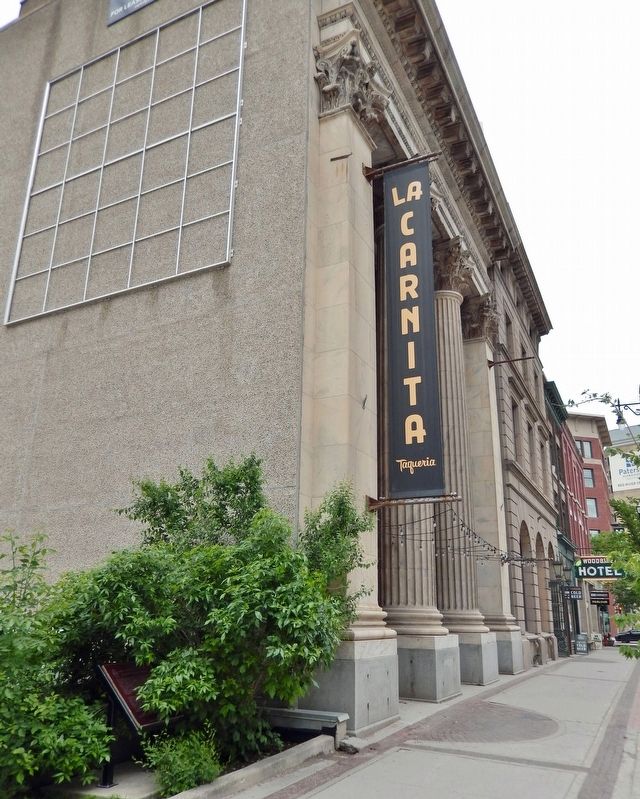
Photographed by Cosmos Mariner, June 16, 2022
2. Early Skyscrapers in Winnipeg Marker
Regarding Early Skyscrapers in Winnipeg / Les gratte-ciel de Winnipeg. National Historic Site of Canada, (1980/06/16).
From the National Historic Site Statement of Significance:
The Early Skyscrapers in Winnipeg National Historic Site of Canada is a grouping of three tall commercial buildings within Winnipeg’s Exchange District National Historic Site of Canada, the historic business core of the city. They exhibit a variety of stylistic details but generally conform to the then-prevalent Chicago style for the incipient skyscrapers appearing in increasingly densely built citycentres. The designation refers to the Union Trust Tower, the Confederation Building, and the Bank of Hamilton building on their footprints.Photographed by Cosmos Mariner, June 16, 20223. Early Skyscrapers in Winnipeg Marker(looking across Main Street from the east • marker is obscured by foliage by the left [south] corner of the building)
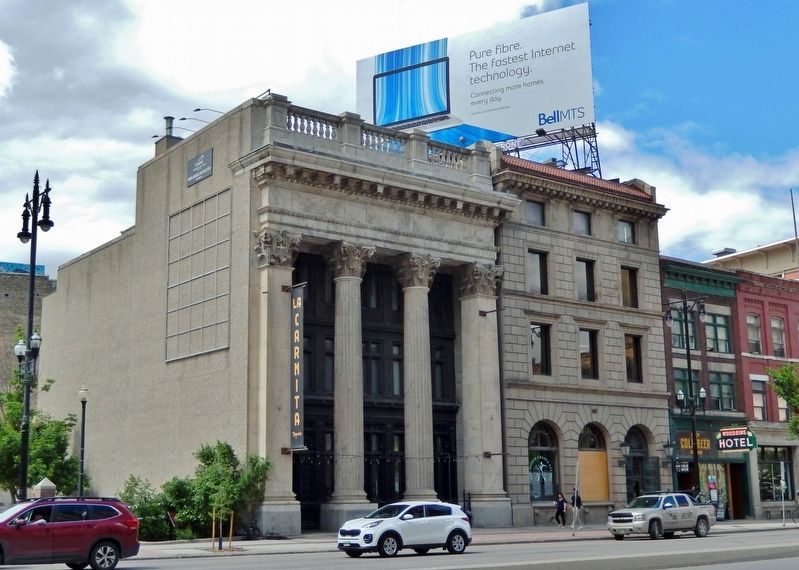
Related markers. Click here for a list of markers that are related to this marker. Early Skyscrapers in Winnipeg
Also see . . . Early Skyscrapers in Winnipeg National Historic Site of Canada.
The Early Skyscrapers in Winnipeg were designated a national historic site of Canada in 1980 because: decorated in a variety of styles, these buildings typify, as a group, Winnipeg’s early skyscrapers, which imposed on the city the verticality and high density of a modern urban core.(Submitted on January 29, 2023, by Cosmos Mariner of Cape Canaveral, Florida.)
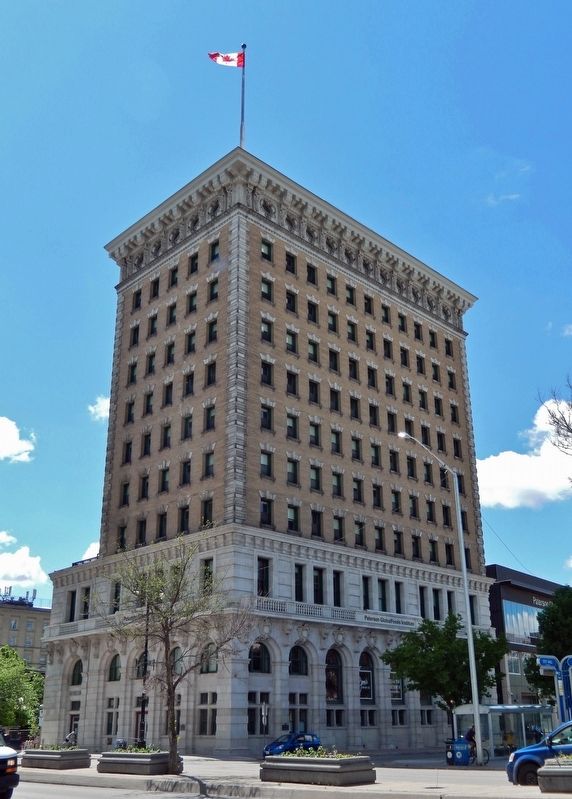
Photographed by Cosmos Mariner, June 16, 2022
4. Union Bank Building (1903)

Photographed by Cosmos Mariner, June 16, 2022
5. Union Trust Tower (1912)

Photographed by Cosmos Mariner, June 16, 2022
6. Confederation Building (1912)

Photographed by Cosmos Mariner, June 16, 2022
7. Bank of Hamilton Building (1916)
Credits. This page was last revised on January 31, 2023. It was originally submitted on January 28, 2023, by Cosmos Mariner of Cape Canaveral, Florida. This page has been viewed 320 times since then and 35 times this year. Photos: 1, 2, 3, 4, 5, 6, 7. submitted on January 29, 2023, by Cosmos Mariner of Cape Canaveral, Florida.
