Main Street District in Dallas in Dallas County, Texas — The American South (West South Central)
MISSING
SEE LOCATION SECTION
Lynching in America ⎯⎯⎯ The Lynching of Allen Brooks
Community Remembrance Project
Photographed by Jeff Leichsenring, September 6, 2023
1. Lynching in America
Inscription.
Lynching in America, also, The Lynching of Allen Brooks. Community Remembrance Project.
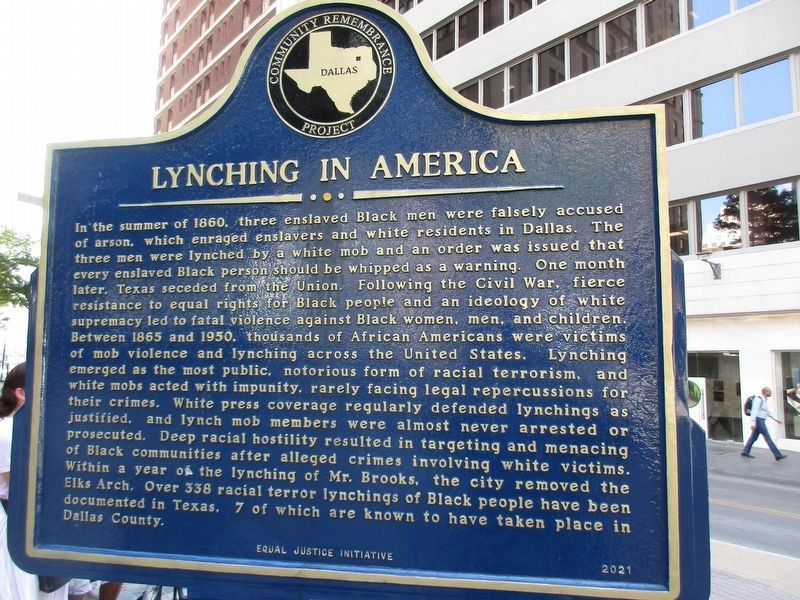
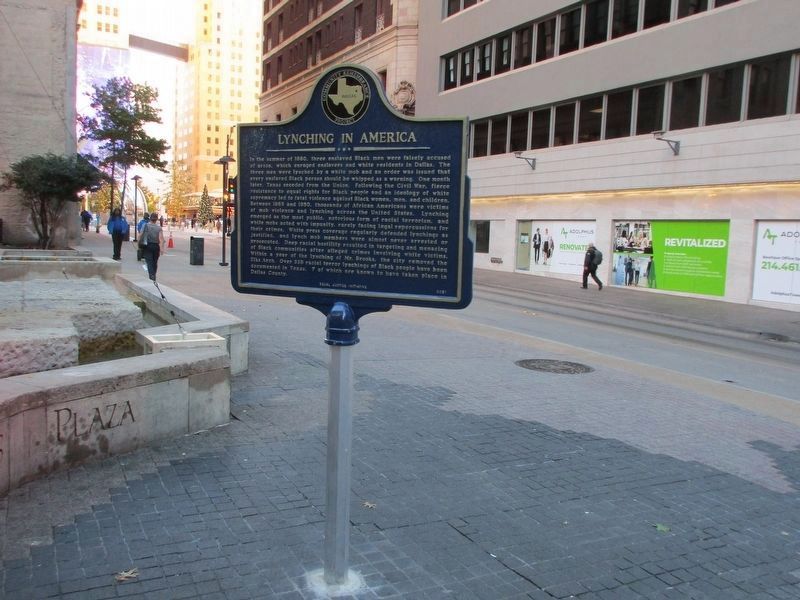
Lynching in America. In the summer of 1860, three enslaved Black men were falsely accused of arson, which enraged enslavers and white residents in Dallas. The three men were lynched by a white mob and an order was issued that every enslaved Black person should be whipped as a warning. One month later, Texas seceded from the Union. Following the Civil War, fierce resistance to equal rights for Black people and an ideology of white supremacy led to fatal violence against Black women, men and children. Between 1865 and 1950, thousands of African Americans were victims of mob violence and lynching across the United States. Lynching emerged as the most public, notorious form of racial terrorism, and white mobs acted with impunity, rarely facing legal repercussions for their crimes. White press coverage regularly defended lynchings as justified, and lynch mob members were almost never arrested or prosecuted. Deep racial hostility resulted in targeting and menacing of Black communities after alleged crimes involving white victims. Within a year of the lynching of Mr. Brooks, the city removed the Elks Arch. Over 338 racial terror lynchings of Black people have been documented in Texas, 7 of which are known to have taken place in Dallas County. ,
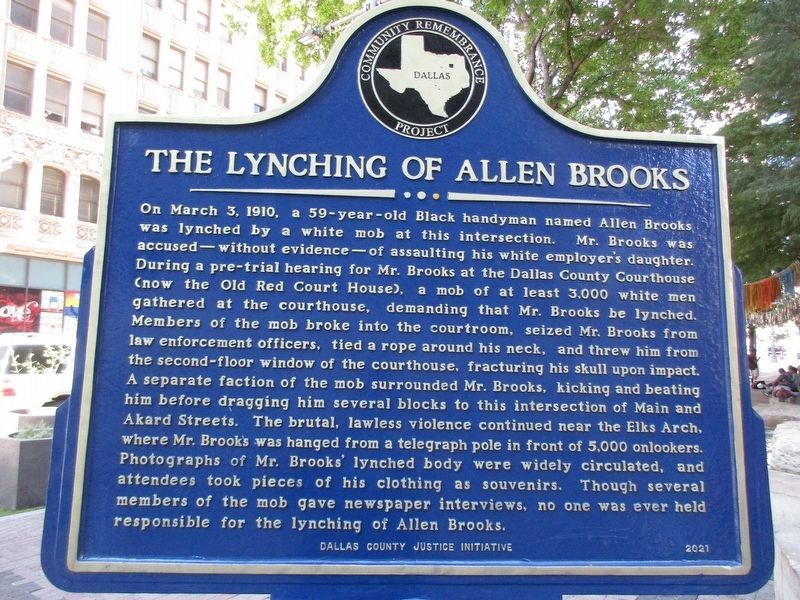
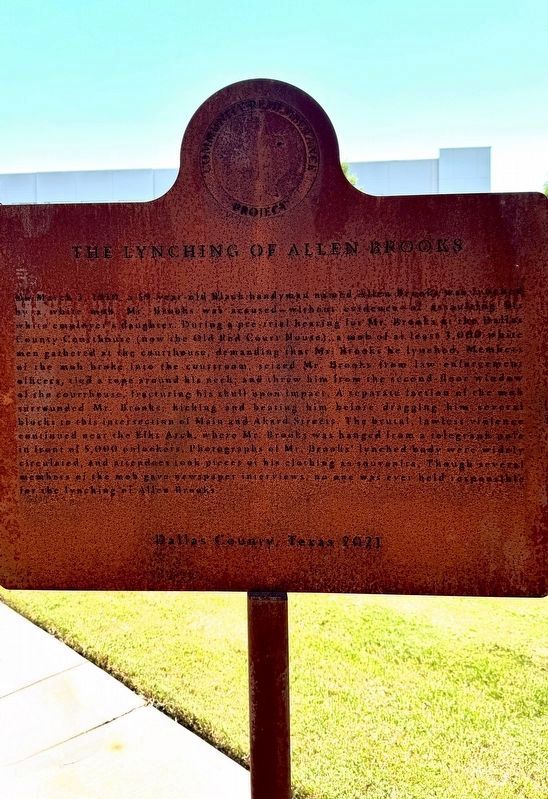
The Lynching of Allen Brooks. On March 3, 1910, a 59-year-old Black handyman named Allen Brooks was lynched by a white mob at this intersection. Mr. Brooks was accused-without evidence-of assaulting his white employer's daughter. During a pre-trial hearing for Mr. Brooks at the Dallas County Courthouse (now the Old Red Courthouse), a mob of at least 3,000 white men gathered at the courthouse, demanding that Mr. Brooks be lynched. Members of the mob broke into the courtroom, seized Mr. Brooks from law enforcement officers, tied a rope around his neck, and threw him from the second-floor window of the courthouse, fracturing his skull upon impact. A separate faction of the mob surrounded Mr. Brooks, kicking and beating him before dragging him several blocks to this intersection of Main and Akard Streets. The brutal lawless violence continued near the Elks Arch, where Mr. Brooks was hanged from a telegraph pole in front of 5,000 onlookers. Photographs of Mr. Brooks' lynched body were widely circulated, and attendees took pieces of his clothing as souvenirs. Though several members of the mob gave newspaper interviews, no one was ever held responsible for the lynching of Allen Brooks.
Lynching in America
In the summer of 1860, three enslaved Black men were falsely accused of arson, which enraged enslavers and white residents in Dallas. The three men were lynched by a white mob and an order was issued that every enslaved Black person should be whipped as a warning. One month later, Texas seceded from the Union. Following the Civil War, fierce resistance to equal rights for Black people and an ideology of white supremacy led to fatal violence against Black women, men and children. Between 1865 and 1950, thousands of African Americans were victims of mob violence and lynching across the United States. Lynching emerged as the most public, notorious form of racial terrorism, and white mobs acted with impunity, rarely facing legal repercussions for their crimes. White press coverage regularly defended lynchings as justified, and lynch mob members were almost never arrested or prosecuted. Deep racial hostility resulted in targeting and menacing of Black communities after alleged crimes involving white victims. Within a year of the lynching of Mr. Brooks, the city removed the Elks Arch. Over 338 racial terror
Click or scan to see this page online
lynchings of Black people have been documented in Texas, 7 of which are known to have taken place in Dallas County.
The Lynching of Allen Brooks
On March 3, 1910, a 59-year-old Black handyman named Allen Brooks was lynched by a white mob at this intersection. Mr. Brooks was accused-without evidence-of assaulting his white employer's daughter. During a pre-trial hearing for Mr. Brooks at the Dallas County Courthouse (now the Old Red Courthouse), a mob of at least 3,000 white men gathered at the courthouse, demanding that Mr. Brooks be lynched. Members of the mob broke into the courtroom, seized Mr. Brooks from law enforcement officers, tied a rope around his neck, and threw him from the second-floor window of the courthouse, fracturing his skull upon impact. A separate faction of the mob surrounded Mr. Brooks, kicking and beating him before dragging him several blocks to this intersection of Main and Akard Streets. The brutal lawless violence continued near the Elks Arch, where Mr. Brooks was hanged from a telegraph pole in front of 5,000 onlookers. Photographs of Mr. Brooks' lynched body were widely circulated, and attendees took
Photographed by Jeff Leichsenring, September 6, 2023
2. The Lynching of Allen Brooks Marker
pieces of his clothing as souvenirs. Though several members of the mob gave newspaper interviews, no one was ever held responsible for the lynching of Allen Brooks.
Erected 2021 by Equal Justice Initiative, Dallas County Remembrance Project.
Topics and series. This historical marker is listed in these topic lists: African Americans • Civil Rights. In addition, it is included in the Lynching in America series list. A significant historical date for this entry is March 3, 1910.
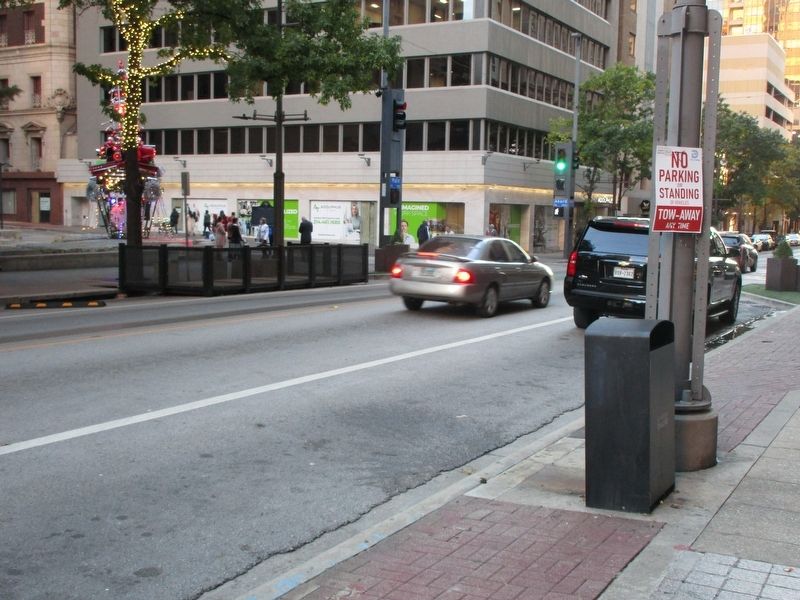
Location. Marker is missing. It was located near 32° 46.833′ N, 96° 47.969′ W. Marker was in Dallas, Texas, in Dallas County. It was in the Main Street District. It was at the intersection of Main Street and North Akard Street on Main Street. Touch for map. Marker was at or near this postal address: 1434 Main St, Dallas TX 75201, United States of America. Touch for directions.

Regionally, this marker was in the Prairies & Lakes Region. Globally, it was in North America, a Gulf of Mexico state, the Western Hemisphere, the Western World, and the Anglosphere. Historically, it found itself in what was once New Spain, the Republic of Texas, one of the Confederate
Photographed by Jeff Leichsenring, November 28, 2022
4. Lynching in America/Lynching of Allen Brooks Marker
Photographed by Brandon D Cross
5. The Lynching of Allen Brooks Marker
A Replica marker of one side is located at the Equal Justice Initiatives' National Memorial for Peace and Justice in Montgomery, Alabama. The Equal Justice Initiative supports efforts to locally memorialize documented victims of racial violence and to educate communities about the history of racial injustice. Mark Hilton
Credits. This page was last revised on May 26, 2025. It was originally submitted on January 30, 2023, by Jeff Leichsenring of Garland, Texas. This page has been viewed 874 times since then and 63 times this year. Photos:1, 2. submitted on September 6, 2023, by Jeff Leichsenring of Garland, Texas. 3, 4. submitted on January 30, 2023, by Jeff Leichsenring of Garland, Texas. 5. submitted on October 16, 2024, by Brandon D Cross of Flagler Beach, Florida. • J. Makali Bruton was the editor who published this page.