Riverside in Cambridge in Middlesex County, Massachusetts — The American Northeast (New England)
Franklin H. Wright
Public Official and Community Leader
| — | 1880 - 1933 | — |
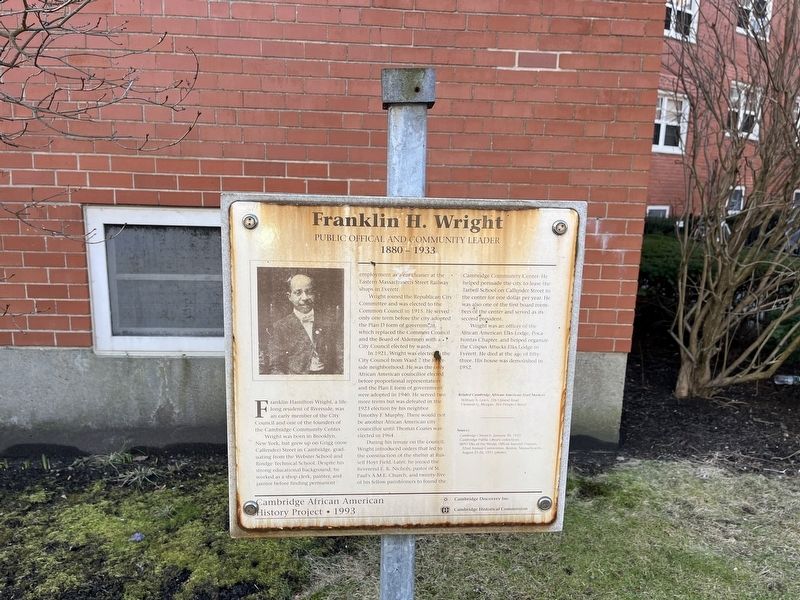
Franklin Hamilton Wright, a life-long resident of Riverside, was an early member of the City Council and one of the founders of the Cambridge Community Center.
Wright joined the Republican City Committee and was elected to the Common Council in 1915. He served only one term before the city adopted the Plan D form of government, which replaced the Common Council and the Board of Aldermen with a City Council elected by wards.
In 1921, Wright was elected to the City Council from Ward 7, the Riverside neighborhood. He was the only African American Councillor elected before proportional representation and the Plan E form of government were adopted in 1940. He served two more terms but was defeated in the 1923 election by his neighbor Timothy F. Murphy. There
this page online
During his tenure on the council, Wright introduced orders that led the construction of the shelter at Russell Hoyt Field. Later, he joined the Reverend E.K. Nichols, pastor of St. Paul's A.M.E. Church, and twenty-five of his fellow parishioners to found the Cambridge Community Center. He helped persuade the city to lease the Tarbell School on Callendar Street to the center for one dollar per year. He was also one of the first board members of the center and served as its second president.
Wright was an officer of the African American Elks Lodge, Pocahontas Chapter, and helped organize the Crispus Attucks Elk Lodge in Everett. He died at the age of fifty-three. His house was demolished in 1952.
Related Cambridge African American Trail Markers
William A. Lewis, 226 Upland Road
Clement G. Morgan, 265 Prospect Street
Sources
Cambridge Chronicle, January 20, 1933
Cambridge Public Library collections
IBPO Elks of the World, Official Souvenir Program, 22nd Annual Convention, Boston, Massachusetts, August 21-26, 1921 (photo)
Erected 1993
Topics. This historical marker is listed in these topic lists: African Americans • Charity & Public Work • Fraternal or Sororal Organizations • Government & Politics. A significant historical date for this entry is January 20, 1933.
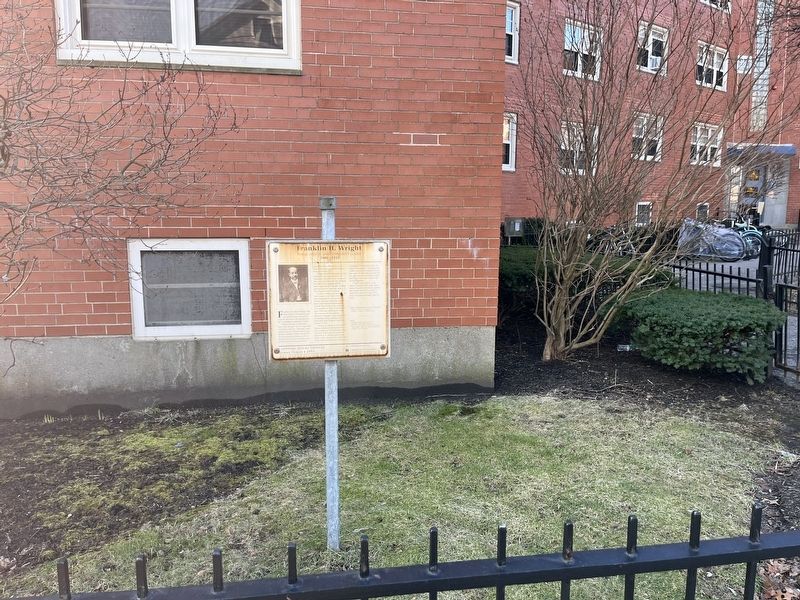
Location. 42° 21.98′ N, 71° 6.773′ W. Marker is in Cambridge, Massachusetts, in Middlesex County. It is in Riverside. It is on Magee Street east of Putnam Avenue, on the right when traveling east. Touch for map. Marker is at or near this postal address: 40 Magee St, Cambridge MA 02139, United States of America. Touch for directions.

Regionally, this marker is in Historic Boston and specifically in Greater Boston. It is also in the American Northeast, in New England, and on the Eastern Seaboard. Globally, it is in the North Atlantic Region, North America, the Western Hemisphere, the Western World, and the Anglosphere. Historically, it finds itself in what was once one of the original Thirteen Colonies.
Other nearby markers. At least 8 other markers are within walking distance of this marker: W.E.B. Du Bois (about 600 feet away, measured in a direct line); Old Cambridge Baptist Church (approx. 0.4 miles away); Club 47 (approx. 0.4 miles away); Dr. Martin Luther King (approx. 0.4 miles away); Josiah Quincy (approx. 0.4 miles away); Sgt. Thomas J. Williams (approx. 0.4 miles away); Sen Lee (approx. half a mile away); Harvard Student Agencies (approx. half a mile away). Touch for a list and map of all markers in Cambridge.
Credits. This page was last revised on January 31, 2023. It was originally submitted on January 31, 2023, by Devry Becker Jones of Washington, District of Columbia. This page has been viewed 283 times since then and 24 times this year. Photos: 1, 2. submitted on January 31, 2023, by Devry Becker Jones of Washington, District of Columbia.
