Montmartre in Paris in Département de Paris, Île-de-France, France — Western Europe
Le dispensaire de Clemenceau
⎯⎯⎯
Clemenceau’s Dispensary
| — | Histoire de Paris | — |
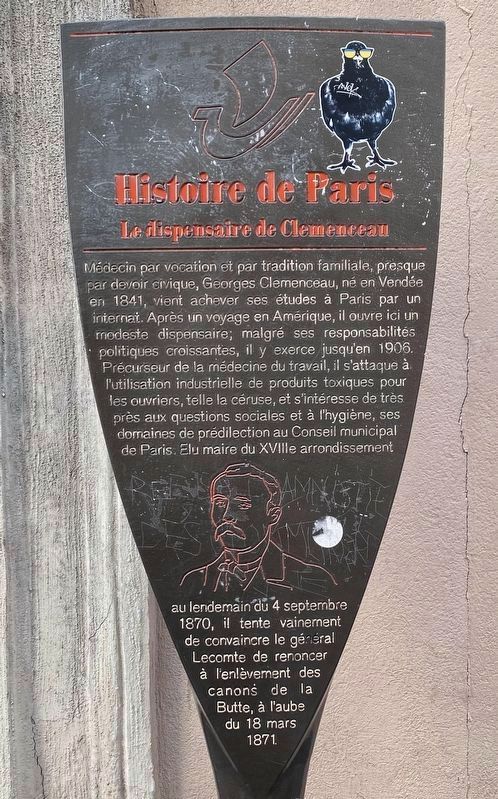
Photographed by Andrew Ruppenstein, August 24, 2022
1. Le dispensaire de Clemenceau / Clemenceau’s Dispensary Marker

A doctor by vocation and by family tradition, and almost by civic duty, Georges Clemenceau, born in Vendée in 1841, came to complete his studies in Paris, at a boarding school. After a trip to America, he opened a modest dispensary here; despite his increasing political responsibilities, he worked there until 1906. A pioneer in occupational medicine, he tackled the industrial use of toxic products for workers, such as white lead, and took a very close interest in social issues and hygiene, his areas of emphasis at the Paris City Council. Elected mayor of the 18th arrondissement the day after September 4, 1870, he tried in vain to convince General Lecomte to give up the removal of the cannons from the Butte, at dawn on March 18, 1871.
Erected by Ville de Paris.
Topics and series. This historical marker is listed in these topic lists: Government & Politics • Industry & Commerce. In addition, it is included in the Histoire de Paris series list.
Location. 48° 53.077′ N,
this page online

Regionally, it is in the North Atlantic Region, Europe, the European Union, Atlantic Europe, the Schengen Area, Western Europe, a coastal Mediterranean country, and the Western World. Historically, it finds itself in what was once a French colony and also the Roman Empire.
Other nearby markers. At least 8 other markers are within walking distance of this marker: Georges Clemenceau (here, next to this marker); Jean Roger Debrais (about 90 meters away, measured in a direct line); École de Orsel Deported Jewish Students Memorial (about 120 meters away); Square Louise-Michel (about 120 meters away); La Grande Crue de 1910 / The Great Flood of 1910 (about 120 meters away); David Kutner (about 180 meters away); Le parc d’artillerie de Montmartre / The Montmartre Artillery “Park” (about 180 meters away); Maurice Drouard

Photographed by Andrew Ruppenstein, August 24, 2022
2. Le dispensaire de Clemenceau / Clemenceau’s Dispensary Marker - wide view
Regarding Le dispensaire de Clemenceau / Clemenceau’s Dispensary. The importance of the last sentence becomes clearer when one knows the following: In the fall of 1870, France was in the midst of the Franco-Prussian war, and following the defeat at the Battle of Sedan and the collapse of the Second Empire, a new Government of National Defense was formed on September 4th. On March 18, 1871, Lecomte, the French Army general who had been tasked with removing a group of canons from a site in Montmartre, was captured by some National Guardsmen and then later killed, as part of the events of the first day of the Uprising of March 18, 1871.
Also see . . . Georges Clemenceau (Wikipedia).
Overview: Georges Benjamin Clemenceau (28 September 1841 – 24 November 1929) was a French statesman who served as Prime Minister of France from 1906 to 1909 and again from 1917 until 1920. A key figure of the Independent Radicals, he was a strong advocate of separation of church and state, amnesty of the Communards exiled to New Caledonia, as well(Submitted on February 1, 2023.)as opposition to colonisation. Clemenceau, a physician turned journalist, played a central role in the politics of the Third Republic, most notably successfully leading France through the end of the First World War.Photographed by Andrew Ruppenstein, August 24, 20223. Le dispensaire de Clemenceau / Clemenceau’s Dispensary Marker - wider view

Additional keywords. panneau
Credits. This page was last revised on May 2, 2025. It was originally submitted on February 1, 2023, by Andrew Ruppenstein of Lamorinda, California. This page has been viewed 315 times since then and 41 times this year. Photos: 1, 2, 3. submitted on February 1, 2023, by Andrew Ruppenstein of Lamorinda, California.
