Civic Centre in Winnipeg, Manitoba — Canada’s Prairie Region (North America)
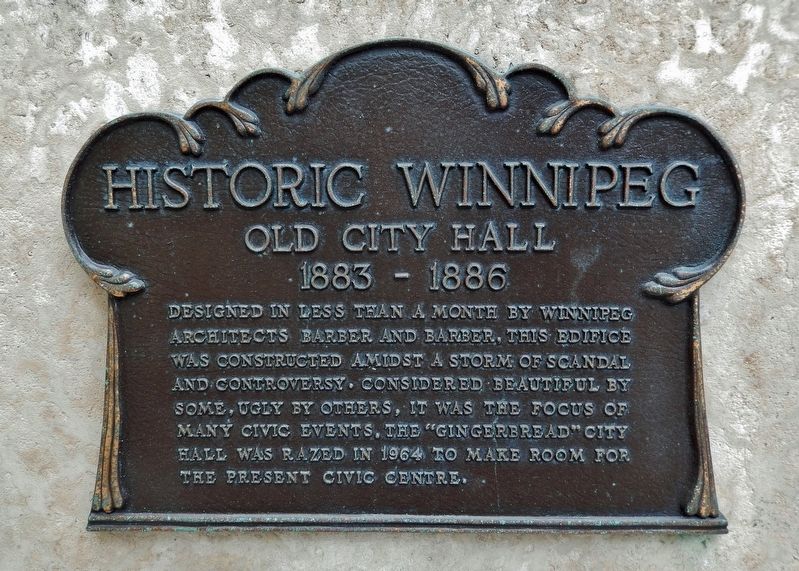
Old City Hall
1883-1886
| — | Historic Winnipeg | — |
Photographed by Cosmos Mariner, June 16, 2022
1. Old City Hall Marker
Topics. This historical marker is listed in these topic lists: Architecture • Government & Politics. A significant historical year for this entry is 1883.
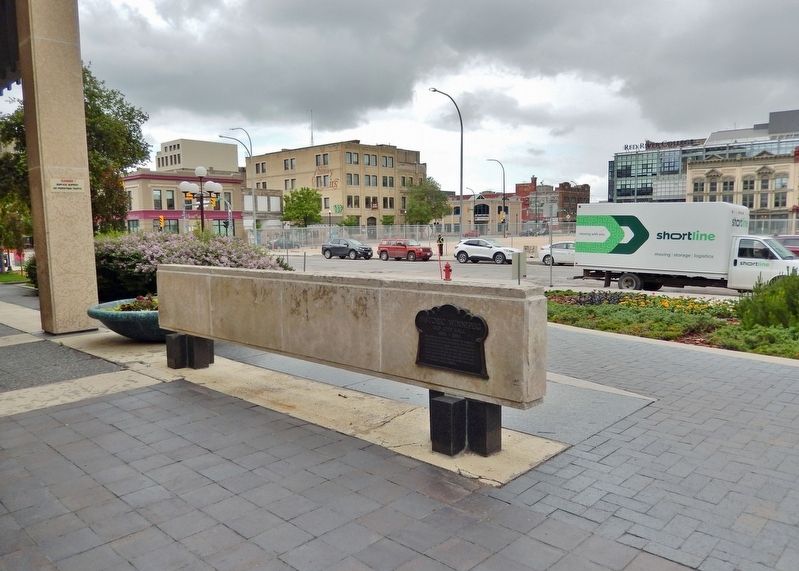
Location. 49° 53.981′ N, 97° 8.374′ W. Marker is in Winnipeg, Manitoba. It is in Civic Centre. It is on King Street (Manitoba Route 42) just north of William Avenue, on the right when traveling north. Marker is mounted on the back side of the "City Hall" sign near the northwest corner of the current City Hall building. Touch for map. Marker is at or near this postal address: 510 Main Street, Winnipeg MB R3B 1B9, Canada. Touch for directions.

Regionally, this marker is in Historic Winnipeg. It is also in the Prairies. Globally, it is in North America, the Western Hemisphere, the Western World, and the Anglosphere. Historically, it finds itself
this page online
Other nearby markers. At least 8 other markers are within walking distance of this marker: Abraham Albert Heaps (a few steps from this marker); First Salvation Army Meeting West of the Great Lakes (a few steps from this marker); The Exchange District / L'Arrondissement de la Bourse (about 90 meters away, measured in a direct line); First Headquarters • International Brotherhood of Magicians (about 90 meters away); Union Bank Building (about 90 meters away); Bloody Saturday (about 120 meters away); Union Bank Building / L’édifice de la Union Bank (about 120 meters away); West Clements Block (Bijou Theatre) (about 120 meters away). Touch for a list and map of all markers in Winnipeg.
Also see . . .
1. Winnipeg’s City Halls 1876-1965.
The first advertisements calling for plans and specifications for the erection of Winnipeg’s second city hall appeared in the city’s daily papers of Saturday, 16 June 1883. A year later, in July 1884, the cornerstone was laid. But the second city hall was surrounded with controversy from the beginning. Disputes(Submitted on February 5, 2023, by Cosmos Mariner of Cape Canaveral, Florida.)over the material used in the construction of the building and over fees paid to the architectural firm of Barber and Barber raged throughout 1884 and 1885. Yet out of this turmoil there finally emerged in 1886 a substantial and solid structure that was to last until the 1960s when it was demolished. Winnipeg’s second city hall was a “Victorian fantasy” that captured in layers of stone and brick more than any other building of the time the exuberance and optimism of the period.Photographed by Cosmos Mariner, June 16, 20222. Old City Hall Marker(looking west from the northwest corner of the current City Hall building • King Street in background)
2. City Hall Building and its History.
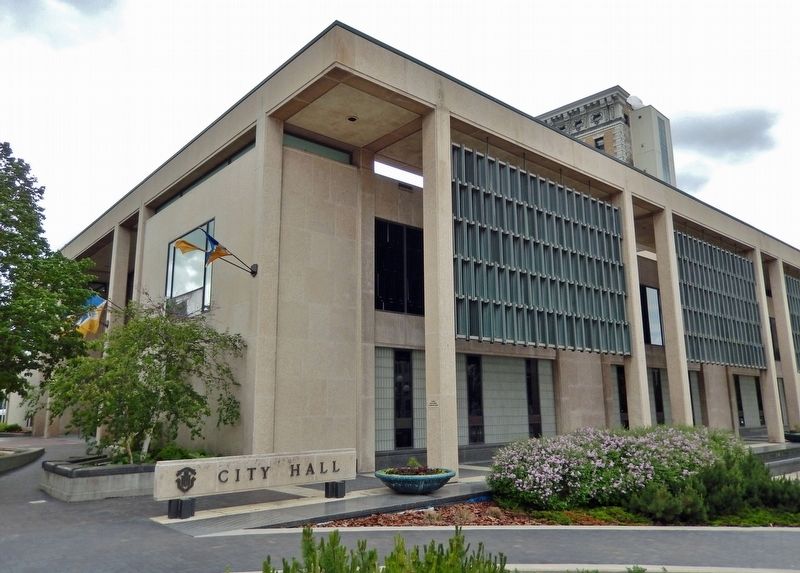
Completed in 1886, the statuesque "Gingerbread" building complete with all manner of Victorian grandeur, symbolized Winnipeg's coming of age at the end of the nineteenth century. Yet it was not long before plans were being made for the construction of another City Hall as Winnipeg experienced exponential growth in the first decade of the twentieth century. Were it not for the onset of World War I, the "Gingerbread" City Hall would likely have been replaced sooner. Instead, the building stood for another fifty years until its tower(Submitted on February 5, 2023, by Cosmos Mariner of Cape Canaveral, Florida.)began to crumble. Falling plaster narrowly missed injuring City Hall visitors in 1958. In 1961, the tower had to be removed and the whole building was demolished in 1962.Photographed by Cosmos Mariner, June 16, 20223. Winnipeg City Hall (northwest elevation)(marker is mounted behind “City Hall” sign on left)
3. Old City Hall. (Submitted on February 5, 2023, by Cosmos Mariner of Cape Canaveral, Florida.)
Photographed by Cosmos Mariner, June 16, 2022
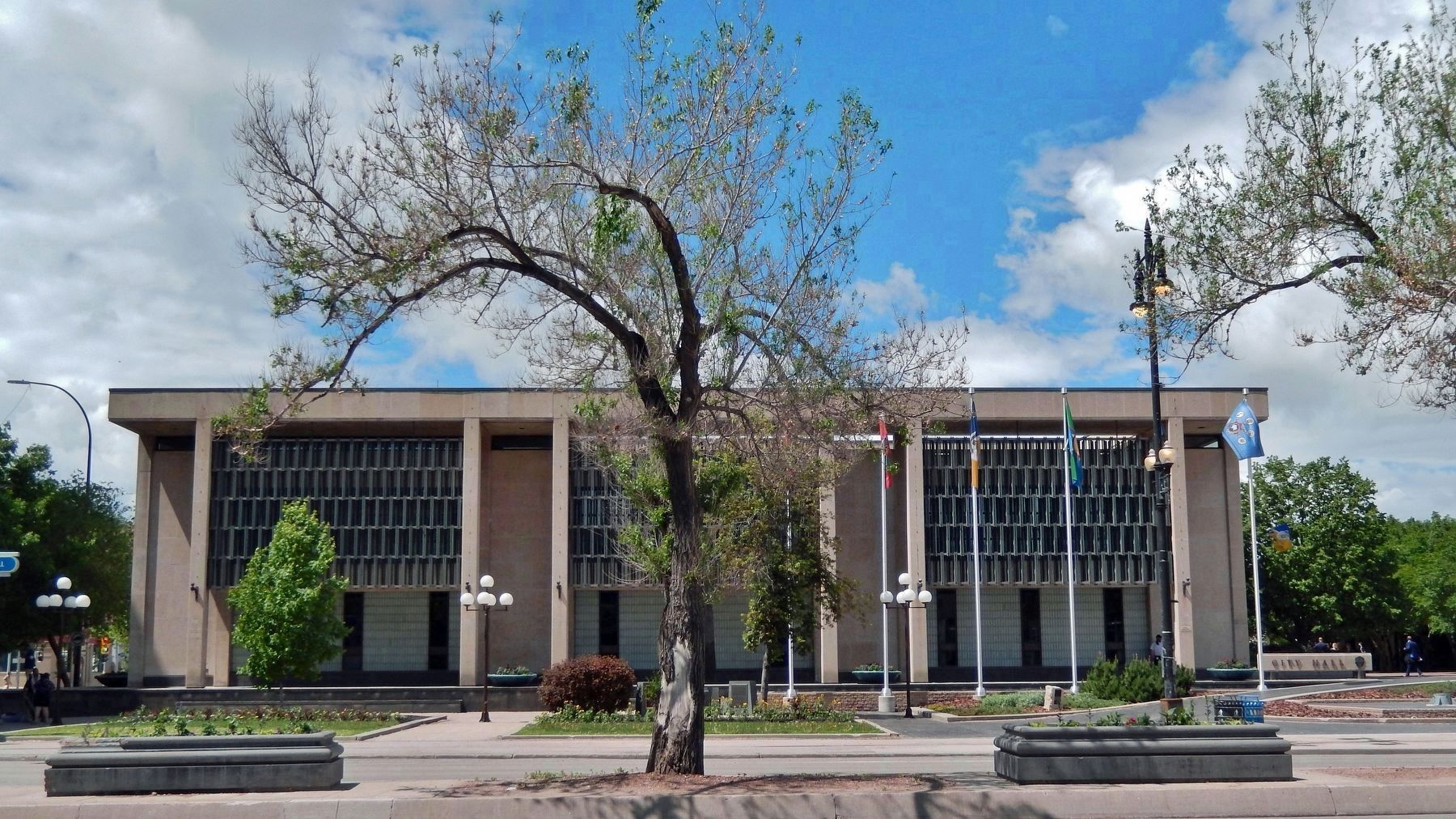
4. Winnipeg City Hall (east elevation)
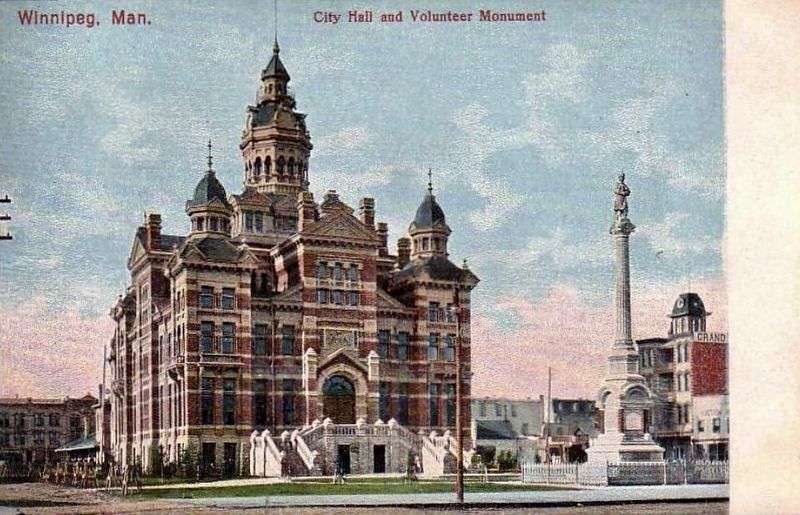
circa 1908
5. City Hall and Volunteer Monument
Credits. This page was last revised on March 12, 2025. It was originally submitted on February 4, 2023, by Cosmos Mariner of Cape Canaveral, Florida. This page has been viewed 1,146 times since then and 105 times this year. Photos: 1, 2, 3, 4. submitted on February 5, 2023, by Cosmos Mariner of Cape Canaveral, Florida. 5. submitted on February 6, 2023.
