Westerpark in Amsterdam, North Holland, Netherlands — Northwestern Europe
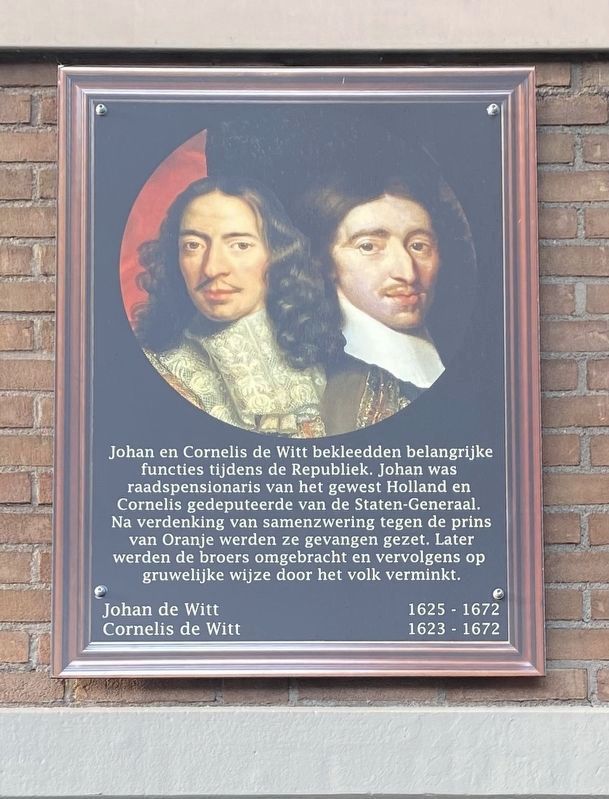
Johan and Cornelis de Witt
Photographed by Andrew Ruppenstein, November 2, 2022
1. Johan and Cornelis de Witt Marker

Johan de Witt 1625-1672 Cornelis de Witt 1623-1672
Johan en Cornelis de Witt bekleedden belangrijke functies tijdens de Republiek. Johan was raadspensionaris van het gewest Holland en Cornelis gedeputeerde van de Staten-Generaal. Na verdenking van samenzwering tegen de prins van Oranje werden ze gevangen gezet. Later werden de broers omgebracht en vervolgens op gruwelijke wijze door het volk verminkt.
Johan and Cornelis de Witt held important positions during the time of the Dutch Republic. Johan was council pensionary of the province of Holland and Cornelis deputy of the States General. After being suspected of plotting against the Prince of Orange, they were imprisoned. Later, the brothers were killed and then horribly mutilated by the people.
Erected by Geef Straten Een Gezicht.
Topics and series. This historical marker is listed in this topic list: Government & Politics. In addition, it is included in the Give Streets a Face / Geef Straten Een Gezicht series list.
Location. 52° 23.005′ N, 4° 52.616′ E. Marker is in Amsterdam,
this page online

Regionally, it is in Europe, the European Union, Atlantic Europe, the Benelux Low Countries, the Schengen Area, Western Europe, and the Western World. Historically, it finds itself in what was once the Holy Roman Empire.
Other nearby markers. At least 8 other markers are within walking distance of this marker: Coenraad van Beuningen (within shouting distance of this marker); Leopold van Limburg Stirum (within shouting distance of this marker); Mr. Gijsbert Karel van Hogendorp (about 90 meters away, measured in a direct line); Adam van der Duyn van Maasdam (about 120 meters away); Kattenslootbrug (approx. 0.2 kilometers away); Fannius Scholten (approx. 0.3 kilometers away); Joan Cornelis van der Hoop (approx. 0.3 kilometers away); Jacob Cats (approx. 0.3 kilometers away). Touch for a list and map of
Photographed by Andrew Ruppenstein, November 2, 2022
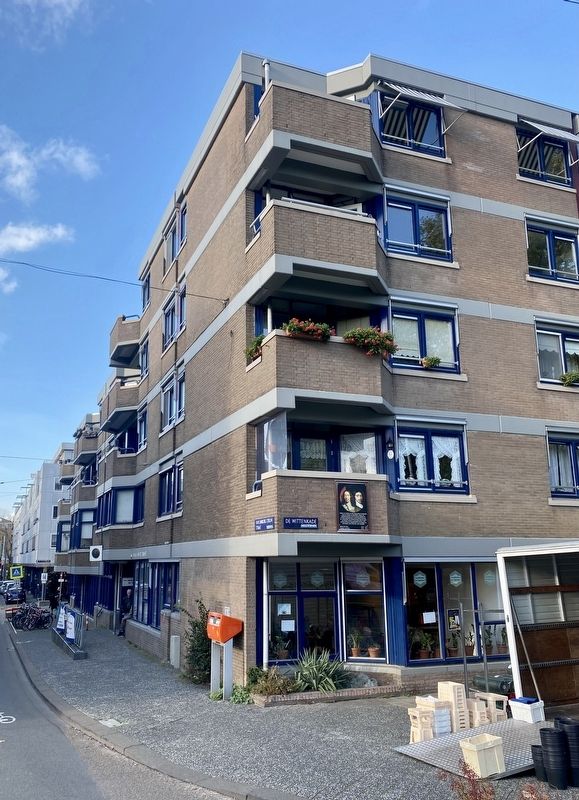
2. Johan and Cornelis de Witt Marker - wide view
Regarding Johan and Cornelis de Witt. A “pensionary”
Also see . . .
1. Cornelis de Witt (Wikipedia).
Overview: Cornelis de Witt (15 June 1623 – 20 August 1672) was a Dutch politician and naval commandant of the Golden Age. During the First Stadtholderless Period De Witt was an influential member of the Dutch States Party, and was in opposition to the House of Orange. In the Rampjaar of 1672 he was lynched together with his brother Johan de Witt by a crowd incited by Orange partisans.(Submitted on February 6, 2023.)
2. Johan de Witt.
Overview: Johan de Witt (24 September 1625 – 20 August 1672), lord of Zuid- en Noord-Linschoten, Snelrewaard, Hekendorp en IJsselvere, was a Dutch statesman and a major political figure in the Dutch Republic in the mid-17th century, the First Stadtholderless Period, when its flourishing sea trade in a period of globalization made the republic a leading European trading and seafaring power – now commonly referred to as the Dutch Golden Age. De Witt controlled the Dutch political system from around 1650 until shortly before his murder and cannibalisation(Submitted on February 6, 2023.)by a pro-Orangist mob in 1672.Jan de Baen (Courtesy of the Rijksmuseum via Wikimedia Commons), circa 16753. The Corpses of the De Witt BrothersWikipedia overview: The Corpses of the De Witt Brothers is a c. 1672–75 oil on canvas painting by the Dutch Golden Age painter Jan de Baen, now in the Rijksmuseum in Amsterdam.It shows the dead and mutilated bodies of the brothers Johan and Cornelis de Witt hanging upside down on the Groene Zoodje, the place of execution in front of the Gevangenpoort in The Hague.
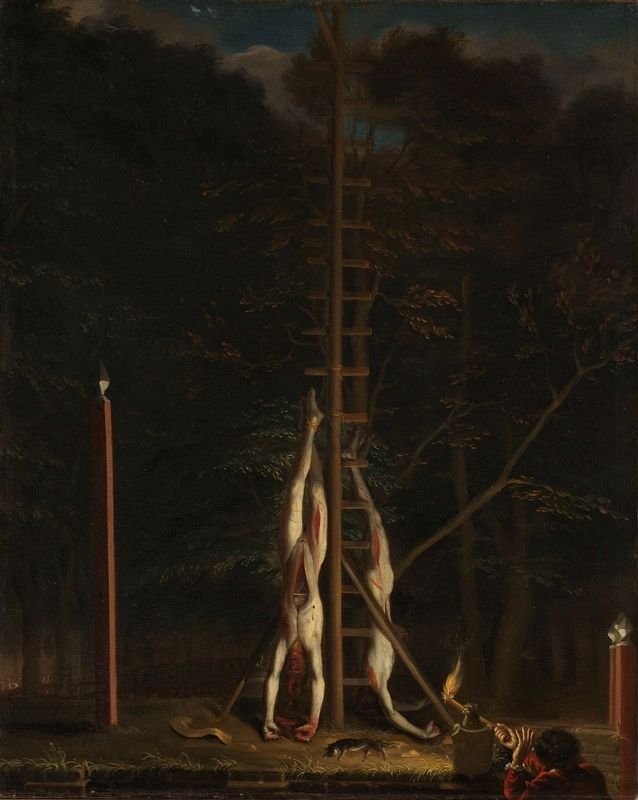
3. The Corpses of the De Witt Brothers (Wikipedia).
Description of the event upon which the painting is based: The two de Witt brothers, opponents of the House of Orange, had dominated Dutch politics for some years, but left the country unprepared for the invasion by Louis XIV of France in 1672, the infamous Rampjaar. Their killing, which took place on 20 August 1672, was an act of aggression of a furious local mob, supporters of the 22 year old William of Orange, the future William III of England, who had just been appointed stadtholder and commander-in-chief of the army and navy by the political opponents of Johan. On August 4 Johan had agreed to his forced resignation from his position as Grand Pensionary of Holland, i.e. the Secretary of the government. Then his brother Cornelis was accused of treason and arrested. The verdict at his trial was exile. Johan went to the jail from their house nearby to take him home for now. The burgerwacht, the local militia, gathered with a mob, angry at the mild verdict, and both brothers were lynched at the gate of the Gevangenispoort.(Submitted on February 6, 2023, by Andrew Ruppenstein of Lamorinda, California.)
Credits. This page was last revised on December 24, 2023. It was originally submitted on February 6, 2023, by Andrew Ruppenstein of Lamorinda, California. This page has been viewed 618 times since then and 127 times this year. Photos: 1, 2, 3. submitted on February 6, 2023, by Andrew Ruppenstein of Lamorinda, California.
