
Westerpark in Amsterdam, North Holland, Netherlands — Northwestern Europe
Johan van Oldenbarneveldt

Photographed by Andrew Ruppenstein, November 2, 2022
1. Johan van Oldenbarneveldt Marker

Johan van Oldenbarneveldt 1547-1619
Raadspensionaris van de Staten-Generaal tijdens de Tachtigjarige Oorlog. Werkte samen met Maurits van Oranje maar werd later verraden en onthoofd. Vondel schreef in 1657 het hekeldicht 'Het Stockske' als protest tegen zijn executie.
Council Pensionary of the States General during the Eighty Years' War. Worked together with Maurits van Oranje, was later betrayed and beheaded. Vondel wrote the satirical poem 'Het Stockske' in 1657 as a protest against his execution.
Erected by Geef Straten Een Gezicht.
Topics and series. This historical marker is listed in this topic list: Government & Politics. In addition, it is included in the Give Streets a Face / Geef Straten Een Gezicht series list. A significant historical year for this entry is 1657.
Location. 52° 22.639′ N, 4° 52.536′ E. Marker is in Amsterdam, Noord-Holland (North Holland). It is in Westerpark. It is on Van Oldenbarneveldtplein, on the right when traveling east. Touch for map. Marker is at or near this postal address: Van Oldenbarneveldtstraat 2HS, Amsterdam, Noord-Holland
this page online

Regionally, it is in Europe, the European Union, Atlantic Europe, the Benelux Low Countries, the Schengen Area, Western Europe, and the Western World. Historically, it finds itself in what was once the Holy Roman Empire.
Other nearby markers. At least 8 other markers are within walking distance of this marker: Zaagmolens / Sawmills (about 120 meters away, measured in a direct line); Rombout Hogerbeets (about 120 meters away); De Kostverlorenvaart (about 180 meters away); Hugo de Groot (about 180 meters away); Amalia van Solms (about 210 meters away); Gillis van Ledenberch (approx. 0.2 kilometers away); Gerard Schaep (approx. 0.3 kilometers away); Molen De Otter (The Otter Windmill) (approx. 0.3 kilometers away). Touch for a list and map of all markers in Amsterdam.
Related markers. Click here for a list of markers that are related to this marker.
Also see . . .
1. Johan van Oldenbarnevelt.
Overview: Johan van Oldenbarnevelt, Heer van Berkel en Rodenrijs (1600), Gunterstein (1611) and Bakkum (1613) (14 September 1547 – 13 May 1619) was a Dutch statesman and(Submitted on February 15, 2023.)revolutionary who played an important role in the Dutch struggle for independence from the Habsburg Castilian Empire.Photographed by Andrew Ruppenstein, November 2, 20222. Johan van Oldenbarneveldt Marker - wide view
On his founding of the Dutch East India Company: … He initiated and brokered the action that founded the Dutch East India Company (VOC) amalgamating half a dozen companies that traded on the Far East (the first from 1595) into one in 1602. The VOC would trade for two centuries. In 1612 the VOC developed the model for the corporation of using joint stock ownership by share holders, who could only get their investment back by selling its shares at a stock exchange, also an Oldenbarnevelt initiative. The basic principle of the model was over time adopted worldwide.

2. Trial of Oldenbarnevelt, Grotius and Hogerbeets (Wikipedia).
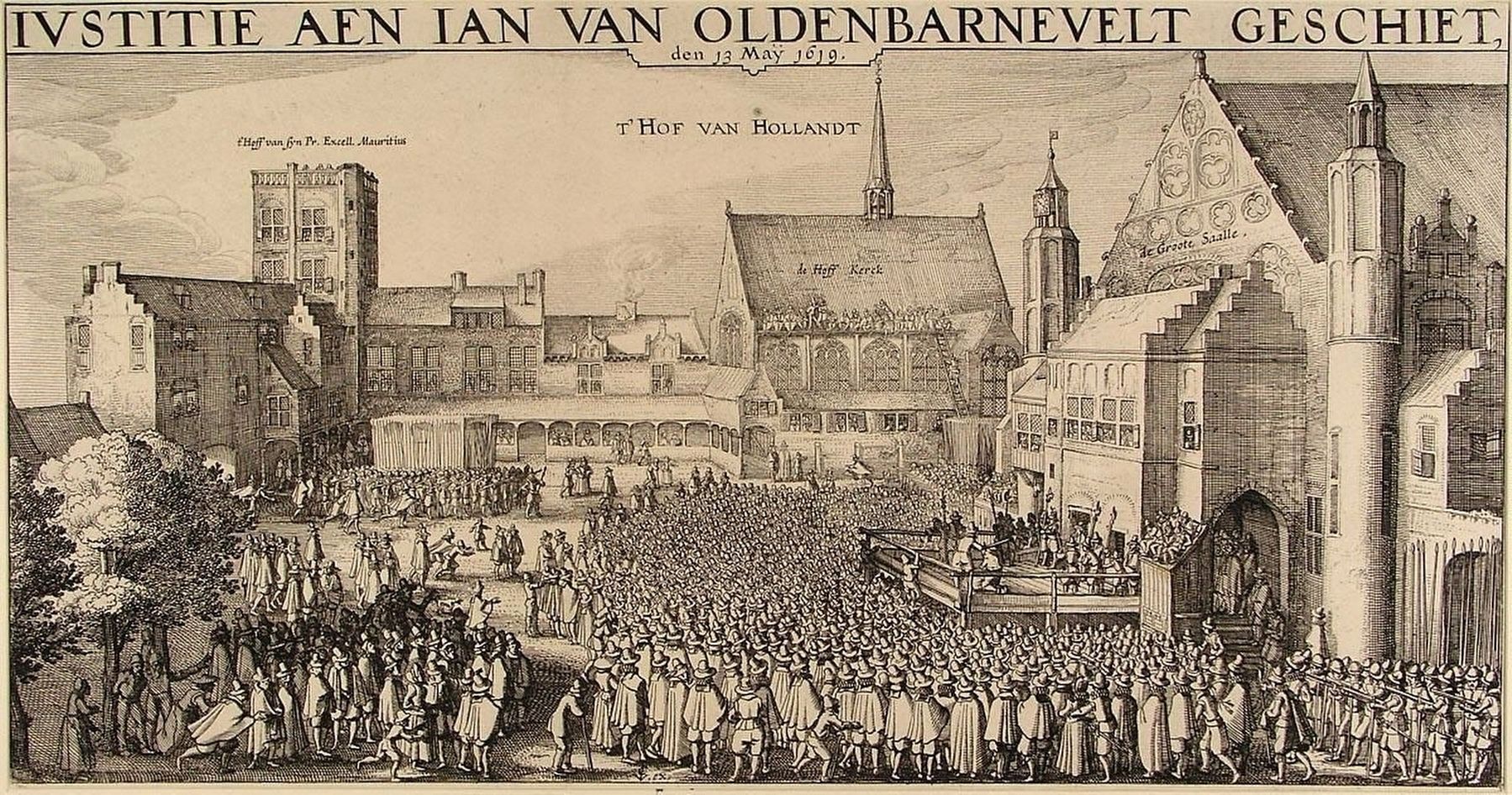
Overview: The Trial of Oldenbarnevelt, Grotius and Hogerbeets was the trial for treason of Johan van Oldenbarnevelt, Land's Advocate of Holland, Hugo Grotius, pensionary of Dordrecht, Rombout Hogerbeets, pensionary of Leiden, and their co-defendant Gilles van Ledenberg, secretary of the States of Utrecht by an ad hoc court of delegated judges of the(Submitted on February 15, 2023.)States General of the Netherlands that was held between 29 August 1618 and 18 May 1619, and resulted in a death sentence for Oldenbarnevelt, and sentences of life in prison for Grotius and Hogerbeets. The trial was and is controversial for political and legal reasons: political, because it put the crown on the Coup d'etat of stadtholder Maurice, Prince of Orange and his partisans in the States General of the Dutch Republic that ended the previous Oldenbarnevelt regime and put the Orangist party in power for the time being; legal, because the trial deprived the defendants of their civil rights under contemporary law, and the judges changed both the "constitution" of the Republic and its laws in an exercise of ex post facto legislation.Photographed by Geheugen van Nederland (via Wikimedia Commons), 16193. Engraving depicting Van Oldenbarnevelt's execution… On Monday, 13 May 1619, the death sentence was read to Van Oldenbarnevelt; and, therefore, on the same morning, the old statesman, at the age of seventy-one, was beheaded in the Binnenhof, in The Hague. His last words to the gathered crowd were: "Men, do not believe I am a traitor; I have acted sincerely and piously, as a good patriot, and I shall die this way." Van Oldenbarnevelt's last words to the executioner were purportedly: "Make it short, make it short." He was buried under the Court Chapel (Hofkapel) at the Binnenhof. - Wikipedia
Credits. This page was last revised on December 30, 2023. It was originally submitted on February 15, 2023, by Andrew Ruppenstein of Lamorinda, California. This page has been viewed 309 times since then and 38 times this year. Photos: 1, 2, 3. submitted on February 15, 2023, by Andrew Ruppenstein of Lamorinda, California.
