
Sayre in Bradford County, Pennsylvania — The American Northeast (Mid-Atlantic)
The Lehigh Valley Railroad Comes to Sayre
Photographed by Cosmos Mariner, May 19, 2022
1. The Lehigh Valley Railroad Comes to Sayre Marker
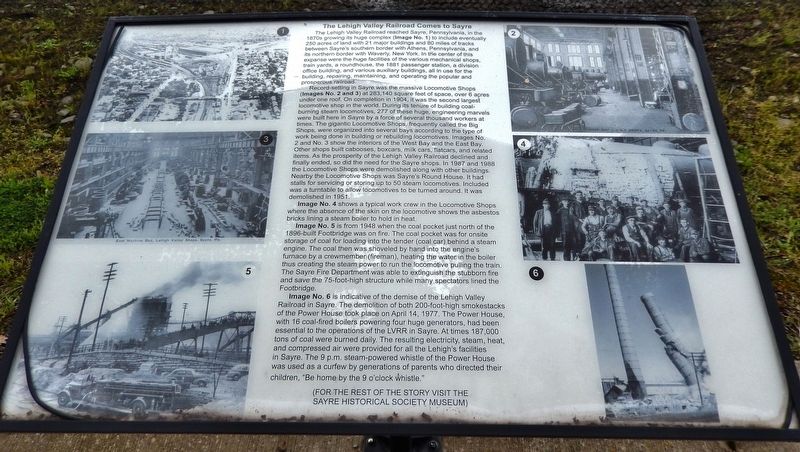
The Lehigh Valley Railroad reached Sayre, Pennsylvania, in the 1870s growing its huge complex (Image No. 1) to include eventually 250 acres of land with 21 major buildings and 80 miles of tracks between Sayre's southern border with Athens, Pennsylvania, and its northern border with Waverly, New York. In the center of this expanse were the huge facilities of the various mechanical shops, train yards, a roundhouse, the 1881 passenger station, a division office building, and various auxiliary buildings, all in use for the building, repairing, maintaining, and operating the popular and prosperous railroad.
Record-setting in Sayre was the massive Locomotive Shops (Images No. 2 and 3) at 283,140 square feet of space, over 6 acres under one roof. On completion in 1904, it was the second largest locomotive shop in the world. During its tenure of building coal-burning steam locomotives, 277 of these huge, engineering marvels were built here in Sayre by a force of several thousand workers at times. The gigantic Locomotive Shops, frequently called the Big Shops, were organized into several bays according to the type of work being
this page online
Image No. 4 shows a typical work crew in the Locomotive Shops where the absence of the skin on the locomotive shows the asbestos bricks lining a steam boiler to hold in heat.
Image No. 5 is from 1948 when the coal pocket just north of the 1896-built Footbridge was on fire. The coal pocket was for onsite storage of coal for loading into the tender (coal car) behind a steam engine. The coal then was shoveled by hand into the engine's furnace by a crewmember (fireman), heating the water in the boiler thus creating the steam power to run the

2. Marker detail: LVRR Complex in Sayre (image 1)
Image No. 6 is indicative of the demise of the Lehigh Valley Railroad in Sayre. The demolition of both 200-foot-high smokestacks of the Power House took place on April 14, 1977. The Power House, with 16 coal-fired boilers powering four huge generators, had been essential to the operations of the LVRR in Sayre. At times 187,000 tons of coal were burned daily. The resulting electricity, steam, heat, and compressed air were provided for all the Lehigh's facilities in Sayre. The 9 p.m. steam-powered whistle of the Power House was used as a curfew by generations of parents who directed their children, "Be home by the 9 o'clock whistle."
Topics. This historical marker is listed in these topic lists: Communications • Industry & Commerce • Railroads & Streetcars. A significant historical year for this entry is 1904.
Location. 41° 58.874′ N, 76° 30.847′ W. Marker is in Sayre, Pennsylvania, in

3. Marker detail: Locomotive Shops, West Bay (image 2)

Regionally, this marker is in the American Northeast and in the Mid-Atlantic. Globally, it is in North America, the Western Hemisphere, the Western World, and the Anglosphere. Historically, it finds itself in what was once the Haudenosaunee (Iroquois) Confederacy and also one of the original Thirteen Colonies.
Other nearby markers. At least 8 other markers are within walking distance of this marker: Passenger Station, Footbridge, and Black Diamond (a few steps from this marker); A Horse Town, the Freight Station, and the Desmond Street Clock (a few steps from this marker); Sayre, A Boomtown (a few steps from this marker); The Lehigh and Early Sayre (within shouting distance of this marker); Parks, Canteen & Schools (within

4. Marker detail: Locomotive Shops, East Bay (image 3)
Related markers. Click here for a list of markers that are related to this marker.
Also see . . . Sayre Yard.
The large yard, and the purpose-built company town, Sayre, Pennsylvania were founded as part of a planned program of expansion and extension to the young railroad's infrastructure. Until the dismantlement under Conrail, the yard engine maintenance building had the largest structure in the United States devoted to the maintenance and construction of railroad locomotives.(Submitted on February 17, 2023, by Cosmos Mariner of Cape Canaveral, Florida.)
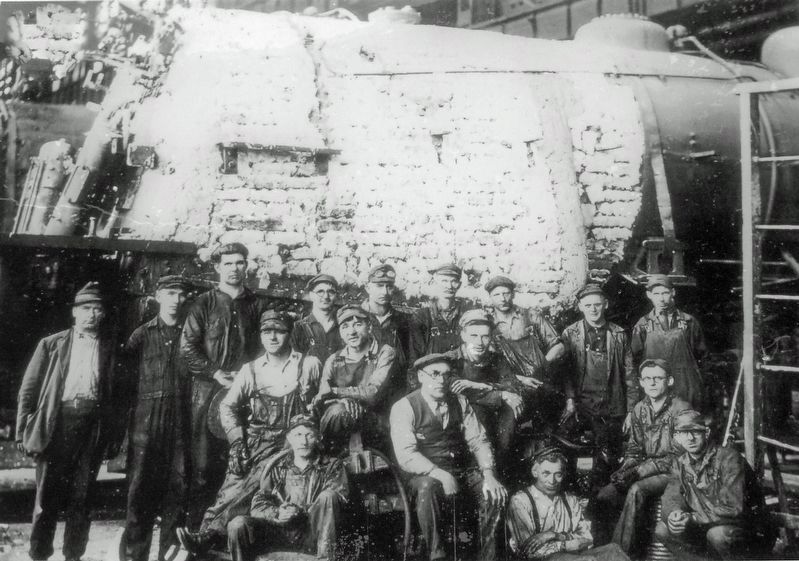
5. Marker detail: Locomotive Shop Crew (image 4)

Photographed by Cosmos Mariner, May 19, 2022
6. The Lehigh Valley Railroad Comes to Sayre Marker
Credits. This page was last revised on February 18, 2023. It was originally submitted on February 15, 2023, by Cosmos Mariner of Cape Canaveral, Florida. This page has been viewed 1,725 times since then and 189 times this year. Photos: 1, 2, 3, 4, 5, 6. submitted on February 17, 2023, by Cosmos Mariner of Cape Canaveral, Florida.
