
Fort Sill in Comanche County, Oklahoma — The American South (West South Central)
U.S. MGR-3 Little John Rocket
Photographed by James Hulse, September 9, 2021
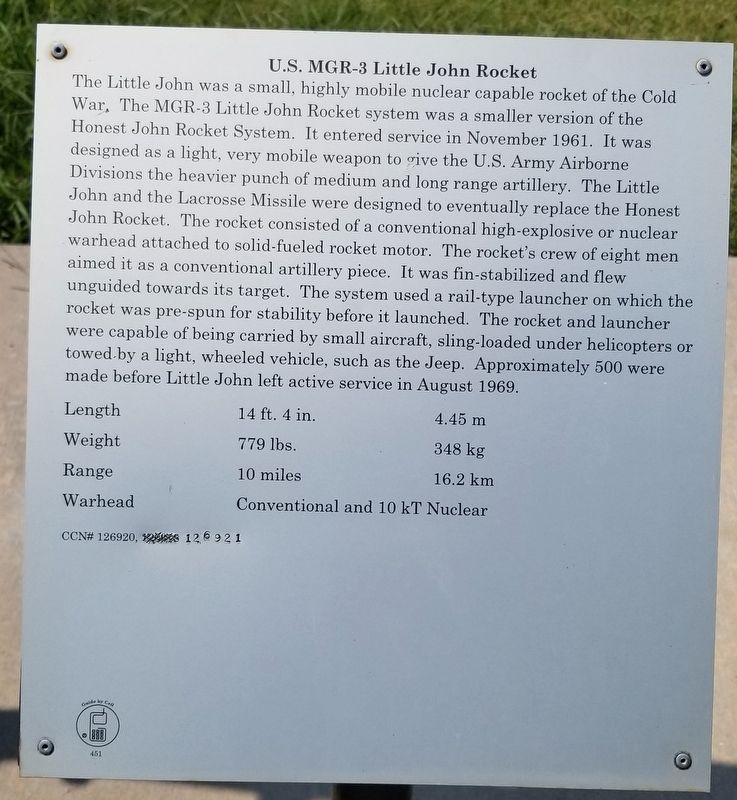
1. U.S. MGR-3 Little John Rocket Marker
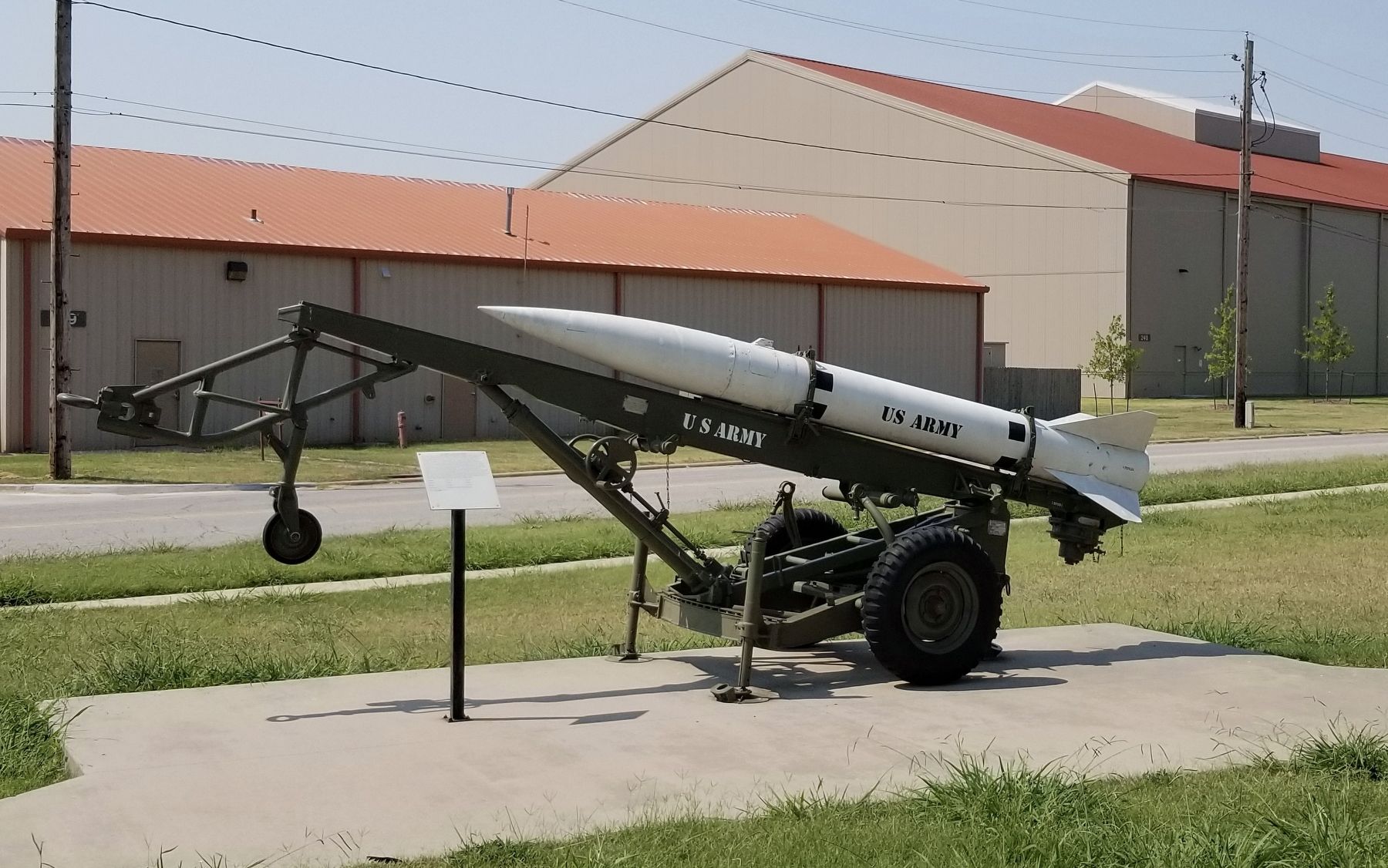
The Little John was a small, highly mobile nuclear capable rocket of the Cold War. The MGR-3 Little John Rocket system was a smaller version of the Honest John Rocket System. It entered service in November 1961. It was designed as a light, very mobile weapon to give the U.S. Army Airborne Divisions the heavier punch of medium and long range artillery. The Little John and the Lacrosse Missile were designed to eventually replace the Honest John Rocket. The rocket consisted of a conventional high-explosive or nuclear warhead attached to solid-fueled rocket motor. The rocket's crew of eight men aimed it as a conventional artillery piece. It was fin-stabilized and flew unguided towards its target. The system used a rail-type launcher on which the rocket was pre-spun for stability before it launched. The rocket and launcher were capable of being carried by small aircraft, sling-loaded under helicopters or towed by a light, wheeled vehicle, such as the Jeep. Approximately 500 were made before Little John left active service in August 1969.
Length - 14 ft. 4 in. - 4.45 m
Weight - 779 lbs. - 348 kg
Range - 10 miles - 16.2 km
Warhead - Conventional and 10 kT Nuclear
CCN# 126920, 126921
Erected by U.S. Army Field Artillery Museum. (Marker Number 451.)
Topics. This
this page online
Location. 34° 39.991′ N, 98° 23.174′ W. Marker is in Fort Sill, Oklahoma, in Comanche County. It is at the intersection of Corral Road and Randolph Road, on the right when traveling west on Corral Road. The marker is located in the central section of Artillery Park at the U.S. Army Field Artillery Museum. Touch for map. Marker is in this post office area: Fort Sill OK 73503, United States of America. Touch for directions.

Regionally, this marker is in Oklahoma’s Kiowa Tribe, in the Comanche Nation, and in Southwest Oklahoma. It is also in the American South, specifically on the prairies, and on the Southern Plains. Globally, it is in North America, the Western Hemisphere, the Western World, and the Anglosphere. Historically, it finds itself in what was once New Spain, the Comanchería, the territory of the Mississippian Culture, and the Louisiana Purchase.
Other nearby markers. At least 8 other markers are within walking distance of this marker: U.S. M44A1 155mm Self-Propelled Howitzer (a few steps from this marker); U.S. T-162 175mm Self-Propelled Howitzer (a few steps from this marker); U.S. M4 Lacrosse Missile (within shouting distance of this marker); U.S. MGM-29 Sergeant Missile (within shouting distance of this marker); U.S. M56 90mm Self-Propelled Gun Scorpion (within shouting distance of this marker); U.S. M1 240mm Howitzer (within shouting distance of this marker); XM-104 105mm Self-Propelled Gun (within shouting distance of this marker); U.S. M1A1 Cannon and M3A1 Carriage Transport Wagons (within shouting distance of this marker). Touch for a list and map of all markers in Fort Sill.
More about this marker. Marker and Museum are located on Fort Sill, an active U.S. military
Photographed by James Hulse, September 9, 2021
2. The U.S. MGR-3 Little John Rocket and Marker
Also see . . . U.S. Army Artillery Museum. (Submitted on February 18, 2023, by James Hulse of Medina, Texas.)
Credits. This page was last revised on October 3, 2024. It was originally submitted on February 17, 2023, by James Hulse of Medina, Texas. This page has been viewed 583 times since then and 45 times this year. Photos: 1, 2. submitted on February 18, 2023, by James Hulse of Medina, Texas.
