Fort Wadsworth on Staten Island in Richmond County, New York — The American Northeast (Mid-Atlantic)
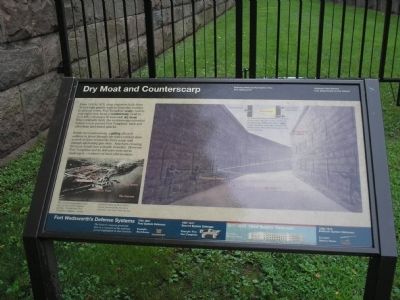
Dry Moat and Counterscarp
Fort Wadsworth
| — | Gateway Nat’l Rec Area, National Park Service, U.S. Department of the Interior | — |
Photographed by Bill Coughlin, August 13, 2009
1. Dry Moat and Counterscarp Marker
Within the counterscarp, a gallery allowed soldiers to shoot through the wall’s vertical slots as well as from behind the fort’s scarp wall through alternating gun slots. Attackers crossing the moat would face a deadly crossfire. However, Fort Tompkins and its defenses were never challenged – evidence of their effectiveness.
Erected by National Park Service, U.S. Department of the Interior.
Topics. This historical marker is listed in these topic lists: Forts and Castles • Military. A significant historical year for this entry is 1859.
Location. 40° 36.261′ N, 74° 3.379′ W. Marker is on Staten Island, New York, in Richmond County. It is in Fort Wadsworth. It is on Tompkins Street, on the left when traveling north. Marker is located in the Fort Wadsworth Unit
this page online

Regionally, this marker is in New York City. It is also in the American Northeast, in the Mid-Atlantic, and on the Eastern Seaboard. Globally, it is in the North Atlantic Region, North America, the Western Hemisphere, the Western World, and the Anglosphere. Historically, it finds itself in what was once New Netherland and also one of the original Thirteen Colonies.
Other nearby markers. At least 8 other markers are within walking distance of this marker: Battery Duane (within shouting distance of this marker); Fort Wadsworth (about 300 feet away, measured in a direct line); Fort Tompkins (about 300 feet away); Defending New York Harbor (about 300 feet away); Battery Weed (about 300 feet away); Verrazano – Narrows Bridge (about 300 feet away); a different marker also named Fort Wadsworth (about 500 feet away); Torpedo Building (about 600 feet away). Touch for a list and map of all markers in Staten Island.
Another marker is no longer nearby. Historic Fort Wadsworth
Photographed by Bill Coughlin, August 13, 2009
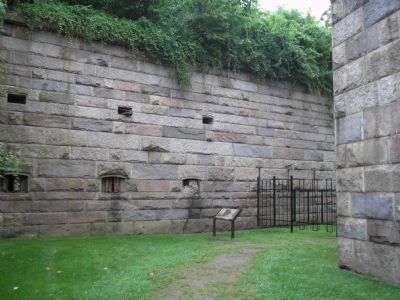
2. Marker behind Fort Tompkins
The alternating gun slots of the counterscarp can be seen in this photo.
More about this marker. The background of the marker contains an illustration of the second Fort Tompkins’ Scarp (or outer wall), Counterscarp Gallery and Dry Moat. It explains the field of fire of defending soldiers and why the soldiers could not shoot each other. The bottom left of the marker features a picture of Fort Tompkins and Battery Weed in New York Harbor. It has a caption of “The counterscarp gallery was part of New York’s defense system. It provided Fort Tompkins, which protected Battery Weed below, which protected the Narrows entrance into New York Harbor.”
The bottom of the marker contains illustrations of Fort Wadsworth’s Defense Systems during different time periods: First System Defenses, 1794 – 1807; Second System Defenses, 1807 – 1817; Third System Defenses, 1817 – 1876 (which includes Battery Weed); and Endicott System Defenses, 1890 – 1910.
Also see . . . Fort Wadsworth. Wikipedia entry. (Submitted on May 14, 2020, by Larry Gertner of New York, New York.)
Photographed by Bill Coughlin, August 13, 2009
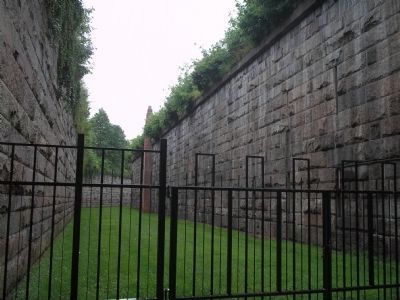
3. Dry Moat
An attcking enemy entering this moat would be fired upon by soldiers from the scarp on the right and the counterscarp on the left.
Photographed by Bill Coughlin, August 13, 2009
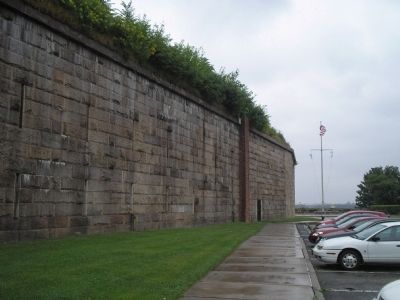
4. Fort Tompkins outer wall
The dry moat and counterscarp are located on the western side of Fort Tompkins.
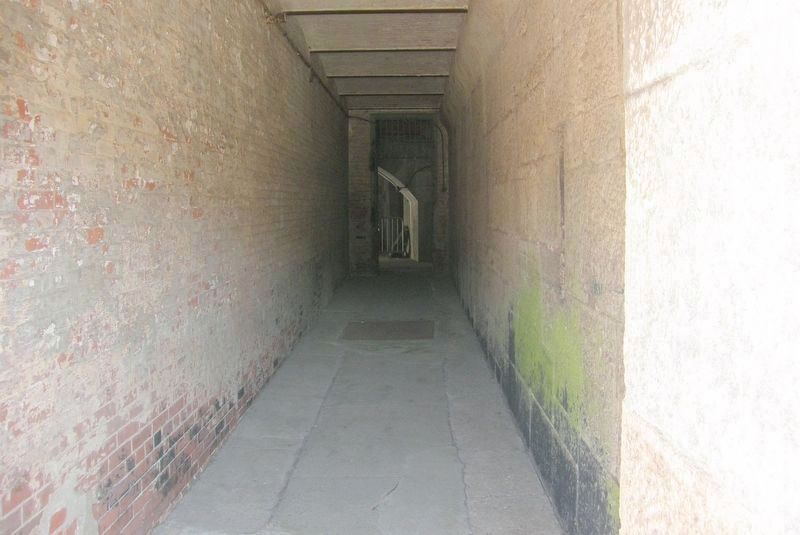
Photographed by Larry Gertner, July 31, 2013
5. Inside a gallery
Heading to the fort's open interior during a Ranger-led tour.
Credits. This page was last revised on September 19, 2023. It was originally submitted on August 15, 2009, by Bill Coughlin of Woodland Park, New Jersey. This page has been viewed 2,216 times since then and 59 times this year. Photos: 1, 2, 3, 4. submitted on August 15, 2009, by Bill Coughlin of Woodland Park, New Jersey. 5. submitted on May 10, 2020, by Larry Gertner of New York, New York.
