Lowell in Kent County, Michigan — The American Midwest (Great Lakes)
Fur Trade in Lowell
Where The Rivers Meet
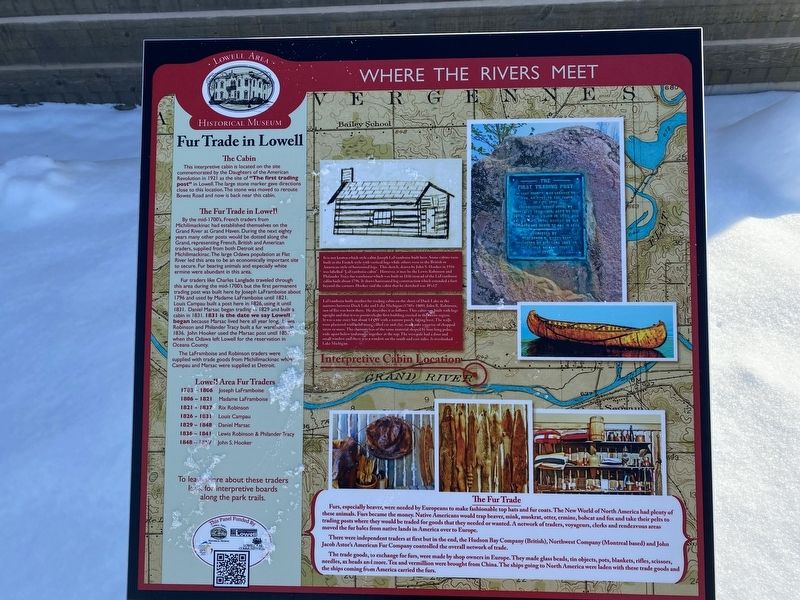
Photographed by J.T. Lambrou, February 1, 2023
1. Fur Trade in Lowell Marker
The Cabin
This interpretive cabin is located on the site commemorated by the Daughters of the American Revolution in 1921 as the site of "The first trading post" in Lowell. The large stone marker gave directions close to this location. The stone was moved to reroute Bowes Road and now is back near this cabin.
The Fur Trade in Lowell
By the mid-1700's, French traders from Michilimackinac had established themselves on the Grand River at Grand Haven. During the next eighty years many other posts would be dotted along the Grand, representing French, British and American traders, supplied from both Detroit and Michilimackinac. The large Odawa population at Flat River led this area to be an economically important site to secure. Fur bearing animals and especially white ermine were abundant in this area.
Fur traders like Charles Langlade traveled through this area during the mid-1700's but the first permanent trading post was built here by Joseph LaFramboise about 1796 and used by Madame LaFramboise until 1821. Louis Campau built a post here in 1826, using it until 1831. Daniel Marsac began trading in 1829 and built a cabin
this page online
Lowell Area Fur Traders
1783-1806 Joseph LaFramboise
1806-1821 Madame LaFramboise
1821 1837 Rix Robinson
1826 1831 Louis Campau
1829-1848 Daniel Marsac
1836-1841 Lewis Robinson & Philander Tracy
1848-1857 John S. Hooker
To learn more about these traders look for interpretive boards along the park trails.
It is not known which style cabin Joseph LaFramboise built here. Some cabins were built in the French style with vertical logs while others were in the British or American style of horizontal logs. This sketch, drawn by John S. Hooker in 1916 was labelled "LaFramboise cabin". However, it may be the Lewis Robinson and Philander Tracy fur warehouse which was built in 1836 instead of the LaFramboise cabin built about 1796. It shows horizontal log construction which extended a foot beyond the corners. Hooker said the cabin that he sketched was 30’ x 12’. LaFramboise
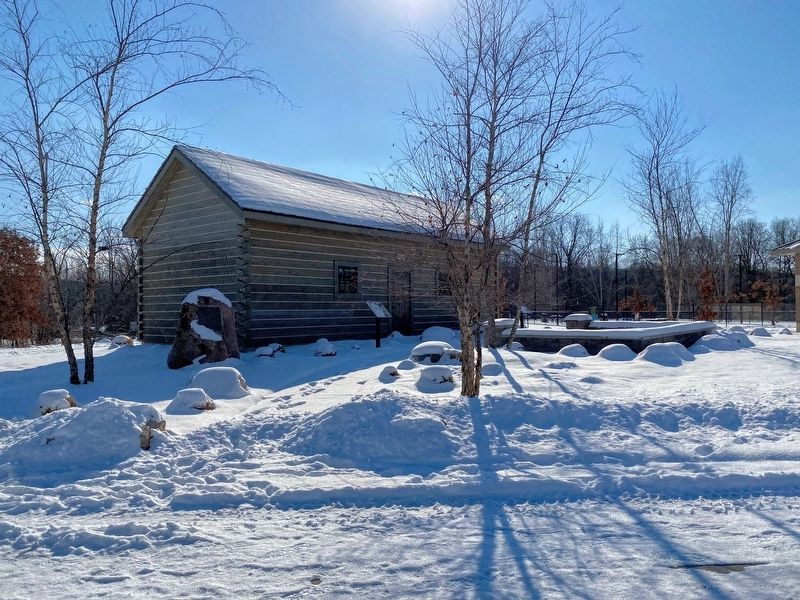
Photographed by J.T. Lambrou, February 1, 2023
2. Fur Trade in Lowell Marker
The marker is just to the left of the door.
There were independent traders at first but in the end, the Hudson Bay Company (British), Northwest Company (Montreal based) and John Jacob Astor's American Fur Company controlled the overall network of trade.
The trade goods, to exchange for furs, were made by shop owners in Europe. They made glass beads, tin objects, pots, blankets, rifles, scissors, needles, ax heads and more. Tea and vermillion were brought from China. The ships going to North America were laden with these trade goods and the ships coming from America carried the furs.
Erected by Lowell Area Historical Museum.
Topics. This historical marker is listed in these topic lists: Animals • Settlements & Settlers. A significant historical year for this entry is 1796.
Location. 42° 55.77′ N, 85° 22.299′ W. Marker is in Lowell, Michigan, in Kent County. It can be reached from Bowes Road near Fulton Street Southeast (Michigan Route 21), on the right when traveling south. Touch for map. Marker is at or near this postal address: 11000 Bowes Road, Lowell MI 49331, United States of America. Touch for directions.

Regionally, this marker is in West Michigan and in Greater Grand Rapids. It is also in the American Midwest. Globally, it is in North America, the Western Hemisphere, the Western World, and the Anglosphere. Historically, it finds itself in what was once the Northwest Territory.
Other nearby markers. At least 8 other markers are within 2 miles of this marker, measured as the crow flies: Joseph and Magdelaine LaFramboise (here, next to this marker); First Trading Post in Kent County (within shouting distance of this marker); Robert W. Graham Home (approx. 1½ miles away); South Broadway St. (approx. 1.6 miles away); Waverly Hotel Block (approx. 1.6 miles away); Museum Block (approx. 1.6 miles away); Broadway Street (approx. 1.6 miles away); Union Block (approx. 1.6 miles away). Touch for a list and map of all markers in Lowell.
Credits. This page was last revised on February 25, 2023. It was originally submitted on February 20, 2023, by J.T. Lambrou of New Boston, Michigan. This page has been viewed 1,224 times since then and 99 times this year. Photos: 1. submitted on February 20, 2023, by J.T. Lambrou of New Boston, Michigan. 2. submitted on February 21, 2023, by J.T. Lambrou of New Boston, Michigan. • J. Makali Bruton was the editor who published this page.
