Fort Sill in Comanche County, Oklahoma — The American South (West South Central)
U.S. M981 Fire Support Team Vehicle
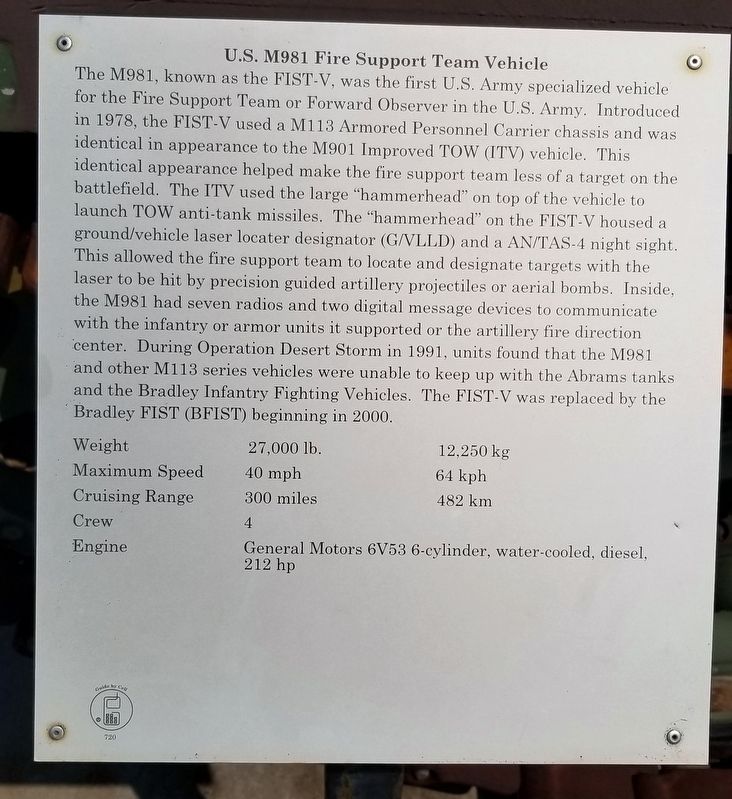
Photographed by James Hulse, September 9, 2021
1. U.S. M981 Fire Support Team Vehicle Marker
this page online
Weight - 27,000 lb. - 12,250 kg
Maximum Speed - 40 mph - 64 kph
Cruising Range - 300 miles - 482 km
Crew 4
Engine - General Motors 6V53 6-cylinder, water-cooled, diesel, 212 hp
Erected by U.S. Army Field Artillery Museum. (Marker Number 720.)
Topics. This historical marker is listed in this topic list: War, 1st Iraq & Desert Storm. A significant historical year for this entry is 1978.
Location. 34° 40.006′ N, 98° 23.233′ W. Marker is in Fort Sill, Oklahoma, in Comanche County. It is at the intersection of Corral Road and Randolph Road, on the right when traveling west on Corral Road. The marker is located in the central section of Artillery Park at the U.S. Army Field Artillery Museum. Touch for map. Marker is in this post office area: Fort Sill OK 73503, United States of America. Touch for directions.

Regionally, this marker is in the Kiowa Tribe, in the Comanche Nation, and in Southwest Oklahoma—Great Plains Country. It is also in the American South, specifically on the prairies, and on the Southern Plains. Globally, it is in North America, the Western Hemisphere, the Western World,

Photographed by James Hulse, September 9, 2021
2. The U.S. M981 Fire Support Team Vehicle and Marker
Other nearby markers. At least 8 other markers are within walking distance of this marker: U.S. M548 Cargo Carrier (a few steps from this marker); U.S. M110A2 8-inch Self-Propelled Howitzer (a few steps from this marker); Austrian GHN-45 155mm Field Gun/Howitzer (within shouting distance of this marker); South African G-5 155mm Field Gun/Howitzer (within shouting distance of this marker); U.S. M198 155mm Howitzer (within shouting distance of this marker); U.S. M109A3 155mm Self-Propelled Howitzer (within shouting distance of this marker); Soviet M1973 (2S3) 152mm Self-Propelled Gun/Howitzer (within shouting distance of this marker); U.S. MGM-31A Pershing II (within shouting distance of this marker). Touch for a list and map of all markers in Fort Sill.
More about this marker. Marker and Museum are located on Fort Sill, an active U.S. military installation. The museum is open to the public, but appropriate identification is required for access for Fort Sill.
Also see . . . U.S. Army Artillery Museum.

Photographed by James Hulse, September 9, 2021
3. The side view of the U.S. M981 Fire Support Team Vehicle and Marker
Credits. This page was last revised on February 26, 2023. It was originally submitted on February 26, 2023, by James Hulse of Medina, Texas. This page has been viewed 1,023 times since then and 139 times this year. Photos: 1, 2, 3. submitted on February 26, 2023, by James Hulse of Medina, Texas.
