
Augsburg, Bavaria, Germany — Central Europe
Die Stadtmetzg
⎯⎯⎯
The Municipal Butcher
| — | Altbaierischer Oxenweg | — |
Photographed by Andrew Ruppenstein, November 15, 2022
1. Die Stadtmetzg / The Municipal Butcher Marker

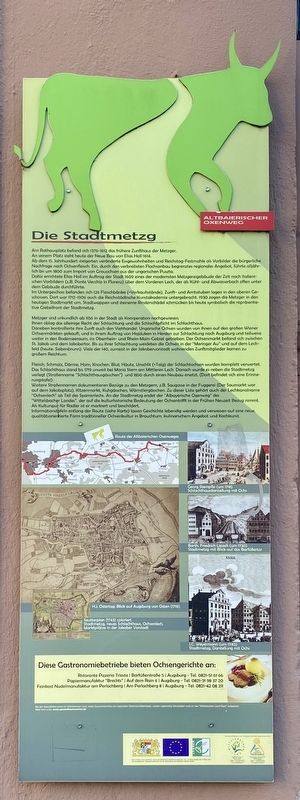
Am Rathausplatz befand sich 1376-1612 das frühere Zunfthaus der Metzger. An seinem Platz steht heute der Neue Bau von Elias Holl 1614.
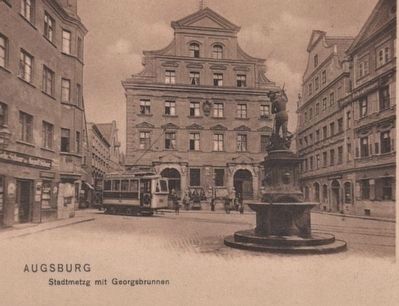
Ab dem 15. Jahrhundert steigerten veränderte Essgewohnheiten und Reichstag-Festmahle als Vorbilder die bürgerliche Nachfrage nach Ochsenfleisch. Ein, durch den verbreiteten Flachsanbau begrenztes regionales Angebot, führte alljähr- lich bis um 1800 zum Import von Grauochsen aus der ungarischen Puszta. Dafür errichtete Elias Holl im Auftrag der Stadt 1609 eines der modernsten Metzgereigebäude der Zeit nach italienischen Vorbildern (z.B. Ponte Vecchio in Florenz) über dem Vorderen Lech, der als Kühl- und Abwasserbach offen unter dem Gebäude durchführte. Im Untergeschoss befanden sich 126 Fleischbänke (-Verkaufsstände). Zunft- und Amtsstuben lagen in den oberen Geschossen. Dort war 1712-1906 auch die Reichsstädtische Kunstakademie untergebracht. 1930 zogen die Metzger in den heutigen Stadtmarkt um. Stadtwappen und steinerne Rinderschädel schmücken bis heute symbolisch die repräsentative Giebelfront der Stadtmetzg.
Metzger sind urkundlich ab 1156 in der Stadt als Koorperation
this page online
Fleisch, Schmalz, Därme, Horn, Knochen, Blut; Häute, Unschlit (=Talg) der Schlachtochsen wurden komplett verwertet. Das Schlachthaus stand bis 1719 unweit bei Maria Stern am Mittleren Lech. Danach wurde es neben die Stadtmetzg verlegt (Straßenname "Schlachthausgässchen") und 1850 durch einen Neubau ersetzt. (Dort befindet sich eine Erinnerungstafel)
Weitere Straßennamen dokumentieren Bezüge zu den Metzgern, z.B. Saugasse in der Fuggerei (Der Saumarkt war auf
Photographed by Andrew Ruppenstein, November 15, 2022
2. Die Stadtmetzg / The Municipal Butcher Marker - wide view
Informationstafeln entlang der Route (siehe Karte) lassen Geschichte lebendig werden und verweisen auf eine neue, qualitätsorientierte Form traditioneller Ochsenkultur in Brauchtum, kulinarischem Angebot und Kochkunst.

Photographed by Andrew Ruppenstein, November 15, 2022
3. Die Stadtmetzg / The Municipal Butcher building
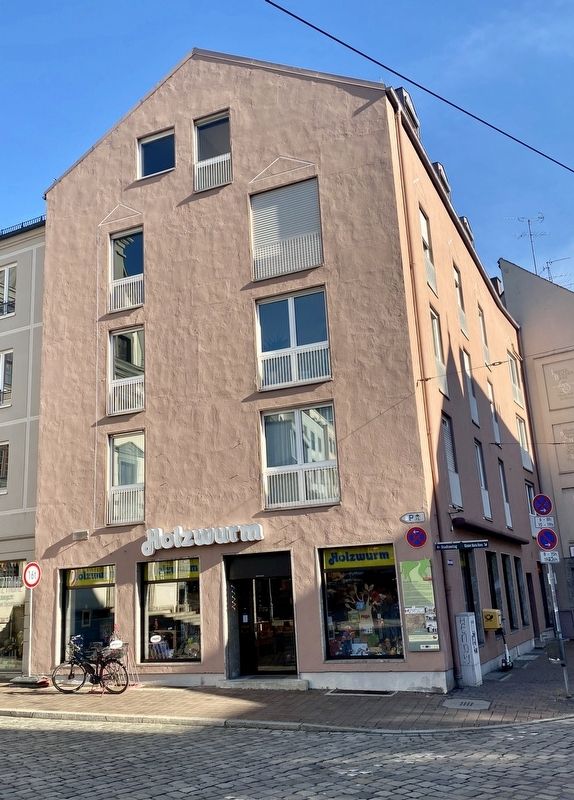
The marker is out of the picture, on the right.
Butchers are documented from 1156 in the city as a corporate body. They had the sole right to slaughter and the obligation to slaughter in the slaughterhouse. In addition, their guild also controlled the livestock trade. Hungarian oxen were bought by them at the large Viennese ox markets, and on their behalf the herds were herded by Hungarian drivers to Augsburg for slaughter, or for some, further to the Lake Constance area, to the Upper Rhine and Rhine-Main area. The ox market was located between the St. Jakob Church and the Jakober Gate. Until they were slaughtered, the oxen grazed in
Photographed by Verlag J.J. Brack, circa 1905
4. Stadtmetzg mit Georgsbrunnen postcard (cropped)
The meat, lard, intestines, horn, bones, blood, hides and tallow from the slaughtered oxen were all completely used. Until 1719, the slaughterhouse was not far from Maria Stern on the Middle Lech. It was then moved next to the Stadtmetzg (street name Schlachthausgässchen, “Slaughterhouse Alley”) and replaced by a new building in 1850. (There is a plaque there) Other street names document references to the butchers, e.g. Saugasse in the Fuggerei (the Saumarkt was on Jakobsplatz), Kitzenmarkt, Kuhgässchen, Wämstlergässchen. This list also includes the Lech canal name "Ochsenlech" as part of the Sparrenlech. The "Albayerische Oxenweg" of the "Wittelsbacher Land" ends at the Stadtmetzg, which leads to the cultural-historical significance of the ox round-ups in the early modern period. It is marked and signposted as a cultural trail for cyclists. Information boards along the route (see map) bring history to life and refer to a new, quality-oriented form of traditional ox culture in customs, culinary offerings and cooking.
Topics. This historical marker is listed in these topic lists: Animals • Industry & Commerce. A significant historical year for this entry is 1614.
Location. 48° 22.175′ N, 10° 53.984′ E. Marker is in Augsburg, Bayern (Bavaria). It is on Metzgplatz, on the right when traveling north. Touch for map. Marker is in this post office area: Augsburg BY 86150, Germany. Touch for directions.

Regionally, this marker is in German Swabia and on the Romantic Road. Globally, it is in Europe, the European Union, Atlantic Europe, Central Europe, the Schengen Area, Western Europe, and the Western World. Historically, it finds itself in what was once the Roman Empire, the Holy Roman Empire, and the former West Germany.
Other nearby markers. At least 8 other markers are within walking distance of this marker: Berthold Brecht House (within shouting distance of this marker); Johann Gottlieb Klaucke (approx. 0.3 kilometers away); Philippine Welser (approx. 0.3 kilometers away); Bothmersches Palais (approx. 0.3 kilometers away); Augusta Vindelicum (approx. 0.6 kilometers away); Das Römische Augsburg / The Roman Augsburg / Il Augsburg Romano (approx. 0.6 kilometers away); Via Claudia Augusta (approx. 0.6 kilometers away); Pemer-Haus am Kappeneck 17, Augsburg (approx. 0.6 kilometers away). Touch for a list and map of all markers in Augsburg.
Also see . . . Altbaierischer Oxenweg (Wikipedia, in German).
Overview (in translation): The Altbaierischer Oxenweg is an old trade route on which tens of thousands of Hungarian gray oxen were driven to Altbayern every year in the Middle Ages and early modern times… Between 1350 and 1750, up to 200,000 oxen were driven from the Hungarian lowlands, the so-called Puszta, to Central Europe every year in order to be able to meet the meat demands of the citizens of growing southern German cities. One of the destinations was Augsburg, as it was one of the most important commercial cities in Europe at the time.(Submitted on March 6, 2023.)
Credits. This page was last revised on March 6, 2023. It was originally submitted on March 6, 2023, by Andrew Ruppenstein of Lamorinda, California. This page has been viewed 167 times since then and 29 times this year. Photos: 1, 2, 3, 4. submitted on March 6, 2023, by Andrew Ruppenstein of Lamorinda, California.
