
Columbus in Muscogee County, Georgia — The American South (South Atlantic)
Mott
Photographed by J. Makali Bruton, November 7, 2022
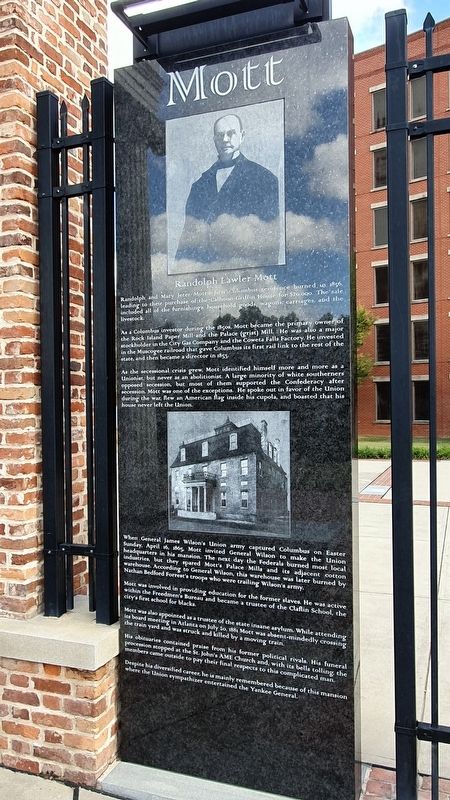
1. Mott Marker
Randolph Lawler Mott
Randolph and Mary Jeter Mott's first Columbus residence burned in 1856, leading to their purchase of the Calhoun-Griffin House for $20,000. The sale included all of the furnishings, household goods, wagons, carriages, and the livestock.
As a Columbus investor during the 1850s, Mott became the primary owner of the Rock Island Paper Mill and the Palace (grist) Mill. He was also a major stockholder in the City Gas Company and the Coweta Falls Factory. He invested in the Muscogee railroad that gave Columbus its first rail link to the rest of the state, and then became a director in 1855.
As the secessional crisis grew, Mott identified himself more and more as a Unionist, but never as an abolitionist. A large minority of white southerners opposed secession, but most of them supported the Confederacy after secession. Mott was one of the exceptions. He spoke out in favor of the Union during the war, flew an American flag inside his cupola, and boasted that his house never left the Union.
When General James Wilson's Union army captured Columbus on Easter Sunday, April 16, 1865, Mott invited General Wilson to make the Union headquarters in his mansion. The next day the Federals burned most local industries, but they spared Mott's Palace Mills and its adjacent cotton warehouse. According to General Wilson, this warehouse was later burned by Nathan Bedford Forrest's troops who were trailing Wilson's army.
Mott was involved in providing education for the former slaves. He was active within the Freedmen's Bureau and became a trustee of the Claflin School, the city's first school for blacks.
Mott was also appointed as a trustee of the state insane asylum. While attending its board meeting in Atlanta on July 20, 1881 Mott was absent-mindedly crossing the train yard and was
this page online
His obituaries contained praise from his former political rivals. His funeral procession stopped at the St. John's AME Church and, with its bells tolling, the members came outside to pay their final respects to this complicated man.
Despite his diversified career, he is mainly remembered because of this mansion where the Union sympathizer entertained the Yankee General.
Topics. This historical marker is listed in these topic lists: Charity & Public Work • Industry & Commerce • War, US Civil. A significant historical date for this entry is April 16, 1865.
Location. 32° 28.392′ N, 84° 59.665′ W. Marker is in Columbus, Georgia, in Muscogee County. It can be reached from 14th Street north of Front Avenue, on the right when traveling west. Touch for map. Marker is at or near this postal address: 1 14th St, Columbus GA 31901, United States of America. Touch for directions.

Regionally, this marker is in Georgia’s Piedmont. It is also in the American South and specifically in the Deep South. Globally, it is in North America, the Western Hemisphere, the Western World, and the Anglosphere.
Photographed by J. Makali Bruton, November 7, 2022
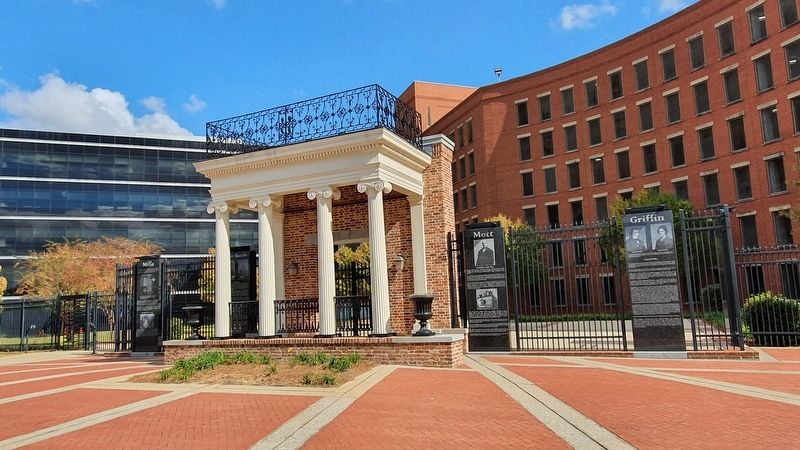
2. Mott Marker
The marker is directly to the right of the reconstructed facade of the Calhoun-Griffin-Mott House.
Other nearby markers. At least 8 other markers are within walking distance of this marker: Last Battle (here, next to this marker); Griffin (here, next to this marker); Mills (here, next to this marker); TSYS (a few steps from this marker); Calhoun (a few steps from this marker); Freedom Day (within shouting distance of this marker); J.S. Pemberton & the Confederacy / The Formula (within shouting distance of this marker); George Parker Swift I (about 400 feet away, measured in a direct line). Touch for a list and map of all markers in Columbus.
Credits. This page was last revised on March 7, 2023. It was originally submitted on March 7, 2023, by J. Makali Bruton of Washington, District of Columbia. This page has been viewed 429 times since then and 43 times this year. Photos: 1, 2. submitted on March 7, 2023, by J. Makali Bruton of Washington, District of Columbia.
