Glen Gardner in Hunterdon County, New Jersey — The American Northeast (Mid-Atlantic)
The Gorge Bridge Train Wreck
The High Bridge Branch of the Central Railroad of New Jersey
Photographed by Alan Edelson, August 20, 2009
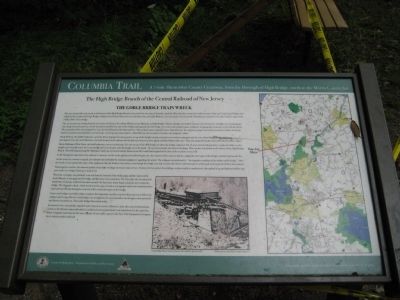
1. The Gorge Bridge Train Wreck Marker
The most memorable train wreck in the history of the High Bridge Branch occurred on the morning of Saturday, April 18, 1885 when the central and southern spans of the 250' long Gorge Bridge (now called the Ken Lockwood Gorge Bridge) collapsed as a heavily laden iron ore train drawn by a powerful Baldwin 4-6-0 locomotive (#112) named Columbia, just started to cross the southern span of the wooden Howe Truss bridge.
The 46 car train was coming from the iron mines in Chester, Port Oram (Wharton) and Hibernia, to High Bridge. It had 40 freight cars loaded with 500 tons of iron ore, 5 freight cars containing 90 tons of pig iron and a caboose. As the locomotive and first few cars of the ill-fated train passed over the bridge, the center and southern spans collapsed, dropping the locomotive to the hillside below. The remainder of the train plunged 60' into the South Branch of the Raritan River. The northern span remained intact. Daniel Bryant, the engineer, jumped out of the locomotive window believing death was imminent and landed on several rocks, receiving only minor injuries. John McGran, the locomotive fireman, also
this page online
Frank McEvoy, the middle brakeman, saved his life by leaping from his position on top of the freight car just a second or two before it plunged into the river. John Bangham, the conductor, and August Gess, the rear brakeman, were both located in the caboose and looked on in horror as the tragedy unfolded before their eyes. They also jumped from the train with only seconds to spare.
Henry Haltiman of Port Oram, the head brakeman, was not so fortunate. He was on top of the fifth freight car when the bridge collapsed. The 26 year old tried desperately to apply the brakes on his freight car to stop the train, but it was too late and in an instant, rode the freight car to his death. He was buried under the twisted wreckage. This was the only fatatlity in the history of the High Bridge Branch. The following morning Mr. Haltiman's body was recovered shortly before noon. His watch had stopped at the time of the accident: 10:05 A.M.
Following the accident, the railroad quickly cleared the wreckage to restore train service. To keep the locomotive from falling, workers tied it to nearby trees, then jacked it up and built
Photographed by Alan Edelson, August 20, 2009
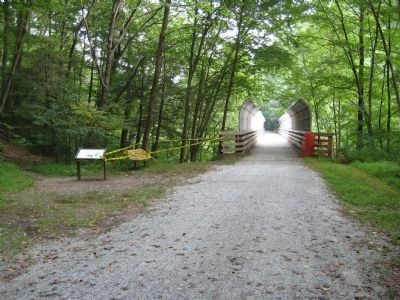
2. The Gorge Bridge Train Wreck Marker
When the wreckage was gradually removed from the bottom of the rocky gorge and the waters of the South Branch, it was apparent the bridge and the train were a total loss. For a few days the site attracted hundreds of curiosity seekers from miles around. Six days later, trains began using the new temporary bridge. The flagman's shack, which stood near this sign, served as a telegraph station for communication with railroad officials during the removal of the wreck and repair to the bridge.
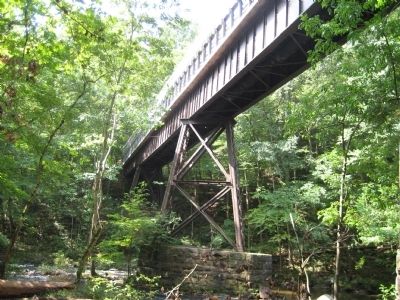
A new steel bridge was built in 1891 to replace the temporary wooden structure that was in use before the collapse and in 1931 this new steel bridge was strengthened to accomodate much larger, more powerful and heavier locomotives. This is the bridge that stands today.
Locomotive #112 was quickly repaired and returned to service. However, since this was its third serious wreck on the Branch, many railroaders considered it to be jinxed and it was transferred to the main line, where it hauled coal trains for the next 17 years. It was sold in 1902 to the New York Equipment Company
Photographed by Alan Edelson, August 20, 2009
3. View of the current bridge from the gorge below.
Erected by County of Hunterdon - Department of Parks and Recreation.
Topics. This historical marker is listed in these topic lists: Bridges & Viaducts • Disasters • Railroads & Streetcars. A significant historical date for this entry is April 18, 1885.
Location. 40° 41.835′ N, 74° 52.357′ W. Marker is in Glen Gardner, New Jersey, in Hunterdon County. It can be reached from Columbia Trail. Marker is located on the Columbia Trail at the south end of the bridge. Touch for map. Marker is at or near this postal address: 203 Columbia Trail, Califon NJ 07830, United States of America. Touch for directions.

Regionally, this marker is in North Jersey and in the New York City Metropolitan Area. It is also in the American Northeast and in the Mid-Atlantic. Globally, it is in North America, the Western Hemisphere, the Western World, and the Anglosphere. Historically, it finds itself in what was once New Netherland and also one of the original Thirteen Colonies.
Other nearby markers. At least 8 other markers are within 2 miles of this marker, measured as the crow flies: Voorhees State Park (approx. 0.8 miles away); Hamlet of Readingsburg (approx. 1.1 miles away); High Bridge and Longwood Valley Branch (approx. 1.2 miles away); High Bridge Company 1268 / Civilian Conservation Corps (approx. 1.2 miles away); Lebanon Township Veterans Monument (approx. 1½ miles away); Welcome to the Twp. of Lebanon (approx. 1½ miles away); a different marker also named Lebanon Township Veterans Monument (approx. 1½ miles away); Taylor Steelworkers Historic Greenway (approx. 1.7 miles away).
Credits. This page was last revised on June 8, 2024. It was originally submitted on August 20, 2009, by Alan Edelson of Union Twsp., New Jersey. This page has been viewed 7,135 times since then and 267 times this year. Photos: 1, 2, 3. submitted on August 20, 2009, by Alan Edelson of Union Twsp., New Jersey. • Kevin W. was the editor who published this page.
