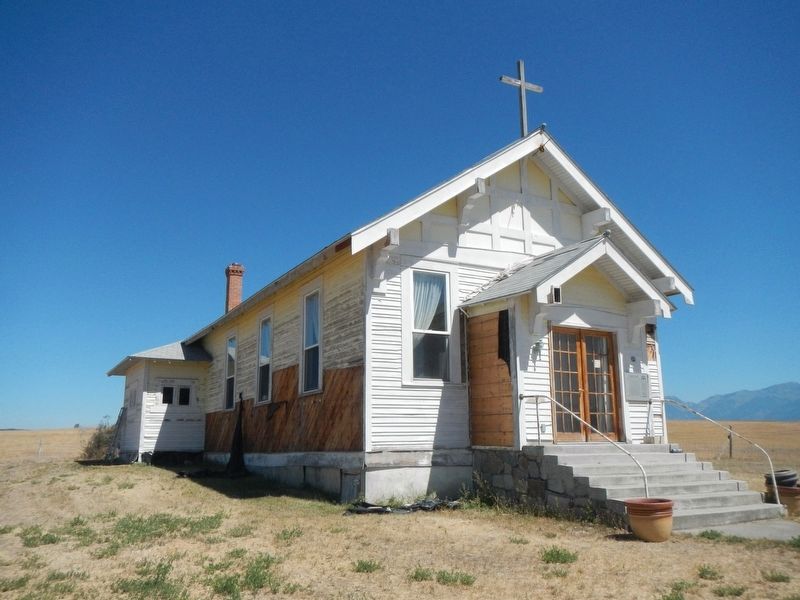
Near Charlo in Lake County, Montana — The American West (Mountains)
St. Joseph's Catholic Church of D'Aste
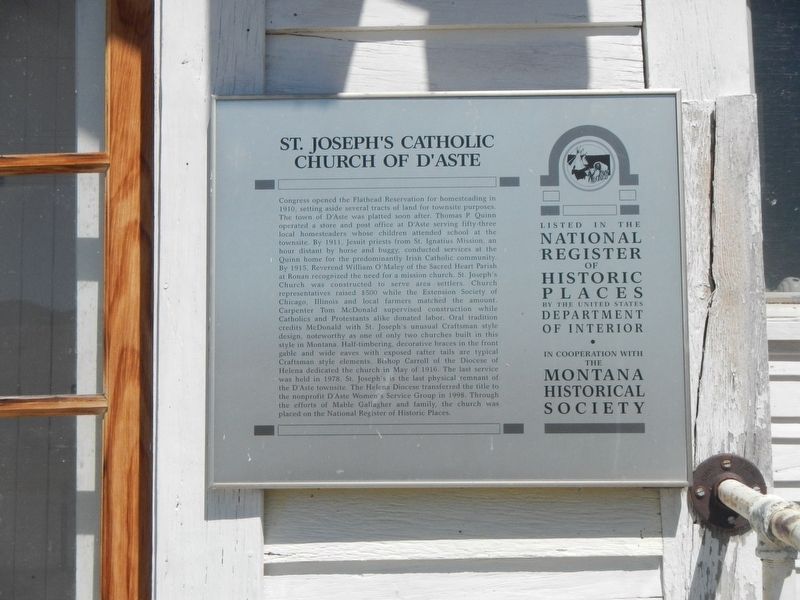
Photographed by Barry Swackhamer, August 8, 2022
1. St. Joseph's Catholic Church of D'Aste Marker
Inscription.
St. Joseph's Catholic Church of D'Aste. . Congress opened the Flathead Reservation for homesteading in 1910, setting aside several tracts of land for townsite purposes. The town of D’Aste was platted soon after. Thomas P. Quinn operated a store and post office at D’Aste, serving fifty-three local homesteaders whose children attended school at the townsite. By 1911, Jesuit priests from St. Ignatius Mission, an hour distant by horse and buggy, conducted services at the Quinn home for the predominantly Irish Catholic community. By 1915, Reverend William O’Maley of the Sacred Heart Parish at Ronan recognized the need for a mission church. St Joseph’s Church was constructed to serve area settlers. Church representatives raised $500 while the Extension Society of Chicago, Illinois, and local farmers matched the amount. Carpenter Tom McDonald supervised construction while Catholics and Protestants alike donated labor. Oral tradition credits McDonald with St. Joseph’s unusual Craftsman style design, noteworthy as one of only two churches built in this style in Montana. Half-timbering, decorative braces in the front gable, and wide eaves with exposed rafter tails are typical Craftsman style elements. Bishop Carroll of the Diocese of Helena dedicated the Church in May of 1916. The last service was held in 1978. St. Joseph’s is the last physical remnant of the D’Aste townsite. The Helena Diocese transferred the title to the nonprofit D’Aste Women’s Service Group in 1998. Through the efforts of Mable Gallagher and family, the church was placed on the National Register of Historic Places.
Congress opened the Flathead Reservation for homesteading in 1910, setting aside several tracts of land for townsite purposes. The town of D’Aste was platted soon after. Thomas P. Quinn operated a store and post office at D’Aste, serving fifty-three local homesteaders whose children attended school at the townsite. By 1911, Jesuit priests from St. Ignatius Mission, an hour distant by horse and buggy, conducted services at the Quinn home for the predominantly Irish Catholic community. By 1915, Reverend William O’Maley of the Sacred Heart Parish at Ronan recognized the need for a mission church. St Joseph’s Church was constructed to serve area settlers. Church representatives raised $500 while the Extension Society of Chicago, Illinois, and local farmers matched the amount. Carpenter Tom McDonald supervised construction while Catholics and Protestants alike donated labor. Oral tradition credits McDonald with St. Joseph’s unusual Craftsman style design, noteworthy as one of only two churches built in this style in Montana. Half-timbering, decorative braces in the front gable, and wide eaves with exposed rafter tails are typical
Click or scan to see this page online
Craftsman style elements. Bishop Carroll of the Diocese of Helena dedicated the Church in May of 1916. The last service was held in 1978. St. Joseph’s is the last physical remnant of the D’Aste townsite. The Helena Diocese transferred the title to the nonprofit D’Aste Women’s Service Group in 1998. Through the efforts of Mable Gallagher and family, the church was placed on the National Register of Historic Places.
Location. 47° 23.118′ N, 114° 11.828′ W. Marker is near Charlo, Montana, in Lake County. It is on Dublin Gulch Road near Biggerstaff Lane, on the right when traveling west. Touch for map. Marker is at or near this postal address: 39754 Dublin Gulch Road, Charlo MT 59824, United States of America. Touch for directions.

Regionally, this marker is in Montana’s Flathead Nation, in Western Montana, and in Glacier
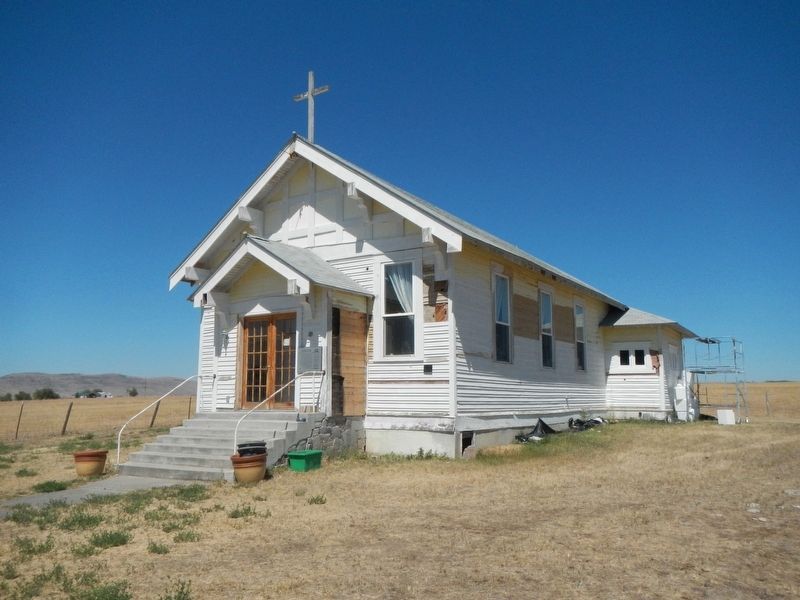
Photographed by Barry Swackhamer, August 8, 2022
2. St. Joseph's Catholic Church of D'Aste and Marker
Country. It is also in the American Mountain West and in the Lewis & Clark Corridor. Globally, it is in North America, the Rocky Mountains, the Western Hemisphere, the Western World, and the Anglosphere. Historically, it finds itself in what was once Rupert’s Land and also the Louisiana Purchase.
Credits. This page was last revised on December 27, 2024. It was originally submitted on March 29, 2023, by Barry Swackhamer of Brentwood, California. This page has been viewed 207 times since then and 22 times this year. Photos:1, 2, 3. submitted on March 29, 2023, by Barry Swackhamer of Brentwood, California.