
Simeon in Albemarle County, Virginia — The American South (Mid-Atlantic)
Ash Lawn – Highland
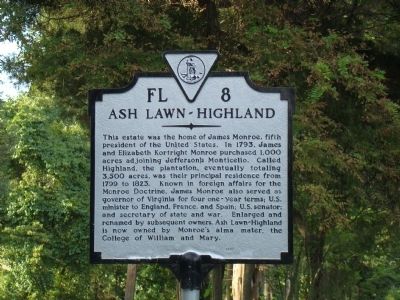
Photographed by J. J. Prats, August 2, 2009
1. Ash Lawn – Highland Marker
Erected 1997. (Marker Number FL-8.)
Topics and series. This historical marker is listed in these topic lists: Education • Settlements & Settlers. In addition, it is included in the Former U.S. Presidents: #03 Thomas Jefferson, the Former U.S. Presidents: #05 James Monroe, and the Virginia Department of Historic Resources (DHR) series lists. A significant historical year for this entry is 1793.
Location. 37° 58.746′ N,
this page online

Regionally, this marker is in the Piedmont and in Central Virginia. It is also in the American South and specifically in the Upper South. Globally, it is in the North Atlantic Region, North America, the Western Hemisphere, the Western World, and the Anglosphere. Historically, it finds itself in what was once the territory of the Mississippian Culture, one of the original Thirteen Colonies, one of the Confederate States of America, and the Antebellum South.
Other nearby markers. At least 8 other markers are within walking distance of this marker: Window To A New America (approx. 0.4 miles away); Iron Casting of a Mileage Marker (approx. 0.4 miles away); Agriculture (approx. 0.4 miles away); Archaeology (approx. 0.4 miles away); What Happened? (approx. 0.4 miles away); Whose House Is This? (approx. 0.4 miles away); Ash Lawn - Highland (approx. 0.4 miles away); Reconstructed Quarters (approx. 0.4 miles away).
More about this marker. This marker replaced a marker dating from the 1940s with the same number but titled “Ash Lawn” with this inscription, “Home of James Monroe, fifth President of the United States, from 1799 until Oak Hill was built. The house was designed by Thomas Jefferson; the rear part was constructed
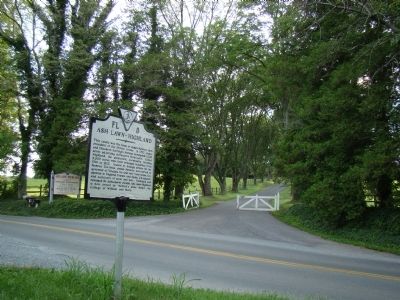
Photographed by J. J. Prats, August 2, 2009
2. Entrace to Ash Lawn – Highland and Marker
Related marker. Click here for another marker that is related to this marker. Ash Lawn – Highland is included as part of the Southern Albemarle Rural Historic District .
Also see . . .
1. An Account of James Monroe’s Land Holdings. “Highland was originally part of a large estate in Albemarle County called ‘Blenheim’ and owned by Champe Carter and Maria Carter, his wife. The parcel comprising Highland was conveyed from the Carters to Monroe in a 1793 deed of purchase for 1,000 pounds purchase price. Highland was bounded on the north by Thomas Jefferson’s Monticello plantation and Philip Mazzei’s plantation called Colle, located along the Colle Branch. The Rivanna River (which is named after Queen Anne) runs just to the north of Monticello, and provided an important transportation source for goods and materials being shipped to and from Richmond and the Chesapeake. The small town of Milton, just to the east of Ash Lawn-Highland, was once a transport hub along the Rivanna. Highland was bordered on the
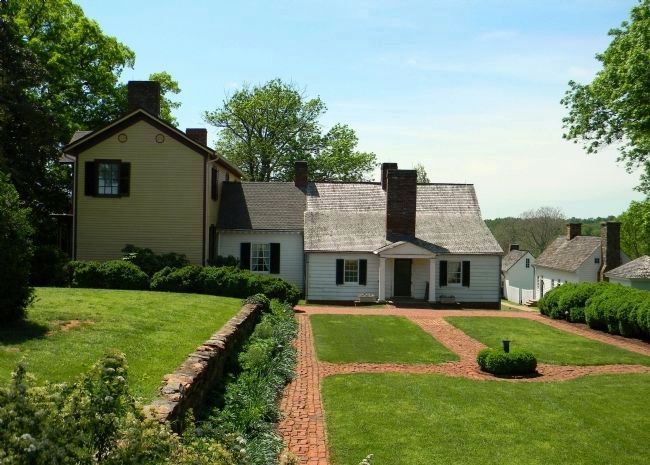
Photographed by Paul Crumlish
3. Ash Lawn – Highland (1799)
Ash Lawn - Highland (located near Simeon) is one of almost two dozen National Register of Historic Places located within the Southern Albemarle Rural Historic District. Built in 1799, it was the estate of James Monroe, the fifth President of the United States.
2. Thomas Jefferson and William Short. “Unlike his more illustrious contemporaries Madison and Monroe, William Short (1759–1849), whom Jefferson referred to as his ‘adoptive son,’ never skyrocketed to political fame. Instead, after serving as Jefferson’s secretary and working as a career diplomat, he became a successful financier. He admitted that ‘nothing could be less Virginian’ than spending less than his income and investing the rest, but from what he called a ‘small patrimony,’ he eventually made himself a millionaire.” (Submitted on August 27, 2009.)
3. Ash Lawn - National Register of Historic Places Nomination Form. (Submitted on May 1, 2011, by PaulwC3 of Northern, Virginia.)
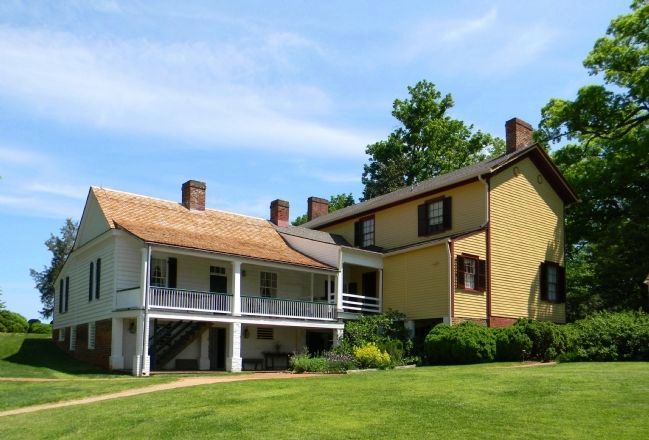
Photographed by Paul Crumlish, April 30, 2011
4. Ash Lawn – Highland
Rear view of the former estate of President James Monroe, showing the original section (circa 1799) built by Monroe and the two-story addition built by later owners of Ash Lawn - Highland.
J. J. Prats Collection, December 2, 2013
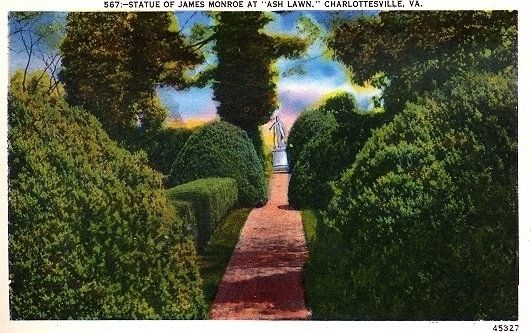
5. Statue of James Monroe at “Ash Lawn” Charlottesville, Va.
Caption on back of undated postcard: “Statue of President James Monroe, erected at ‘Ash Lawn’ in 1931 on the 100th anniversary of his death. Made by the sculptor Atillo Piccirilli on the order of the Venezuelan Government as a mark of appreciation when they were defended by the Monroe Doctrine during Cleveland's administration. ‘Ash Lawn,’ home of James Monroe, revolutionary hero, signer of the Louisiana Purchase, author of the Monroe Doctrine and fifth president of the United States. Planned for him by his friend and neighbor Thomas Jefferson and built in 1798, within sight of Monticello and about four miles from Charlottesville, Va.” “No. 45327. Published by Asheville Post Card Co., Asheville, N. C. Made in USA” White border dates this postcard to before 1930.
Photographed by Paul Crumlish, April 30, 2011
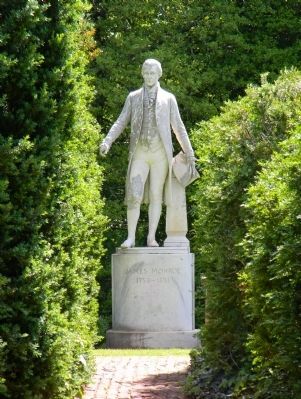
6. James Monroe
A statue of James Monroe in the Statue Yard at Ash Lawn - Highland
Photographed by Allen C. Browne, February 16, 2015
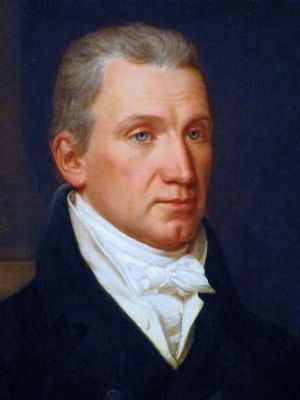
7. James Monroe
This 1816 portrait of James Monroe by John Vanderlyn hangs in the National Portrait Gallery in Washington, DC.
“In 1820, White House incumbent James Monroe stood virtually unopposed in his bid for a second term, an expression of the so-called ‘Era of Good Feelings’ that set in after the War of 1812 and was marked by a temporary halt in two-party factionalism.
Monroe brought to his presidency a style that meshed well with this rancorless climate. When, for example, he vetoed public improvements legislation, he offered Congress suggestions for accomplishing the same end through means that circumvented his Constitution-based objections. The most enduring legacy of his administration, however, was the Monroe Doctrine, which registered opposition to European meddling in the Western Hemisphere. It ultimately became a keystone of American foreign policy.
The restrained coloring and brushwork in Monroe's portrait by John Vanderlyn testifies to the strong influence of French neoclassicism during the artist's years of study in Paris. It may also reflect Monroe's own tastes, which ran to the French as a result of several diplomatic missions to Paris.” — National Portrait Gallery
“In 1820, White House incumbent James Monroe stood virtually unopposed in his bid for a second term, an expression of the so-called ‘Era of Good Feelings’ that set in after the War of 1812 and was marked by a temporary halt in two-party factionalism.
Monroe brought to his presidency a style that meshed well with this rancorless climate. When, for example, he vetoed public improvements legislation, he offered Congress suggestions for accomplishing the same end through means that circumvented his Constitution-based objections. The most enduring legacy of his administration, however, was the Monroe Doctrine, which registered opposition to European meddling in the Western Hemisphere. It ultimately became a keystone of American foreign policy.
The restrained coloring and brushwork in Monroe's portrait by John Vanderlyn testifies to the strong influence of French neoclassicism during the artist's years of study in Paris. It may also reflect Monroe's own tastes, which ran to the French as a result of several diplomatic missions to Paris.” — National Portrait Gallery
Credits. This page was last revised on February 2, 2023. It was originally submitted on August 27, 2009, by J. J. Prats of Powell, Ohio. This page has been viewed 2,320 times since then and 53 times this year. Last updated on October 18, 2009, by PaulwC3 of Northern, Virginia. Photos: 1, 2. submitted on August 27, 2009, by J. J. Prats of Powell, Ohio. 3, 4. submitted on May 1, 2011, by PaulwC3 of Northern, Virginia. 5. submitted on December 2, 2013, by J. J. Prats of Powell, Ohio. 6. submitted on May 1, 2011, by PaulwC3 of Northern, Virginia. 7. submitted on July 18, 2015, by Allen C. Browne of Silver Spring, Maryland. • Kevin W. was the editor who published this page.
