Waterloo in Monroe County, Illinois — The American Midwest (Great Lakes)
The Bellefontaine Spring & House
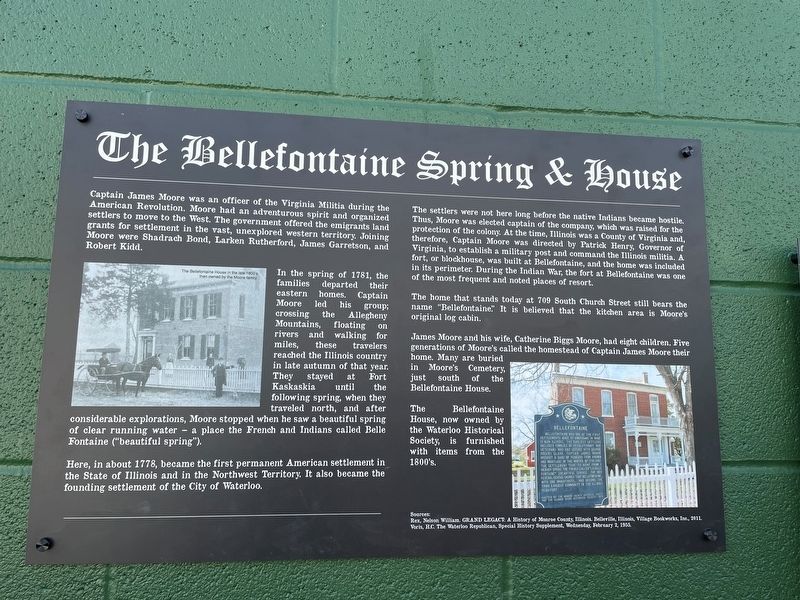
Photographed by Thomas Smith, March 31, 2023
1. The Bellefontaine Spring & House Marker
Captain James Moore was an officer of the Virginia Militia during the American Revolution. Moore had an adventurous spirit and organized settlers to move to the West. The government offered the emigrants land grants for settlement in the vast, unexplored western territory Joining Moore were Shadrach Bond, Larken Rutherford, James Garretson, and Robert Kidd.
In the spring of 1781, the families departed their eastern homes. Captain Moore led his group; crossing the Allegheny Mountains, floating on rivers and walking for miles, these travelers reached the Illinois country in late autumn of that year. They stayed at Fort Kaskaskia until the following spring, when they traveled north, and after considerable explorations, Moore stopped when he saw a beautiful spring of clear running water a place the French and Indians called Belle Fontaine ("beautiful spring").
Here, in about 1778, became the first permanent American settlement in the State of Illinois and in the Northwest Territory. It also became the founding settlement of the City of Waterloo.
The settlers were not here long before the native Indians became
this page online
The home that stands today at 709 South Church Street still bears the name "Bellefontaine." It is believed that the kitchen area is Moore's original log cabin.
James Moore and his wife, Catherine Biggs Moore, had eight children. Five generations of Moore's called the homestead of Captain James Moore their home. Many are buried in Moore's Cemetery, just south of the Bellefontaine House.
James Moore and his wife, Catherine Biggs Moore, had eight children. Five generations of Moore's called the homestead of Captain James Moore their home. Many are buried in Moore's Cemetery, just south of the Bellefontaine House.
The Bellefontaine
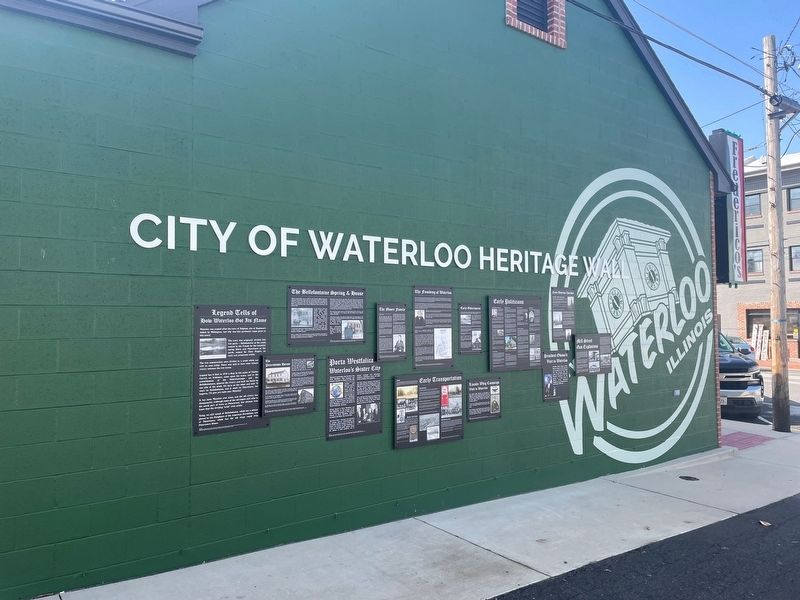
Photographed by Thomas Smith, March 31, 2023
2. The Bellefontaine Spring & House Marker
Topics. This historical marker is listed in these topic lists: Patriots & Patriotism • Settlements & Settlers • Waterways & Vessels. A significant historical year for this entry is 1781.
Location. 38° 20.202′ N, 90° 9.021′ W. Marker is in Waterloo, Illinois, in Monroe County. It is on North Main Street south of First Street, on the left when traveling south. The marker hangs on north side of Frederico's Restaurant. Touch for map. Marker is at or near this postal address: 114 N Main St, Waterloo IL 62298, United States of America. Touch for directions.

Regionally, this marker is in Greater St. Louis. It is also in the American Midwest, in the Lewis & Clark Corridor, in the Corn Belt, and in the Great River Road Region. Globally, it is in North America, the Western Hemisphere, the Western World, and the Anglosphere. Historically, it finds itself in what was once the territory of the Mississippian Culture and also the Northwest Territory.
Other nearby markers. At least 8 other markers are within walking distance of this marker: Lincoln Whig Campaign (here, next to this marker); Porta Westfalica (here, next to this marker); Legend Tells How Waterloo Got Its Name (here, next to this marker); The Peterstown House (here, next to this marker); Early Politicians (here, next to this marker); Mill Street Gas Explosions (here, next to this marker); Early Waterloo Churches (here, next to this marker); Early Government (here, next to this marker). Touch for a list and map of all markers in Waterloo.
Credits. This page was last revised on April 8, 2023. It was originally submitted on April 4, 2023, by Thomas Smith of Waterloo, Ill. This page has been viewed 791 times since then and 103 times this year. Photos: 1, 2. submitted on April 4, 2023, by Thomas Smith of Waterloo, Ill. • Devry Becker Jones was the editor who published this page.
