Snook in Burleson County, Texas — The American South (West South Central)
Dabney Hill Freedom Colony
Photographed by Ronald Claiborne, January 6, 2024
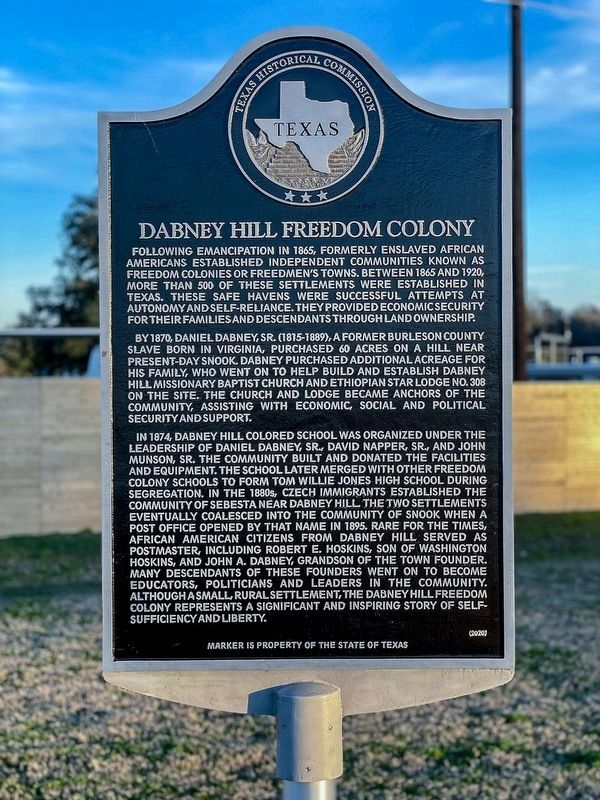
1. Dabney Hill Freedom Colony Marker
By 1870, Daniel Dabney, Sr. (1815-1889), a former Burleson County slave born in Virginia, purchased 60 acres on a hill near present-day Snook. Dabney purchased additional acreage for his family, who went on to help build and establish Dabney Hill Missionary Baptist Church and Ethiopian Star Lodge No. 308 on the site. The church and lodge became anchors of the community, assisting with economic, social and political security and support.
In 1874, Dabney Hill Colored School was organized under the leadership of Daniel Dabney, Sr., David Napper, Sr., and John Munson, Sr. The community built and donated the facilities and equipment. The school later merged with other Freedom Colony schools to form Tom Willie Jones High School
this page online
Erected 2020 by Texas Historical Commission. (Marker Number 22836.)
Topics. This historical marker is listed in these topic lists: African Americans • Fraternal or Sororal Organizations • Religion & Religious Structures • Settlements & Settlers. A significant historical year for this entry is 1865.
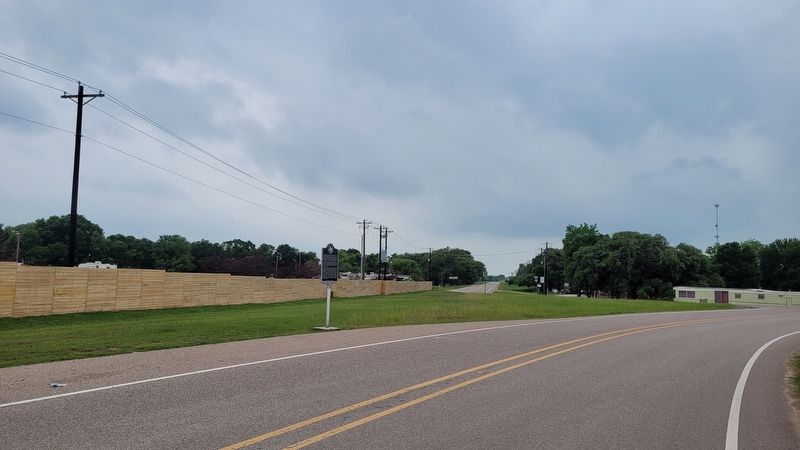
Location. 30° 30.182′ N, 96° 28.327′ W. Marker is in Snook, Texas, in Burleson County. It is at the intersection of County Highway 267 and Farm to Market Road 2155, on
Photographed by James Hulse, April 2, 2023
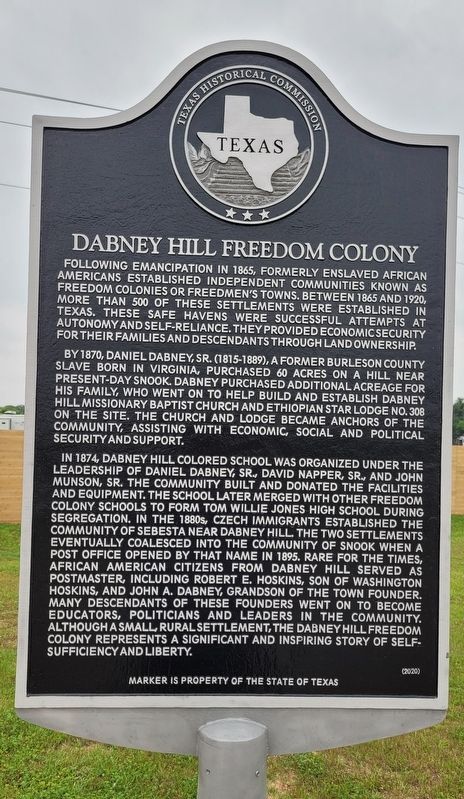
2. Dabney Hill Freedom Colony Marker

Regionally, this marker is in the Prairies & Lakes Region. It is also in the American South. Globally, it is in North America, a Gulf of Mexico state, the Western Hemisphere, the Western World, and the Anglosphere. Historically, it finds itself in what was once New Spain, the Republic of Texas, one of the Confederate States of America, and the Antebellum South.
Other nearby markers. At least 8 other markers are within 8 miles of this marker, measured as the crow flies: Snook Brethren Church (approx. 0.7 miles away); Community of Snook (approx. 0.9 miles away); Snook Cemetery (approx. 2 miles away); Giesenschlag Cemetery (approx. 2.2 miles away); Brazos Bottom Baptist Church Cemetery (approx. 4.1 miles away); Lone Oak Baptist Church (approx. 4.9 miles away); Providence Cemetery (approx. 6.7 miles away); San Salvador Mission Church (approx. 7.7 miles away). Touch for a list and map of all markers in Snook.
Also see . . . Freedmen's Settlements. Texas State Historical Association (TSHA)
Freedmen’s settlements, otherwise known as Black settlements, freedom colonies, or freedmen’s towns, are historically significant communities founded across the South, including Texas, from 1865 to 1930. Black Texans obtained the land upon which these settlements were founded via cash purchase or adverse possession, often in flood-prone bottomlands on the edges of plantations and city boundaries.(Submitted on April 8, 2023, by James Hulse of Medina, Texas.)
Photographed by James Hulse, April 2, 2023
3. The Dabney Hill Freedom Colony Marker along the street
Photographed by Ronald Claiborne, January 6, 2024
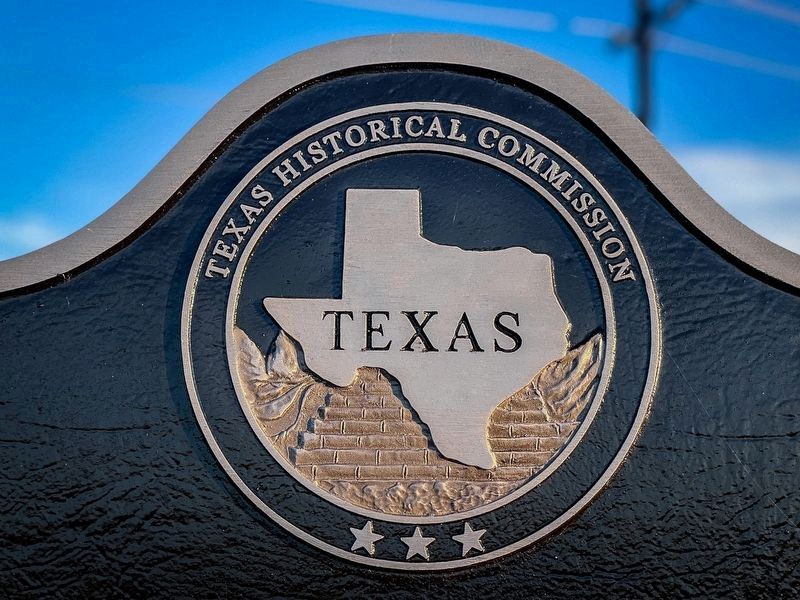
4. Dabney Hill Freedom Colony Marker Crest Detail
The newer golden colored crest is used in place of the older monochrome version.
Credits. This page was last revised on January 8, 2024. It was originally submitted on April 8, 2023, by James Hulse of Medina, Texas. This page has been viewed 1,991 times since then and 216 times this year. Photos: 1. submitted on January 7, 2024, by Ronald Claiborne of College Station, Texas. 2, 3. submitted on April 9, 2023, by James Hulse of Medina, Texas. 4. submitted on January 7, 2024, by Ronald Claiborne of College Station, Texas.
