Windsor and Maidenhead in Berkshire, England, United Kingdom — Northwestern Europe (the British Isles)
War Horse Memorial
⎯⎯⎯
Pride of The War Horse
Photographed by Stephen Palmer, April 9, 2023
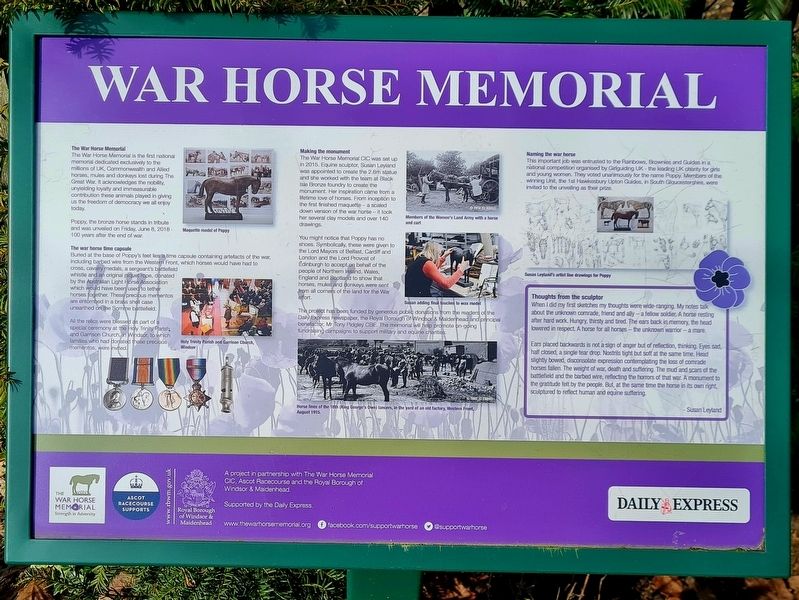
1. War Horse Memorial side of marker
The War Horse Memorial
The War Horse Memorial is the first national memorial dedicated exclusively to the millions of UK, Commonwealth and Allied horses, mules and donkeys lost during The Great War. It acknowledges the nobility, unyielding loyalty and immeasurable contribution these animals played in giving us the freedom of democracy we all enjoy today.
Poppy, the bronze horse stands in tribute and was unveiled on Friday, June 8, 2018 100 years after the end of the war.
The war horse time capsule
Buried at the base of Poppy’s feet lies a time capsule containing artefacts of the war including barbed wire from the Western Front, which horses would have had to cross, cavalry medals, a sergeant’s battlefield whistle and an original piquet rope, donated by the Australian which would have been used to tether horses together. These precious mementos are entombed in a brass shell case unearthed on the Somme battlefield.
All the relics were blessed as part of a special ceremony at the Holy Trinity Parish and Garrison Church in Windsor, to which families who had donated these precious mementos were invited.
Making the
this page online
The War Horse Memorial CCI was set up in 2015. Equine sculptor, Susan Leyland was appointed to create the 2.6m statue and she worked with the team at Black Isle Bronze foundry to create the monument. Her inspiration came from a lifetime love of horses. From inception to the first fished maquette - a scaled down version of the war horse – it took her several clay models and over 140 drawings.
You might notice that Poppy has no shoes. Symbolically, these were given to The Lord Mayors of Belfast, Cardiff and London and the Lord Provost of Edinburgh to accept on behalf of the people of Northern Ireland, Wales, England and Scotland to show that horses, mules and donkeys were sent from all corners of the land for the War effort.
The project has been funded by generous public donations from the readers of the Daily Express newspaper, the Royal Borough of Windsor & Maidenhead and principal benefactor, Mr Tony Pidgley CBE. The memorial will help promote on-going fundraising campaigns to support military and equine charities.
Naming the war horse
This important job was entrusted to the Rainbows, Brownies and Guides in a national
Photographed by Stephen Palmer, April 9, 2023
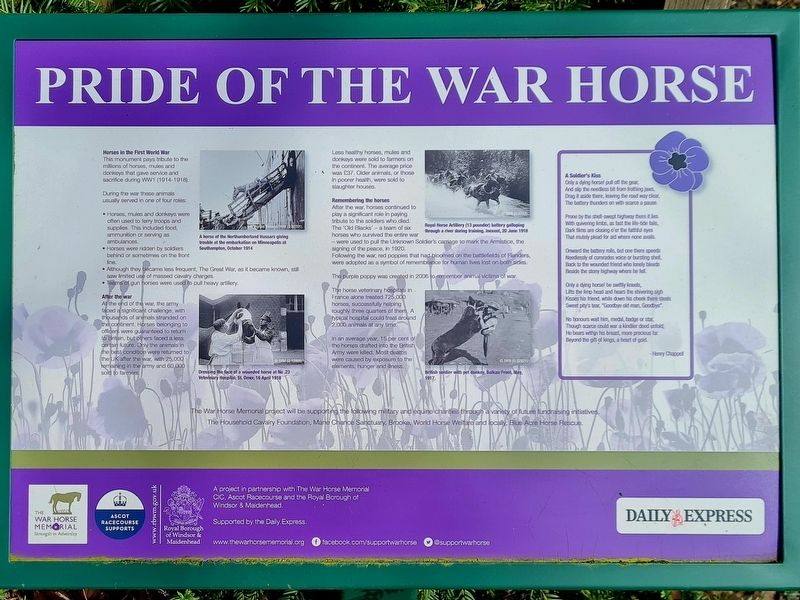
2. Pride Of The War Horse side of marker
Thoughts from the sculptor
When I did my first sketches my thoughts were wide-ranging. My notes talk about the unknown comrade, friend and ally - a fellow solder. A horse resting after hard work. Hungry, thirsty and tired. The ears back in memory, the head bowed in respect. A horse for all horses - the unknown warrior – a mare.
Ears placed backwards is not a sign of anger but of reflection, thinking. Eyes sad, half closed, a single tear drop. Nostrils tight but soft at the same time. Head slighty bowed, disconsolate expression contemplating the loss of comrade horses fallen. The weight of war, death and suffering. The mud and scars of the battlefield and the barbed wire, reflecting the horrors of that war. A monument to the gratitude felt by the people. But, at the same time the horse in its own right, sculptured to reflect human and equine suffering.
Susan Leyland

Photographed by Stephen Palmer, April 9, 2023
3. War Horse Memorial
Pride of The War Horse
Horses in the First World War
This monument pays tribute to the millions of horses, mules and donkeys that gave service and sacrifice during WWI (1914-1918).
During the war these animals usually served in one of four roles:
• Horses, mules and donkeys were often used to ferry troops and supplies. This included food, ammunition or serving as ambulances.
• Horses were ridden by soldiers behind or sometimes on the front line.
• Although they became less frequent, The Great War, as it became known, still saw limited use of massed cavalry charges.
• Teams of gun horses were used to pull heavy artillery.
After the war
At the end of the war, the army faced a significant challenge, with thousands of animals stranded on the continent. Horses belonging to officers were guaranteed to return to Britain, but others faced a less certain future. Only the animals in the best condition were returned to the UK after the war, with 25,000 remaining in the army and 60,000 sold to farmers.
Less healthy horses, mules and donkeys were sold to farmers on the continent. The average price was £37. Older animals, or those

Photographed by Stephen Palmer, April 9, 2023
4. War Horse Memorial
Remembering the horses
After the war, horses continued to play a significant role in paying tribute to the soldiers who died. The ‘Old Blacks’ - team of six horses who survived the entire war - were used to pull the Unknown Solder's carriage to mark the Armistice, the signing of the peace, in 1920.
Following the war, red poppies that had bloomed on the battlefields of Flanders, were adopted as a symbol of remembrance for human lives lost on both sides.
The purple poppy was created in 2006 to remember animal victims of war.
The horse veterinary hospitals in France alone treated 725,000 horses, successfully helping roughly three quarters of them. A typical hospital could treat around 2,000 animals at any time.
In an average year, 15 per cent of the horses drafted into the British Amy were killed. Most deaths were caused by exposure to the elements, hunger and illness.
Erected 2018 by The War Horse Memorial CIC, Ascot Racecourse, the Royal Borough of Windsor and Maidenhead.
Topics and series. This historical marker is listed in these topic lists: Animals • War, World I. In addition, it is included in the Time Capsules series list.
Location. 51° 24.689′ N, 0° 41.244′ W. Marker is in Windsor and Maidenhead, England, in Berkshire. It is at the intersection of High Street on High Street. The memorial is in the middle of the roundabout with the markers to the east across the street. Touch for map. Marker is at or near this postal address: A329, Windsor and Maidenhead, England SL5 8FG, United Kingdom. Touch for directions.

Regionally, this marker is in the Greater South East. Globally, it is on the Atlantic Ocean, in the North Atlantic Region, in Europe, in Atlantic Europe, on one of the British Isles, in the Western World, and in the Anglosphere. Historically, it finds itself in what was once the Roman Empire.
Other nearby markers. At least 8 other markers are within 3 kilometers of this marker, measured as the crow flies: Old Ascot Fire Station (approx. 1.1 kilometers away); Henry Beaucourt Skyrme (approx. 1.4 kilometers away); Honouring the Men and Boys from Chavey Down - World War II (approx. 1.7 kilometers away); Honouring the Men and Boys from Chavey Down - World War I (approx. 1.8 kilometers away); Welcome to Lily Hill Park (approx. 2.7 kilometers away); Lily Hill Park (approx. 2.8 kilometers away); The Chestnuts (approx. 2.9 kilometers away); The Warfield Ice House (approx. 3 kilometers away).
Credits. This page was last revised on April 12, 2023. It was originally submitted on April 9, 2023, by Stephen Palmer of Ascot, England. This page has been viewed 765 times since then and 93 times this year. Photos: 1, 2, 3, 4. submitted on April 9, 2023, by Stephen Palmer of Ascot, England. • J. Makali Bruton was the editor who published this page.
