Riverton in Burlington County, New Jersey — The American Northeast (Mid-Atlantic)
Riverton Public School
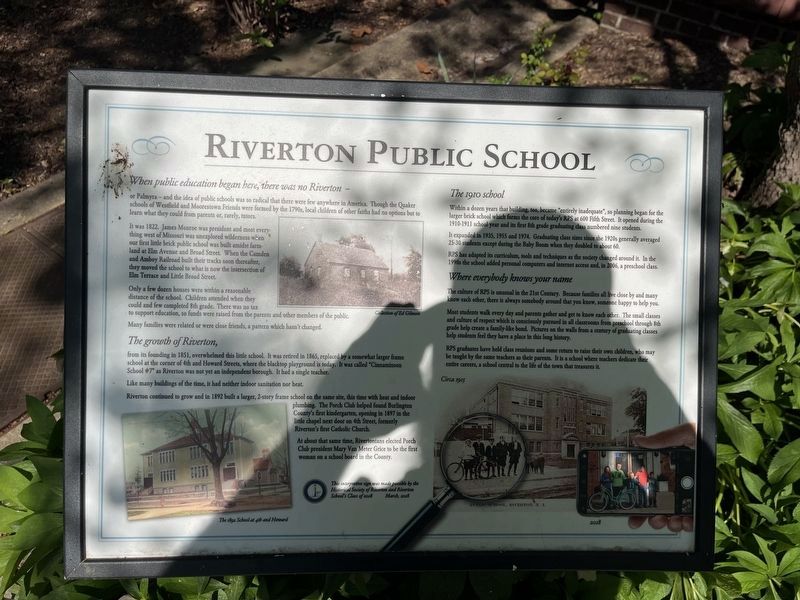
When public education began here, there was no Riverton — or Palmyra — and the idea of public schools was so radical that there were few anywhere in America. Though the Quaker schools of Westfield and Moorestown Friends were formed by the 1790s, local children of other faiths had no options but to learn what they could from parents or, rarely, tutors.
It was 1822. James Monroe was president and most everything west of Missouri was unexplored wilderness when our first little brick public school was built amidst farmland at Elm Avenue and Broad Street. When the Camden and Amboy Railroad built their tracks soon thereafter, they moved the school to what is now the intersection of Elm Terrace and Little Broad Street.
Only a few dozen houses were within a reasonable distance of the school. Children attended when they could and completed the 8th grade. There was no tax to support education, so funds were raised from the parents and other members of the public.
Many families were related or were close friends, a pattern which hasn't changed.
The growth of Riverton, from its founding in 1851, overwhelmed this little
this page online
Like many buildings of the time, it had neither indoor sanitation nor heat.
Riverton continued to grow and in 1892 built a larger, 2-story frame school on the same site, this time with heat and indoor plumbing. The Porch Club helped found Burlington County's first kindergarten, opening in 1897 in the little chapel next door on 4th Street, formerly Riverton's first Catholic Church.
At about the same time, Rivertonians elected Porch Club president Mary Van Meter Grice to be the first woman on a school board in the County.
The 1910 school
Within a dozen years that building, too, became "entirely inadequate", so planning began for the larger brick school which forms the care of today's RPS at 600 Fifth Street. It opened during the 1910-1911 school year and its first 8th grade graduating class numbered nine students.
It expanded in 1935, 1955 and 1974. Graduating
RPS has adapted its curriculum, tools and techniques as the society changed around it. In the 1990s the school added personal computers and internet access and, in 2006, a preschool class.
Where everybody knows your name
The culture of RPS is unusual in the 21st Century. Because families all live close by and many know each other, there is always somebody around that you know, somebody happy to help you.
Most students walk every day and parents gather and get to know each other. The small classes and culture of respect which is consciously pursued in all classrooms from preschool through 8th grade to help create a family-like bond. Pictures on the walls from a century of graduating classes help students feel they have a place in this long history.
RPS graduates have held class reunions and some return to raise their own children, who may be taught by the same teachers as their parents. It is a school where teachers dedicate their entire careers, a school central to the life of the town that treasures it.
Erected 2018 by Historical Society of Riverton and Riverton School's Class of 2018.
Topics and series. This historical marker is listed in these topic lists: Education • Religion & Religious Structures. In addition, it is included in the Quakerism series list. A significant historical year for this entry is 1822.
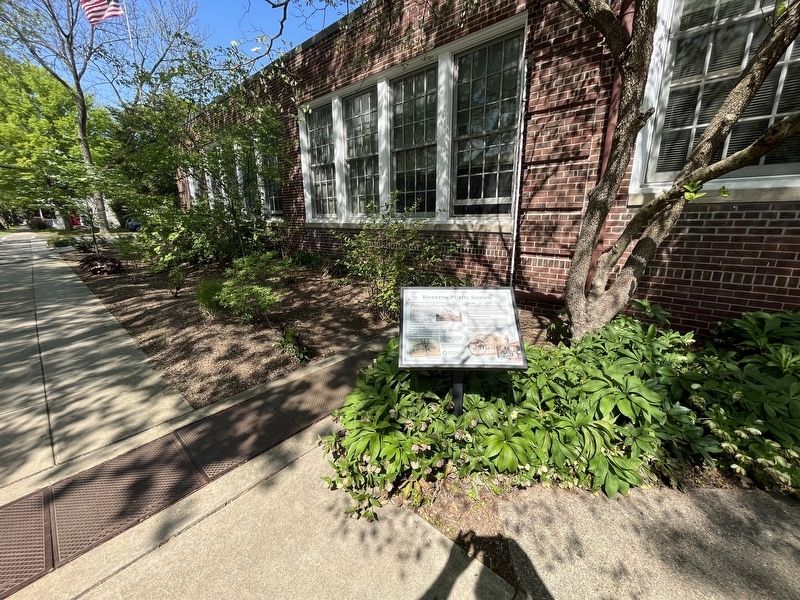
Location. 40° 0.676′ N, 75° 0.77′ W. Marker is in Riverton, New Jersey, in Burlington County. It is on 5th Street just east of Howard Street, on the right when traveling west. Touch for map. Marker is at or near this postal address: 120 5th St, Riverton NJ 08077, United States of America. Touch for directions.

Regionally, this marker is in South Jersey and in Greater Philadelphia. It is also in the American Northeast, in the Mid-Atlantic, and on the Eastern Seaboard. Globally, it is in the North Atlantic Region, North America, the Western Hemisphere, the Western World, and the Anglosphere. Historically, it finds itself in what was once New Netherland and also one of the original Thirteen Colonies.
Other nearby markers. At least 8 other markers are within walking distance of this marker: In Memory of Lives lost by Riverton Gold Star Servicemen in World War 1 (here, next to this marker); Patrolman Thomas C. Whitelock (about 600 feet away, measured in a direct line); Riverton (about 600 feet away); Christ Episcopal Church (about 600 feet away); a different marker also named Christ Episcopal Church (about 600 feet away); Joseph Campbell House (about 700 feet away); Veterans Memorial (about 700 feet away); Riverton Free Library (about 700 feet away). Touch for a list and map of all markers in Riverton.
Credits. This page was last revised on April 22, 2023. It was originally submitted on April 22, 2023, by Devry Becker Jones of Washington, District of Columbia. This page has been viewed 226 times since then and 46 times this year. Photos: 1, 2. submitted on April 22, 2023, by Devry Becker Jones of Washington, District of Columbia.
