Central Harlem in Manhattan in New York County, New York — The American Northeast (Mid-Atlantic)
Alexander Hamilton's House
The New Home of the Hamilton-Grange
| — | National Park Service, U.S. Department of the Interior | — |
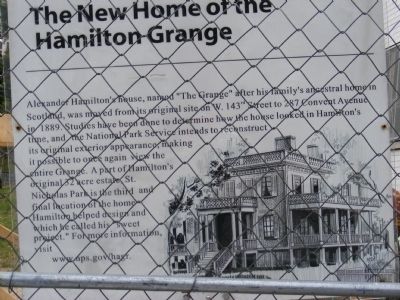
Photographed by Don Morfe, September 26, 2010
1. Alexander Hamilton's House Marker
Erected by National Park Service.
Topics. This historical marker is listed in this topic list: Notable Buildings. A significant historical year for this entry is 1889.
Location. This marker has been replaced by another marker nearby. It was located near 40° 49.286′ N, 73° 56.835′ W. Marker was in Manhattan, New York, in New York County. It was in Central Harlem. It was on West 141st Street. Touch for map. Marker was at or near this postal address: 414 West 141 Street, New
this page online

Regionally, this marker was in New York City. It was also in the American Northeast, in the Mid-Atlantic, and on the Eastern Seaboard. Globally, it was in the North Atlantic Region, North America, the Western Hemisphere, the Western World, and the Anglosphere. Historically, it found itself in what was once New Netherland and also one of the original Thirteen Colonies.
Other nearby markers. At least 8 other markers are within walking distance of this location: Hamilton Grange (a few steps from this marker); Hamilton's Eden (a few steps from this marker); a different marker also named Hamilton's Eden (a few steps from this marker); From Hamilton's Home to a National Memorial (a few steps from this marker); a different marker also named Hamilton Grange (within shouting distance of this marker); Hamilton Heights Historic District (within shouting distance of this marker); Dorothy Maynor (about 400 feet away, measured in a direct line); Shepard Hall (about 500 feet away). Touch for a list and map of all markers in Manhattan.
Also see . . .
1. Grange House - National Park Service.
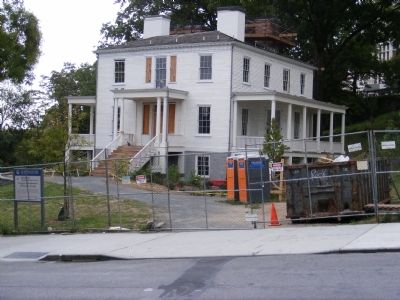
Photographed by Don Morfe, September 26, 2010
2. Alexander Hamilton's House Marker
2. Alexander Hamilton's 1802 "The Grange". "Daytonian in Manhattan" entry. (Submitted on March 19, 2020, by Larry Gertner of New York, New York.)
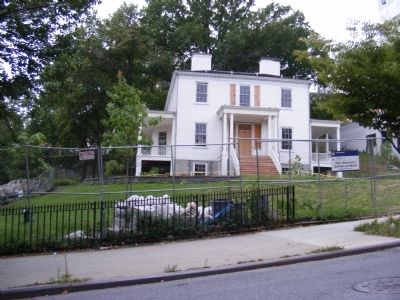
Photographed by Don Morfe, September 26, 2010
3. Alexander Hamilton's House Marker
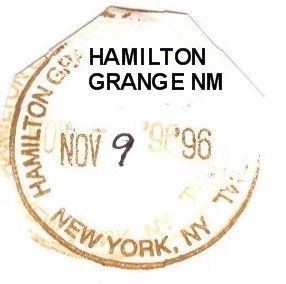
Photographed by Don Morfe, November 9, 1996
4. Alexander Hamilton's House Marker
National Park Passport Cancellation Stamp.
Photographed by Allen C. Browne, January 18, 2014
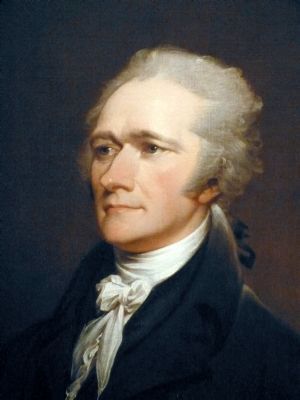
5. Alexander Hamilton
This 1806 portrait of Alexander Hamilton by John Trumbull hangs in the National Portrait Gallery.
“Illegitimate and orphaned at an early age, Alexander Hamilton possessed the drive and intelligence that attracted wealthy patrons who sent him to study at King's College (now Columbia University). An early advocate for independence from Britain, he enlisted in the army and came to the attention of George Washington, who made him a member of his military "family."
After independence, Hamilton supported a strong national government, assisting in the ratification of the Constitution by authoring, with John Jay and James Madison, the most original contribution to American political thought, the Federalist Papers. Washington, impressed with Hamilton's mastery of economics, made him the first secretary of treasury. Hamilton's policies assumption of state debts, encouragement of commerce and manufacturing, and promotion of a national bank are credited with laying the groundwork for a strong republic. He was killed in a duel with the vice president, Aaron Burr.”— National Portrait Gallery
“Illegitimate and orphaned at an early age, Alexander Hamilton possessed the drive and intelligence that attracted wealthy patrons who sent him to study at King's College (now Columbia University). An early advocate for independence from Britain, he enlisted in the army and came to the attention of George Washington, who made him a member of his military "family."
After independence, Hamilton supported a strong national government, assisting in the ratification of the Constitution by authoring, with John Jay and James Madison, the most original contribution to American political thought, the Federalist Papers. Washington, impressed with Hamilton's mastery of economics, made him the first secretary of treasury. Hamilton's policies assumption of state debts, encouragement of commerce and manufacturing, and promotion of a national bank are credited with laying the groundwork for a strong republic. He was killed in a duel with the vice president, Aaron Burr.”— National Portrait Gallery
Credits. This page was last revised on July 12, 2025. It was originally submitted on January 3, 2013. This page has been viewed 1,388 times since then and 65 times this year. Last updated on April 28, 2023. Photos: 1, 2, 3, 4. submitted on January 3, 2013, by Don Morfe of Baltimore, Maryland. 5. submitted on June 19, 2015, by Allen C. Browne of Silver Spring, Maryland. • J. Makali Bruton was the editor who published this page.
