Halifax in Halifax County, North Carolina — The American South (South Atlantic)
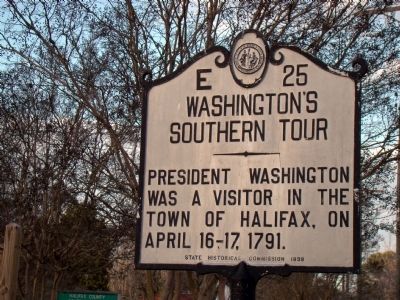
Washington’s Southern Tour
Photographed by J. J. Prats, February 14, 2009
1. Washington’s Southern Tour Marker
Erected 1939 by State Historical Commission. (Marker Number E-25.)
Topics and series. This historical marker is listed in this topic list: Patriots & Patriotism. In addition, it is included in the Daughters of the American Revolution (DAR), the Former U.S. Presidents: #01 George Washington, the George Washington Slept Here, and the North Carolina Division of Archives and History series lists. A significant historical date for this entry is April 16, 1791.
Location. 36° 19.296′ N, 77° 35.592′ W. Marker is in Halifax, North Carolina, in Halifax County. It is on South King Street south of Ferrell Lane, on the right when traveling south. Touch for map. Marker is at or near this postal address: 24 S King St, Halifax NC 27839, United States of America. Touch for directions.

Regionally, this marker is in North Carolina’s Coastal Plain. It is also in the American South and specifically in the Upper South. Globally, it is in North America, the Western Hemisphere, the Western World, and the Anglosphere. Historically, it finds itself in what
this page online
Other nearby markers. At least 8 other markers are within walking distance of this marker: Independence (here, next to this marker); Visit of George Washington (within shouting distance of this marker); The Halifax Resolves (within shouting distance of this marker); Cornwallis (within shouting distance of this marker); Hutchins G. Burton (about 400 feet away, measured in a direct line); a different marker also named Willie Jones (about 500 feet away); Ram Albemarle (approx. 0.4 miles away); Lafayette's Tour (approx. 0.4 miles away). Touch for a list and map of all markers in Halifax.
Another marker is no longer nearby. Willie Jones (was about 500 feet away but has been replaced with another marker now near it).
Regarding Washington’s Southern Tour. George Washington toured the southern states in the second year of his first term as President of the United States.
Also see . . . The Life and Times of George Washington, Volume 2. 1903 book by John
Photographed by J. J. Prats, February 14, 2009
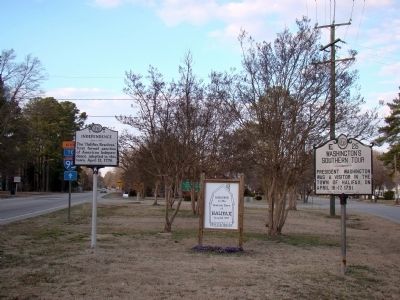
2. Two Markers at Southern Entrance to Halifax
Third marker, "Cornwallis," can be seen at the far left on the 301 bypass. U.S. 301 Business heads to town on the right.
Photographed by J. J. Prats, February 14, 2009
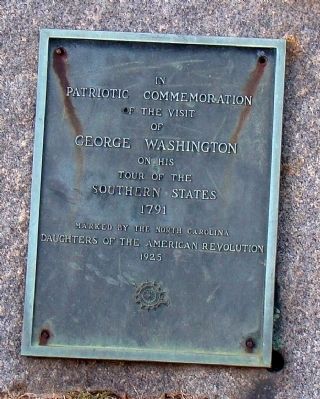
3. DAR Commemorative Tablet
This tablet is nearby, on the other side of the stone with the DAR commemorative tablet for the Halifax Resolves. It reads, "In patriotic commemoration of the visit of George Washington on his Tour of the Southern States, 1791. Marked by the North Carolina Daughters of the American Revolution, 1925."
Photographed by J. J. Prats, February 14, 2009
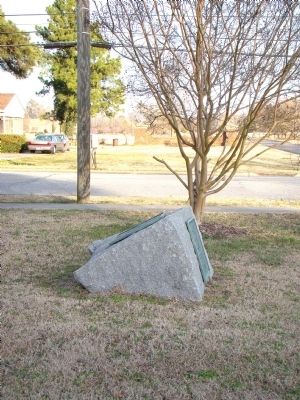
4. The Two DAR Tablets
The tablet commemorating Washington's Southern Tour faces right.
Credits. This page was last revised on April 29, 2023. It was originally submitted on February 16, 2009, by J. J. Prats of Powell, Ohio. This page has been viewed 1,526 times since then and 27 times this year. Last updated on April 29, 2023, by Michael Buckner of Durham, North Carolina. Photos: 1, 2, 3, 4. submitted on February 16, 2009, by J. J. Prats of Powell, Ohio. • Bernard Fisher was the editor who published this page.
