LaGrange in Troup County, Georgia — The American South (South Atlantic)
Dr. Ulrich Bonnell Phillips
Noted Georgia Historian
Photographed by David Seibert, August 24, 2009
1. Dr. Ulrich Bonnell Phillips Marker
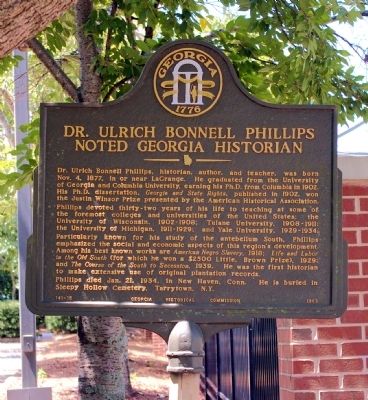
Dr. Ulrich Bonnell Phillips, historian, author, and teacher, was born Nov. 4, 1877, in or near LaGrange. He graduated from the University of Georgia and Columbia University, earning his Ph.D. from Columbia in 1902. His Ph.D. dissertation, Georgia and State Rights, published in 1902, won the Justin Winsor Prize presented by the American Historical Association.
Phillips devoted thirty-two years of his life to teaching at some of the foremost colleges and universities of the United States: the University of Wisconsin, 1902-1908; Tulane University, 1908-1911; the University of Michigan, 1911-1929; and Yale University, 1929-1934.
Particularly known for his study of the antebellum South, Phillips emphasized the social and economic aspects of this region’s development. Among his best known works are American Negro Slavery, 1918; Life and Labor in the Old South (for which he won a $2500 Little. Brown Prize), 1929; and The Course of the South to Secession, 1939. He was the first historian to make extensive use of original plantation records.
Phillips died Jan. 21, 1934, in New Haven. Conn. He is buried in Sleepy
this page online
Erected 1963 by Georgia Historical Commission. (Marker Number 141-15.)
Topics and series. This historical marker is listed in these topic lists: Arts, Letters, Music • Education. In addition, it is included in the Georgia Historical Society series list. A significant historical date for this entry is January 21, 1934.
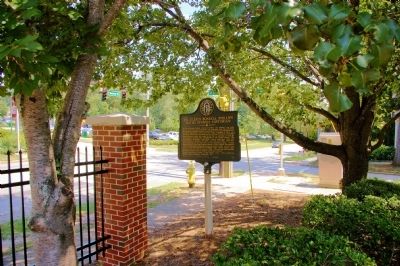
Location. 33° 2.293′ N, 85° 2.477′ W. Marker is in LaGrange, Georgia, in Troup County. It is at the intersection of Vernon Street (U.S. 29) and Park Avenue, on the right when traveling east on Vernon Street. Touch for map. Marker is in this post office area: Lagrange GA 30240, United States of America. Touch for directions.

Regionally, this marker is in Georgia’s Piedmont. It is also in the American South and specifically in the Deep South. Globally, it is in North America, the Western Hemisphere, the Western World, and the Anglosphere. Historically, it finds itself in what was once the territory of the Mississippian Culture, one of the original Thirteen Colonies, one of the Confederate States of America, and the Antebellum South.
Other nearby markers. At least 8 other
Photographed by David Seibert, August 24, 2009
2. Dr. Ulrich Bonnell Phillips Marker
Trees at the intersection can make the marker difficult to see
Another marker is no longer nearby. Troup County (was approx. 0.6 miles away but has been permanently removed).
Also see . . . Ulrich Bonnell Phillips. New Georgia Encyclopedia website entry (Submitted on September 7, 2009, by David Seibert of Sandy Springs, Georgia.)
Credits. This page was last revised on November 9, 2021. It was originally submitted on September 4, 2009, by David Seibert of Sandy Springs, Georgia. This page has been viewed 1,249 times since then and 23 times this year. Photos: 1, 2. submitted on September 4, 2009, by David Seibert of Sandy Springs, Georgia. • Bill Pfingsten was the editor who published this page.
