Old City in Knoxville in Knox County, Tennessee — The American South (East South Central)
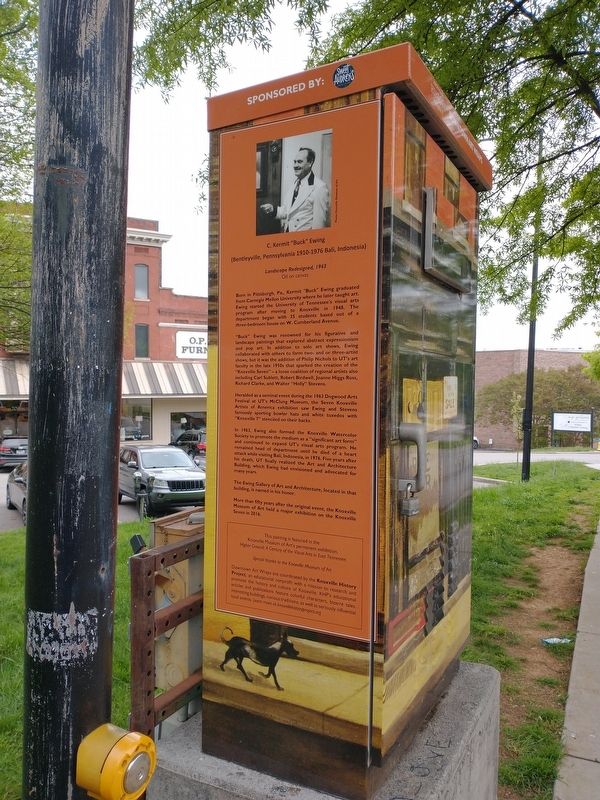
C. Kermit “Buck” Ewing
(Bentleyville, Pennsylvania 1910-1976 Bali, Indonesia)
Photographed by Tom Bosse, April 15, 2023
1. C. “Kermit” Buck Ewing Marker
Oil on canvas
Born in Pittsburgh, Pa., Kermit "Buck" Ewing graduated from Carnegie Mellon University where he later taught art. Ewing started the University of Tennessee's visual arts program after moving to Knoxville in 1948. The department began with 35 students based out of a three-bedroom house on W. Cumberland Avenue.
"Buck" Ewing was renowned for his figurative and landscape paintings that explored abstract expressionism and pop art. His painting here, "Sports Final", depicts a newspaper seller on Kingston Pike in Knoxville in 1949. In addition to solo art shows, Ewing collaborated with others to form two- and three-artist shows, but it was the addition of Philip Nichols to UT's art faculty in the late 1950s that sparked the creation of the "Knoxville Seven" - a loose coalition of regional artists also including Carl Sublett, Robert Birdwell, Joanne Higgs Ross, Richard Clarke, and Walter "Holly" Stevens.
Heralded as a seminal event during the 1963 Dogwood Arts Festival at UT's McClung Museum, the Seven Knoxville Artists of America exhibition saw Ewing and Stevens famously sporting
this page online
In 1963, Ewing also formed the Knoxville Watercolor Society to promote the medium as a "significant art form" and continued to expand UT's visual arts program. He remained head of department until he died of a heart attack while visiting Bali, Indonesia, in 1976. Five years after his death, UT finally realized the Art and Architecture Building, which Ewing had envisioned and advocated for many years.
The Ewing Gallery of Art and Architecture, located in that building, is named in his honor.
More than fifty years after the original event, the Knoxville Museum of Art held a major exhibition on the Knoxville Seven in 2016.
Knoxville Museum of Art’s permanent exhibition,
Higher Ground: A Century of the Visual Arts in East Tennessee.
Special thanks to the Knoxville Museum of Art.
Downtown Art Wraps are coordinated by the Knoxville History
Project, an educational nonprofit with a mission to research and
promote the history and culture of Knoxville. KHP's educational
articles and publications feature colorful characters, bizarre tales,
interesting buildings, curious traditions, as well as seriously influential
local events. Learn more at knoxvillehistoryproject.org
Erected by Knoxville
Photographed by Tom Bosse, April 15, 2023
2. C. “Kermit” Buck Ewing Marker
Topics and series. This historical marker is listed in this topic list: Arts, Letters, Music. In addition, it is included in the Knoxville History Project - Downtown Art Wraps series list. A significant historical year for this entry is 1948.
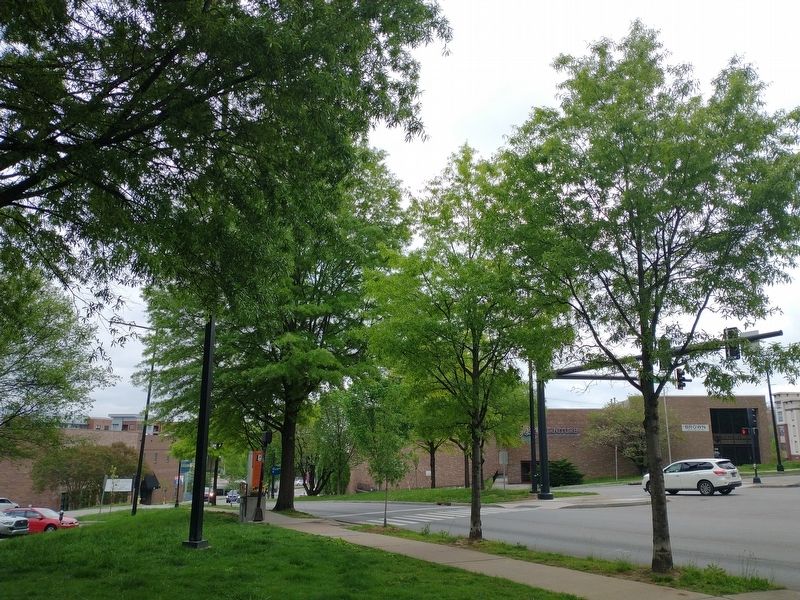
Location. 35° 58.079′ N, 83° 55.144′ W. Marker is in Knoxville, Tennessee, in Knox County. It is in Old City. It is at the intersection of West Summit Hill Drive Southwest and State Street, on the right when traveling west on West Summit Hill Drive Southwest. Touch for map. Marker is at or near this postal address: 209 W Summit Hill Dr SW, Knoxville TN 37902, United States of America. Touch for directions.

Regionally, this marker is in East Tennessee. It is also in the American South, specifically in the Upper South, in Appalachia, and specifically in Southern Appalachia. Globally, it is in North America, the Western Hemisphere, the Western World, and the Anglosphere. Historically, it finds itself in what was once the original Cherokee Nation, the territory of the Mississippian Culture, one of the Confederate States of America, and the Antebellum South.
Other nearby markers. At least 8 other markers are within walking distance of this marker: Archie Campbell / Chet Atkins (within shouting distance of this marker); Robert Birdwell (about 300 feet away, measured in a direct line); Cal Fackler Johnson (about 300 feet away); Uncle Dave Macon (about 300 feet away); The Midday Merry-Go-Round (about 400 feet away); Richard Clarke (about 400 feet away); Hubris Building (about 500 feet away); a different marker also named Robert Birdwell (about 600 feet away). Touch for a list and map of all markers in Knoxville.
More about this marker. There is a duplicate of this marker on Main and Gray streets.
Credits. This page was last revised on May 7, 2023. It was originally submitted on April 30, 2023, by Tom Bosse of Jefferson City, Tennessee. This page has been viewed 248 times since then and 28 times this year. Photos: 1, 2. submitted on April 30, 2023, by Tom Bosse of Jefferson City, Tennessee. • James Hulse was the editor who published this page.
