
Downtown in Knoxville in Knox County, Tennessee — The American South (East South Central)
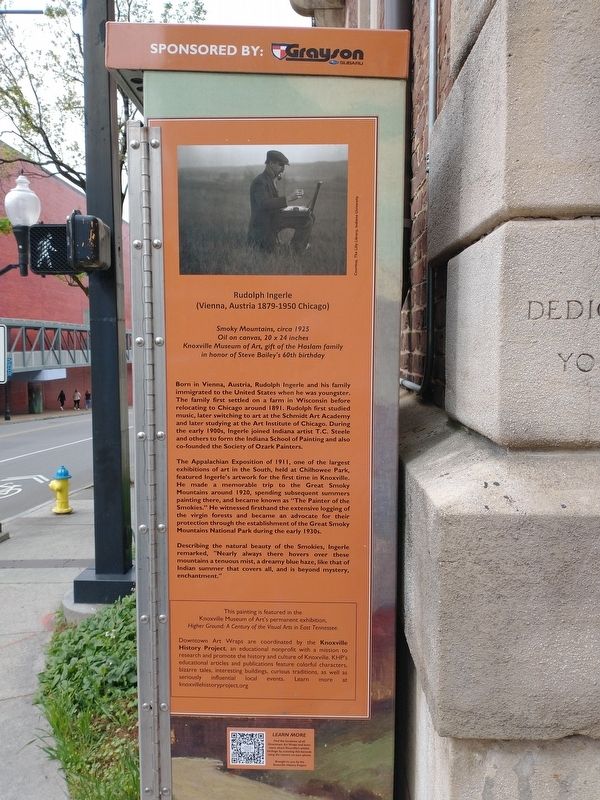
Rudolph Ingerle
(Vienna, Austria 1879-1950 Chicago)
Photographed by Tom Bosse, April 15, 2023
1. Rudolph Ingerle Marker
Oil on canvas, 20 x 24 inches
Knoxville Museum of Art, gift of the Haslam family
in honor of Steve Bailey's 60th birthday.
Born in Vienna, Austria, Rudolph Ingerle and his family immigrated to the United States when he was a youngster. The family first settled on a farm in Wisconsin before relocating to Chicago around 1891. Rudolph first studied music, later switching to art at the Schmidt Art Academy and later studying at the Art Institute of Chicago. During the early 1900s, Ingerle joined Indiana artist T. C. Steele and others to form the Indiana School of Painting and also co-founded the Society of Ozark Painters.
The Appalachian Exposition of 1911, one of the largest exhibitions of art in the South, held at Chilhowee Park, featured Ingerle's artwork for the first time in Knoxville. He made a memorable trip to the Great Smoky Mountains around 1920, spending subsequent summers painting there, and became known as "The Painter of the Smokies". He witnessed firsthand the extensive logging of the virgin forests and became an advocate for their protection through the establishment of the
this page online
Describing the natural beauty of the Smokies, Ingerle remarked, "Nearly always there hovers over these mountains a tenuous mist, a dreamy blue haze, like that of Indian summer that covers all, and is beyond mystery, enchantment."
Knoxville Museum of Art's permanent exhibition,
Higher Ground: A Century of the Visual Arts in East Tennessee.
Downtown Art Wraps are coordinated by the Knoxville
History Project, an educational nonprofit with a mission to
research and promote the history and culture of Knoxville. KHP's
educational articles and publications feature colorful characters,
bizarre tales, interesting buildings, curious traditions, as well as
seriously influential local events. Learn more at knoxvillehistoryproject.org
Erected by Knoxville History Project.
Topics and series. This historical marker is listed in this topic list: Arts, Letters, Music. In addition, it is included in the Knoxville History Project - Downtown Art Wraps series list. A significant historical year for this entry is 1925.
Location. 35° 57.783′ N, 83° 55.26′ W.
Photographed by Tom Bosse, April 15, 2023
2. Rudolph Ingerle Marker

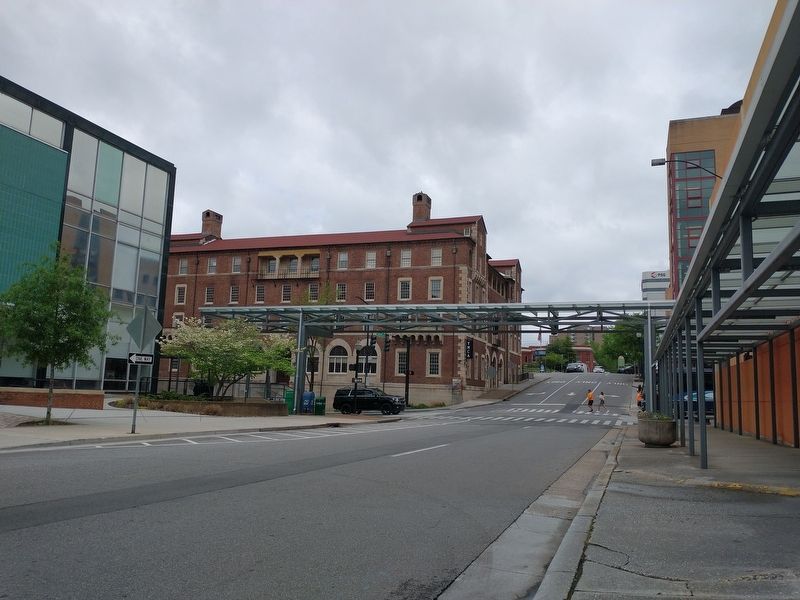
Regionally, this marker is in East Tennessee. It is also in the American South, specifically in the Upper South, in Appalachia, and specifically in Southern Appalachia. Globally, it is in North America, the Western Hemisphere, the Western World, and the Anglosphere. Historically, it finds itself in what was once the original Cherokee Nation, the territory of the Mississippian Culture, one of the Confederate States of America, and the Antebellum South.
Other nearby markers. At least 8 other markers are within walking distance of this marker: Grand Lodge of Tennessee (within shouting distance of this marker); Rotary Club of Knoxville (about 400 feet away, measured in a direct line); Lawson McGhee Library (about 400 feet away); Beauford Delaney (about 400 feet away); Carl Sublett (about 500 feet away); Charles Krutch (about 700 feet away); Burn Memorial (about 700 feet away); Master Sgt. Roddie Edmonds (about 800 feet away). Touch for a list and map of all markers in Knoxville.
Credits. This page was last revised on May 7, 2023. It was originally submitted on May 1, 2023, by Tom Bosse of Jefferson City, Tennessee. This page has been viewed 185 times since then and 18 times this year. Photos: 1, 2. submitted on May 1, 2023, by Tom Bosse of Jefferson City, Tennessee. • James Hulse was the editor who published this page.
