Glencoe Village near Burlington in Alamance County, North Carolina — The American South (South Atlantic)
A Legacy of Community
Photographed by Patrick G. Jordan, June 27, 2010
1. A Legacy of Community Marker
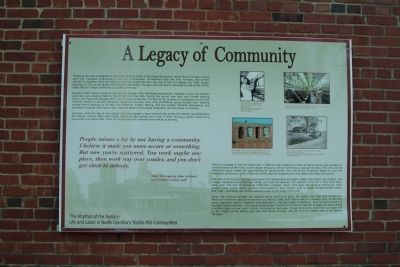
Several factors drove owners to sell the mill houses. With affordable automobiles available, many mill workers could buy cars allowing them to live farther from the mills. During this period, new labor laws limited working hours, and most mills adopted shift work to boost production. Increasing the numbers of employees would have required owners to provide additional, expensive housing. Also, laws prohibiting young children from working caused family housing to be less cost effective. Finally, fearing that the villages fostered delinquency and promoted a distinct white lower class, regional leaders encouraged integration into the
this page online
Ironically, while the sale of mill villages ultimately eroded unique communities some mill workers benefited from the change. Owners often sold houses directly to workers who lived in them. During a period when home ownership rose nationwide, many mill employees also switched from renting to owning.
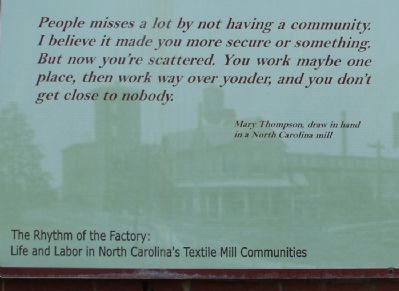
People misses a lot by not having a community. I believe it made you more secure or something. But now you’re scattered. You work maybe one place, then work way over yonder, and you don’t get close to nobody.
Mary Thompson, draw in hand in a North Carolina millV
With the passage of the Civil Rights Act in 1964 and the increasing number of higher-paying jobs available to whites outside of the mills, owners began employing African Americans in greater numbers. Still mills did not offer them equal wages and opportunities for advancement. Not until African Americans began to unite and voice their grievances in the 1960s and 1970s did their experiences in the textile mills begin to improve.
The sale of the houses did not break down mill communities overnight; rather, the process was gradual. The villages remained
Photographed by Patrick G. Jordan, June 27, 2010
2. A Legacy of Community Marker
Today, the whirring spindles and banging looms are but an echo. The textile mills that once formed the Piedmont’s economic backbone are moving to Mexico, India, and China in search of cheaper labor. As the mills close, they leave behind a legacy of cities and towns – from Burlington to Gastonia – born during the height of Southern industrialization. The unique communities of people who lived and labored in these mill towns made a lasting imprint on our social, cultural, and physical landscape. Though most North Carolinians no longer live by the rhythm of the factory, the lives and stories of those who did form an integral part of our shared heritage.
Topics. This historical marker is listed in this topic list: Industry & Commerce. A significant historical year for this entry is 1958.
Location. 36° 8.332′ N,
Photographed by Patrick G. Jordan, June 27, 2010
3. A Legacy of Community Marker

Regionally, this marker is in the Piedmont and specifically in Piedmont Triad. It is also in the American South and specifically in the Upper South. Globally, it is in North America, the Western Hemisphere, the Western World, and the Anglosphere. Historically, it finds itself in what was once the territory of the Mississippian Culture, one of the original Thirteen Colonies, one of the Confederate States of America, and the Antebellum South.
Other nearby markers. At least 8 other markers are within walking distance of this marker: African Americans in the Mill Village (here, next to this marker); The Mill Buildings (a few steps from this marker); After the Whistle Blows (a few steps from this marker); Men in the Mill Village (a few
Photographed by Patrick G. Jordan, June 27, 2010
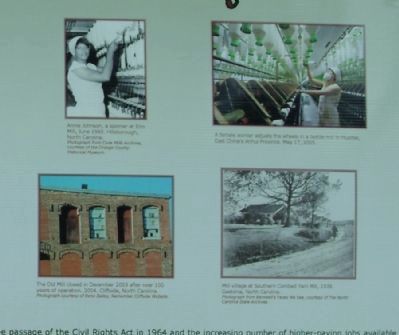
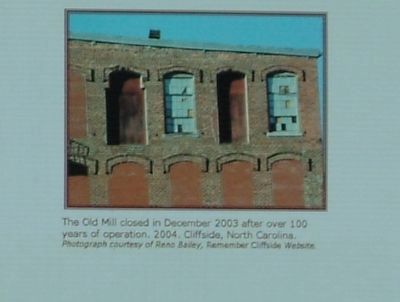
4. The Old Mill closed in December 2003
after over 100 years of operation. 2004, Cliffside, North Carolina.
Related markers. Click here for a list of markers that are related to this marker. To better understand the relationship, study each marker in the order shown.
Additional keywords. Alamance Cotton Mill, Glencoe, Fabric, Textiles, Company Shops, Holt
Photographed by Patrick G. Jordan, June 27, 2010
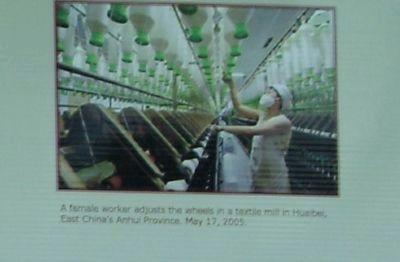
5. A female worker adjusts the wheels in a textile mill in Hunbaei,
East China's Anhui Province, May 17, 2005.
Photographed by Patrick G. Jordan, June 27, 2010
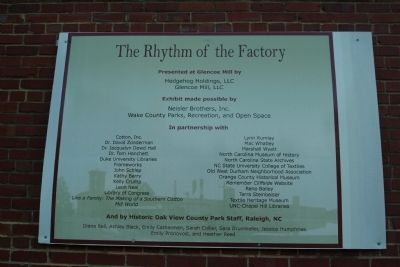
6. Rhythm of the Factory Marker
Photographed by Patrick G. Jordan, June 27, 2010
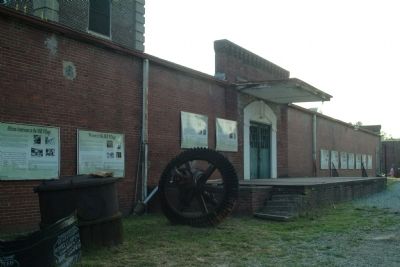
7. Rhythm of the Factory Series of Markers - on the Glencoe Mill
Photographed by Patrick G. Jordan, June 27, 2010
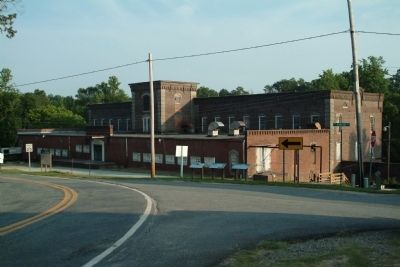
8. Glencoe Mill
Credits. This page was last revised on May 11, 2023. It was originally submitted on July 10, 2010, by Patrick G. Jordan of Graham, North Carolina. This page has been viewed 1,026 times since then and 21 times this year. Last updated on May 9, 2023, by Michael Buckner of Durham, North Carolina. Photos: 1, 2, 3, 4, 5, 6, 7, 8. submitted on July 10, 2010, by Patrick G. Jordan of Graham, North Carolina. • J. Makali Bruton was the editor who published this page.
