Glencoe Village in Burlington in Alamance County, North Carolina — The American South (South Atlantic)
Working the Shift
Photographed by Patrick G. Jordan, June 27, 2010
1. Working the Shift Marker
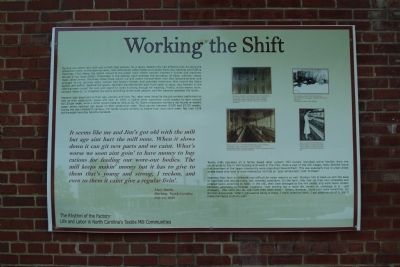
Workers’ jobs depended on their age, gender, and race. Pay rates were linked to the job workers performed as well as their experience, speed and skill. In 1904,
this page online
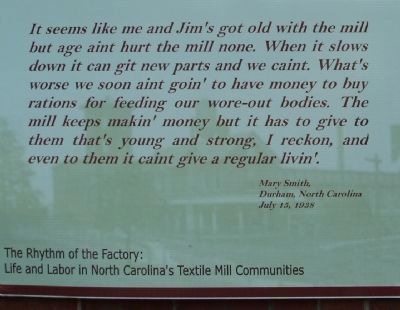
It seems like me and Jim’s got old with the mill but age aint hurt the mill none. When it slows down it can git new parts and we caint. What’s worse we soon aint goin’ to have money to buy rations for feeding our wore-out bodies. The mill keeps makin’ money but it has to give to them that’s young and strong, I reckon, and even to them it caint give a regular livin’.
Mary Smith, Durham, North Carolina
Textile mills operated on a family based labor system. Mill owners recruited entire families from the countryside to live in mill housing and work in the mills. Once a part of the mill village, many families found that members of the larger community were prejudiced toward them. This was especially true in urban areas where
Photographed by Patrick G. Jordan, June 27, 2010
2. Working the Shift Marker
Adapting from farm to millwork was difficult for other reasons as well. Workers had to keep up with the pace of machines and endure noisy, hot, crowded conditions. On the farm, they had set their own schedules and ordered tasks according to need; in the mill, their time belonged to the mill owner, and work never ended. Millwork, according to Chester Copeland, “was nothing but a robot life…there’s no challenge to it – just drudgery. The more you do, the more they want done.” Others, however, found paid work rewarding. Icy Norman discovered, “after I got used to being in there, I really loved my work… I got pleasure out of it, and it made me happy to do my job.”
Topics. This historical marker is listed in this topic list: Industry & Commerce. A significant historical year for this entry is 1904.
Location. 36° 8.341′ N, 79° 25.686′ W. Marker is in Burlington, North Carolina, in Alamance County. It is in Glencoe Village. It is on Glencoe Street, on the left when traveling west. Glencoe Village is 3 miles north of Burlington, NC from NC Highway 62. Touch for map.
Photographed by Patrick G. Jordan, June 27, 2010
3. Working the Shift Marker

Regionally, this marker is in the Piedmont and specifically in Piedmont Triad. It is also in the American South and specifically in the Upper South. Globally, it is in North America, the Western Hemisphere, the Western World, and the Anglosphere. Historically, it finds itself in what was once the territory of the Mississippian Culture, one of the original Thirteen Colonies, one of the Confederate States of America, and the Antebellum South.
Other nearby markers. At least 8 other markers are within walking distance of this marker: Power, Wheel House and Turbine (here, next to this marker); Cotton Dust and Poverty (here, next to this marker); Calling the Mill Village 'Home' (here, next to this marker); Neighbors Divided (here, next to this marker); The Rise of the Textile Mill Communities (here, next to this marker); Picker House and Dye House (a few steps from this marker); After the Whistle Blows (a few steps from this marker); Women in the Mill Village (a few steps from this marker). Touch for a list and map
Photographed by Patrick G. Jordan, June 27, 2010
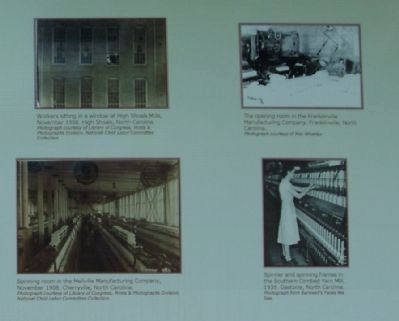
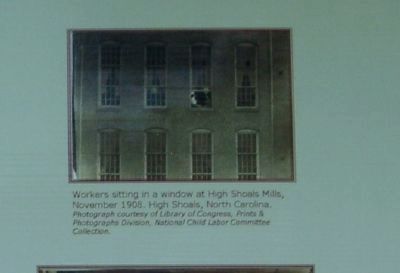
4. Workers sitting in a window at High Shoals Mills,
November, 1908. High Shoals, North Carolina
Related markers. Click here for a list of markers that are related to this marker. To better understand the relationship, study each marker in the order shown.
Additional keywords. Alamance Cotton Mill, Glencoe, Fabric, Textiles, Company Shops, Holt
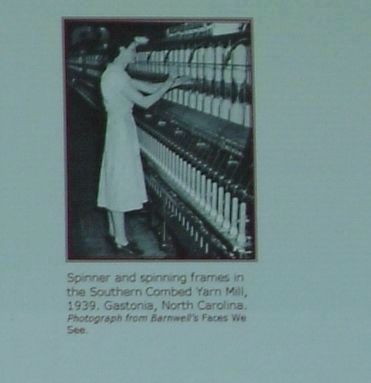
Photographed by Patrick G. Jordan, June 27, 2010
5. Spinner and spinning frames in the Southern Combed Yarn Mill, 1939
Gastonia, North Carolina
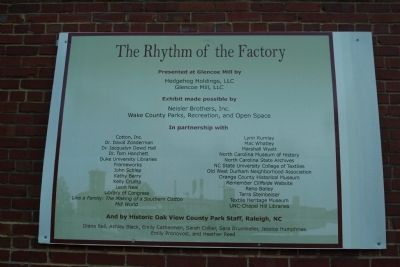
Photographed by Patrick G. Jordan, June 27, 2010
6. Rhythm of the Factory Marker
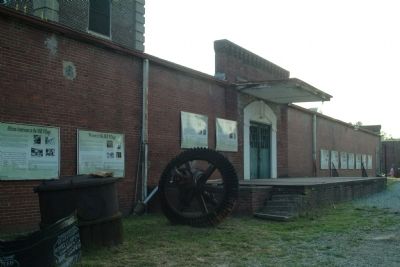
Photographed by Patrick G. Jordan, June 27, 2010
7. Rhythm of the Factory Series of Markers - on the Glencoe Mill
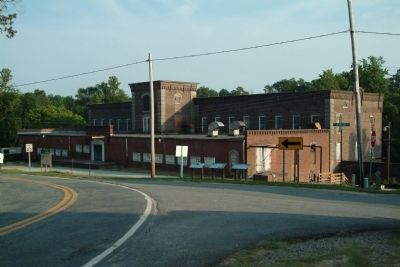
Photographed by Patrick G. Jordan, June 27, 2010
8. Glencoe Mill
Credits. This page was last revised on May 11, 2023. It was originally submitted on July 9, 2010, by Patrick G. Jordan of Graham, North Carolina. This page has been viewed 905 times since then and 30 times this year. Last updated on May 9, 2023, by Michael Buckner of Durham, North Carolina. Photos: 1, 2, 3. submitted on July 10, 2010, by Patrick G. Jordan of Graham, North Carolina. 4. submitted on July 9, 2010, by Patrick G. Jordan of Graham, North Carolina. 5, 6, 7, 8. submitted on July 10, 2010, by Patrick G. Jordan of Graham, North Carolina. • J. Makali Bruton was the editor who published this page.
