Near Four Oaks in Johnston County, North Carolina — The American South (South Atlantic)
March 20th— Johnston Remains on the Battlefield
Photographed by Karl Stelly, January 16, 2017
1. March 20th - Johnston Remains on the Battlefield Marker
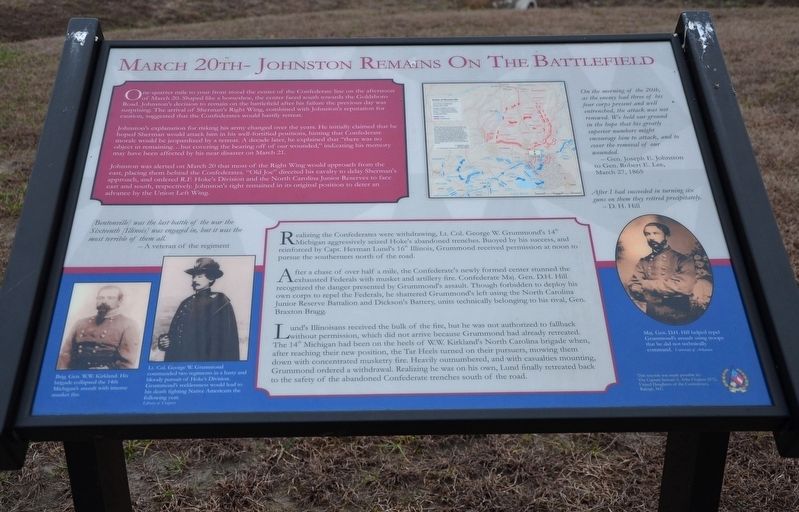
Johnston's explanation for risking his army changed over the years. He initially claimed that he hoped Sherman would attack him in his well-fortified positions, hinting that Confederate morale would be jeopardized by a retreat. A decade later, he explained that "there was no object in remaining...but covering the bearing off of our wounded," indicating his memory may have been affected by his near disaster on March 21.
Johnston was alerted on March 20 that most of the Right Wing would approach from the east, placing them behind the Confederates. "Old Joe" directed his cavalry to delay Sherman's approach, and ordered R.F. Hoke's Division and the North Carolina Junior Reserves to face east and south, respectively.
this page online
[Bentonville] was the last battle of the war the Sixteenth [Illinois] was engaged in, but it was the most terrible of them all.
—A veteran of the regiment
On the morning of the 20th, as the enemy had three of his four corps present and well entrenched, the attack was not renewed. We held our ground in the hope that his greatly superior numbers might encourage him to attack, and to cover the removal of our wounded.
—Gen. Joseph E. Johnston to Gen. Robert E. Lee, March 27, 1865
Realizing the Confederates were withdrawing, Lt. Col. George W. Grummond's 14th Michigan aggressively seized Hoke's abandoned trenches. Buoyed by his success, and reinforced by Capt. Herman Lund's 16th Illinois, Grummond received permission at noon to pursue the southerners north of the road.
After a chase of over half a mile, the Confederate's newly formed center stunned the exhausted Federals with musket and artillery fire. Confederate Maj. Gen. D.H. Hill recognized the danger presented by Grummond's assault. Though forbidden to deploy his own corps to
Photographed by Karl Stelly, January 16, 2017
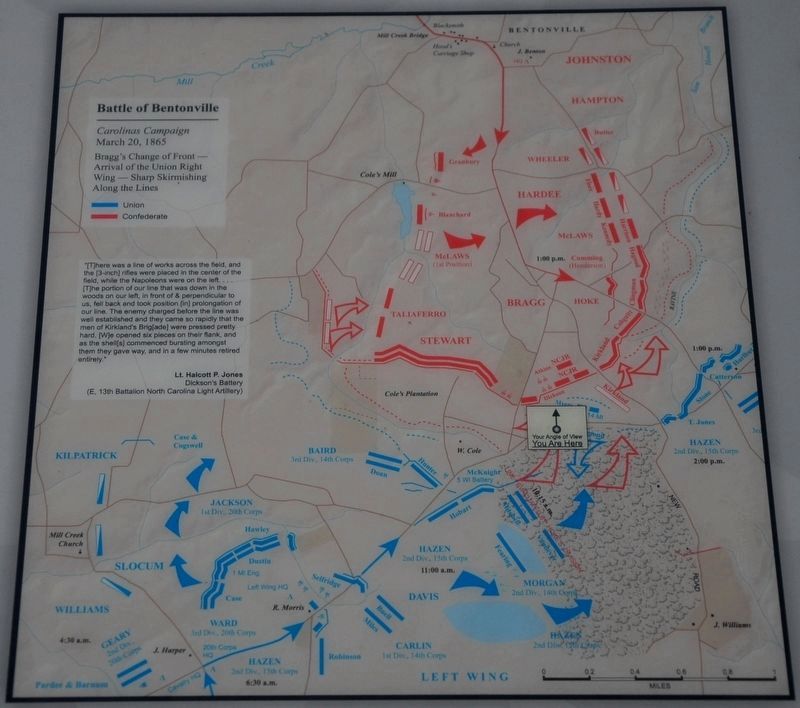
2. Battle of Bentonville Map
Battle of Bentonville, Carolinas Campaign, March 20, 1865 - From the marker
Lund's Illinoisans received the bulk of the fire, but he was not authorized to fall back without permission, which did not arrive because Grummond had already retreated. The 14th Michigan had been on the heels of W.W. Kirkland's North Carolina brigade when, after reaching their new position, the Tar Heels turned on their pursuers, mowing them down with concentrated musketry fire. Heavily outnumbered, and with casualties mounting, Grummond ordered a withdrawal. Realizing he was on his own, Lund finally retreated back to the safety of the abandoned Confederate trenches south of the road.
After I had succeeded in turning six guns on them they retired precipitately.
—D.H. Hill
Topics. This historical marker is listed in this topic list: War, US Civil. A significant historical date for this entry is March 20, 1865.
Location. 35° 19.054′ N, 78° 17.224′ W. Marker is near Four Oaks, North Carolina, in Johnston County. It is on Harper House Road (County Route 1008) 0.1
Photographed by Karl Stelly, January 16, 2017
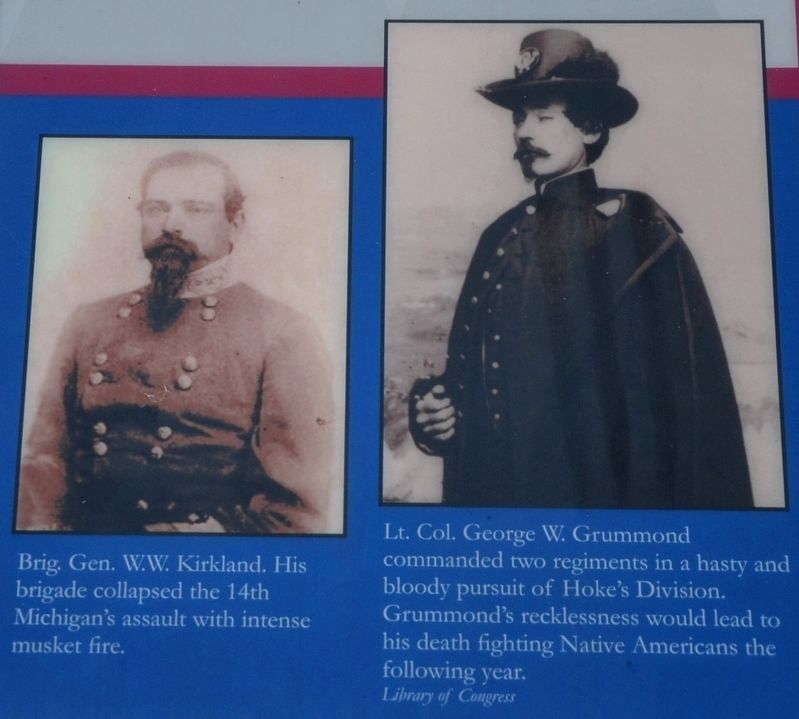
3. Brig. Gen. W.W. Kirkland & Lt. Col. George W. Grummond
Brig. Gen. W.W. Kirkland. His brigade collapsed the 14th Michigan's assault with intense musket fire.
Lt. Col. George W. Grummond commanded two regiments in a hasty and bloody pursuit of Hoke's Division. Grummond's recklessness would lead to his death fighting Native Americans the following year. (Library of Congress)

Regionally, this marker is in North Carolina’s Piedmont. It is also in the American South and specifically in the Upper South. Globally, it is in North America, the Western Hemisphere, the Western World, and the Anglosphere. Historically, it finds itself in what was once the territory of the Mississippian Culture, one of the original Thirteen Colonies, one of the Confederate States of America, and the Antebellum South.
Other nearby markers. At least 8 other markers are within walking distance of this marker: Sherman's Right Wing Arrives at Bentonville (a few steps from this marker); Federal Junction (approx. ¼ mile away); Main Union Line (approx. half a mile away); The Fight For Flowers' Crossroads (approx. 0.6 miles away); The XV Corps At Bentonville (approx. 0.6 miles away); N.C. Junior Reserves (approx. 0.6 miles away); Merging of the Armies
Photographed by Karl Stelly, January 16, 2017
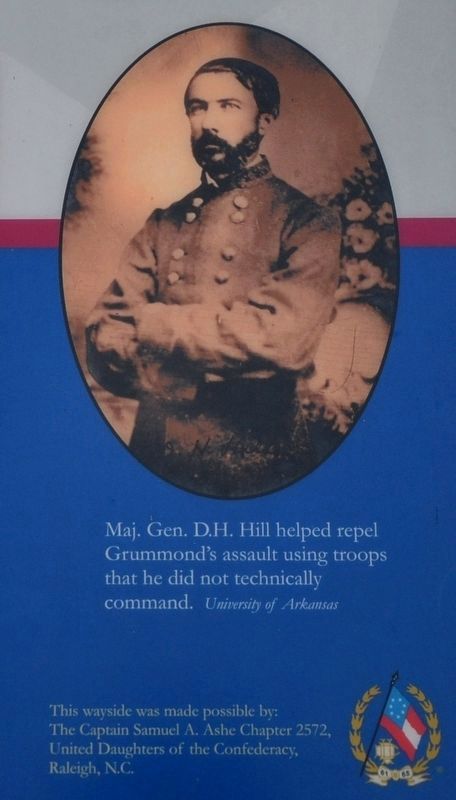
4. Confederate Major General Daniel Harvey Hill
Maj. Gen. D.H. Hill helped repel Grummond's assault using troops that he did not technically command. (University of Arkansas)
(New Paragraph)
This wayside was made possible by:
(New Paragraph)
The Captain Samuel A. Ashe Chapter 2572, United Daughters of the Confederacy, Raleigh, N.C.
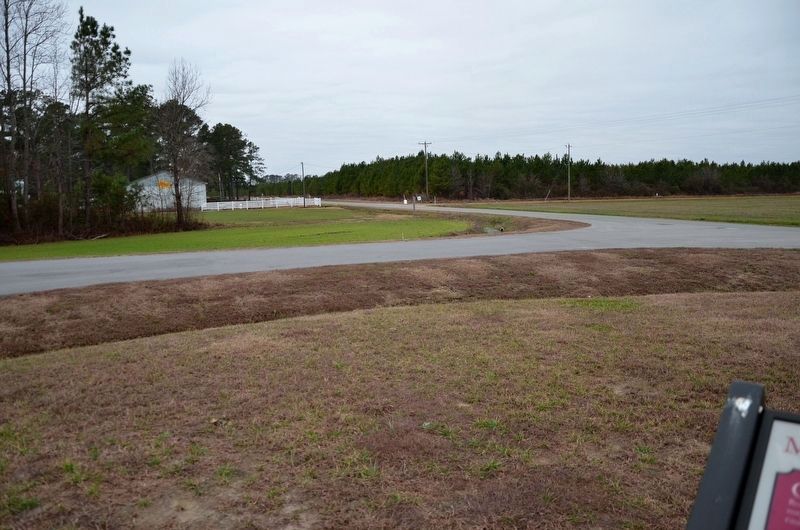
Photographed by Karl Stelly, January 16, 2017
5. March 20th— Johnston Remains on the Battlefield Marker
This view was taken standing at the marker. This view looks toward the northwest. The Harper House Road can be seen disappearing into the woods near the top center of the photo.
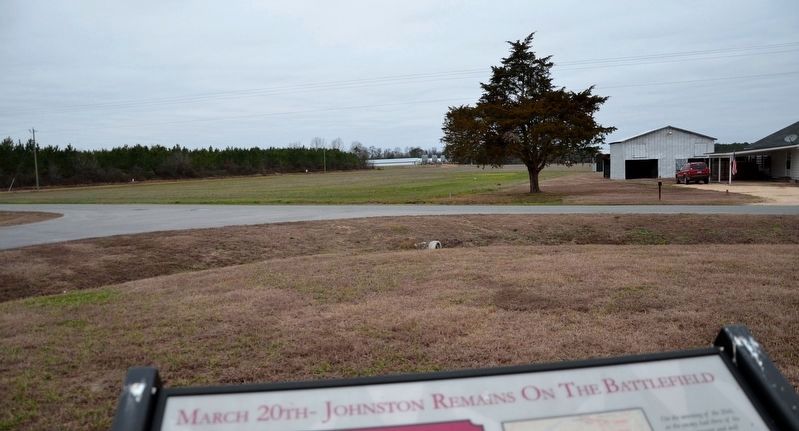
Photographed by Karl Stelly, January 16, 2017
6. March 20th— Johnston Remains on the Battlefield Marker
This view is looking straight out from the marker, showing the field and terrain beyond. This view looks toward the North. The Harper House Road runs from left to right.
Credits. This page was last revised on May 10, 2023. It was originally submitted on January 31, 2017, by Karl Stelly of Gettysburg, Pennsylvania. This page has been viewed 639 times since then and 24 times this year. Last updated on May 9, 2023, by Michael Buckner of Durham, North Carolina. Photos: 1, 2, 3, 4. submitted on January 31, 2017, by Karl Stelly of Gettysburg, Pennsylvania. 5, 6. submitted on February 4, 2017, by Karl Stelly of Gettysburg, Pennsylvania. • Bernard Fisher was the editor who published this page.
