
Hillsborough in Orange County, North Carolina — The American South (South Atlantic)
Billy Strayhorn
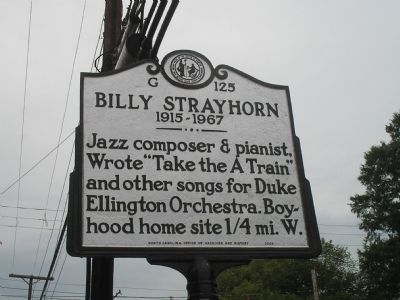
Photographed by Bill Coughlin, July 31, 2010
1. Billy Strayhorn Marker
Erected 2008 by North Carolina Office of Archives and History. (Marker Number G-125.)
Topics. This historical marker is listed in these topic lists: African Americans • Arts, Letters, Music • Entertainment.
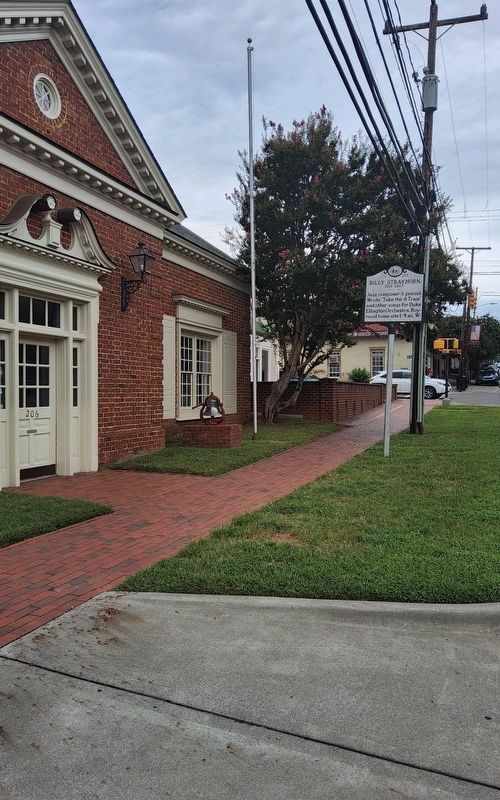
Location. 36° 4.455′ N, 79° 5.967′ W. Marker is in Hillsborough, North Carolina, in Orange County. It is on S Churton Street (U.S. 70), on the right when traveling south. Touch for map. Marker is at or near this postal address: 206 S Churton St, Hillsborough NC 27278, United States of America. Touch for directions.

Regionally, this marker is in North Carolina’s Piedmont and in the Research Triangle. It is also in the American South and specifically in the Upper South. Globally, it is in North America, the Western Hemisphere, the Western World, and the Anglosphere. Historically, it finds itself in what was once the territory of the Mississippian Culture, one of the original Thirteen Colonies, one of the Confederate
this page online
Other nearby markers. At least 8 other markers are within walking distance of this marker: North Carolina Society of the Cincinnati (a few steps from this marker); William Churton (within shouting distance of this marker); James Hogg (within shouting distance of this marker); Edmund Fanning (within shouting distance of this marker); Lynching In America / The Lynching of Washington, Thomas Jefferson, and Daniel Morrow (within shouting distance of this marker); Regulators Hanged (about 300 feet away, measured in a direct line); Thomas Burke (about 400 feet away); Orange County Courthouse, 1845-1957 (about 400 feet away). Touch for a list and map of all markers in Hillsborough.
Other markers no longer nearby. Edmund Fanning (was within shouting distance of this marker but has been replaced with another marker now near it); Paper Mill (was about 300 feet away but has been permanently removed).
Also see . . . NC Department of Natural and Cultural Resources Profile for Billy Strayhorn.
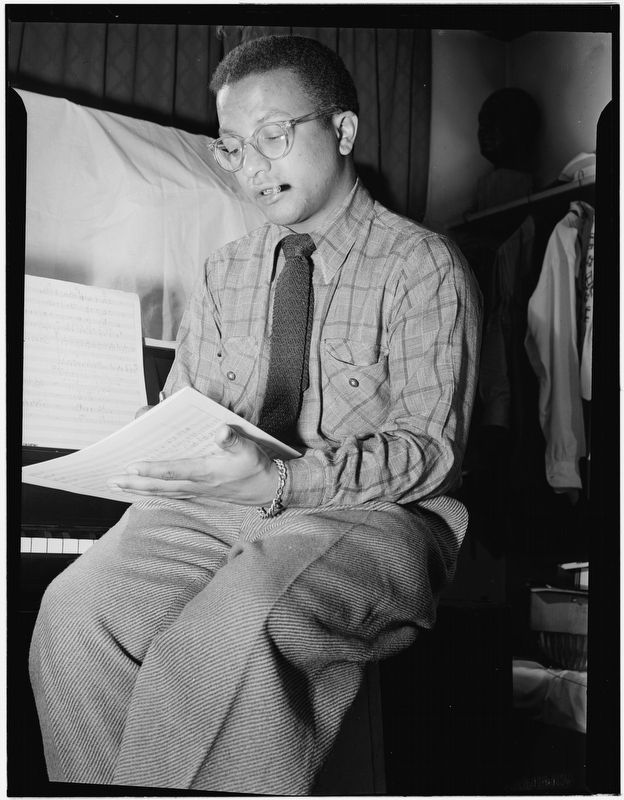
William Thomas (“Billy” professionally) Strayhorn, Duke Ellington’s longtime collaborator,(Submitted on February 24, 2025, by Devry Becker Jones of Washington, District of Columbia.)was among the most influential figures in American jazz. A versatile composer, arranger, and pianist, Strayhorn joined Ellington’s orchestra at age 22 in 1939 and worked with the bandleader the rest of his life. Ellington publicly acknowledged the central role Strayhorn played in his success, writing the band’s theme “Take the A Train” and penning popular and widely recorded songs such as “Lush Life” and “Satin Doll.” Strayhorn was a formative influence on an entire generation of musicians. Living in New York City most of his adult life, he was actively involved in the civil rights movement and was a personal friend of Martin Luther King Jr..Photographed by Bill Coughlin, July 31, 20102. Marker in Hillsborough
Although Strayhorn was born in Dayton, Ohio, his roots ran deep in Orange County and, importantly, his frequent stays in Hillsborough as a boy were essential to his musical development. His father and grandfather both worked at the Eno Mill. His grandparents, who owned a piano, lived in a house (now gone) at the corner of Margaret Lane and Hillsborough Avenue. Returning with his mother and siblings to North Carolina from Ohio regularly from age five, Strayhorn attended his first year of schoolwhile in Hillsborough; a classmate remembered him as “small and bright.” He spent breaks and summers in North Carolina through his early teenage years (by then the family had moved to Pittsburgh) and often took the train to visit an uncle in Durham.William P. Gottlieb, photographer [Courtesy Library of Congress], circa 19463. Portrait of Billy Strayhorn, New York, N.Y., between 1946 and 1948
Biographer David Hajdu contends that North Carolina became the young man’s spiritual home, the place he was introduced to music. Initially gospel tunes drew him to the piano. He often wandered through the slave cemetery across from his boyhood home and walked along the Eno River. At Strayhorn’s death at age 52 in 1967, Ellington said his friend “had no aspirations to enter into any kind of competition, yet the legacy he leaves, his oeuvre, will never be less than the ultimate on the highest plateau of culture.” In 2007 Strayhorn was the subject of a PBS documentary.
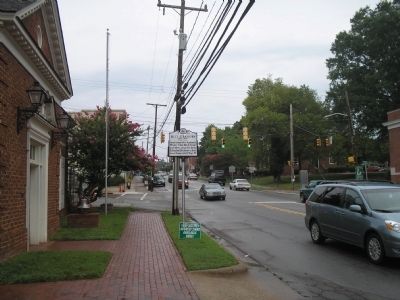
Photographed by Richard Hawkins, August 2, 2025
4. Billy Strayhorn Marker
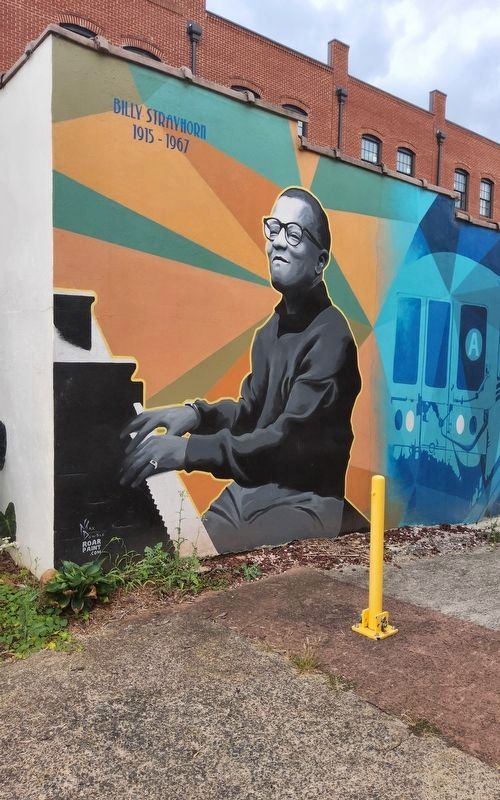
Photographed by Richard Hawkins, August 2, 2025
5. Billy Strayhorn Marker
Credits. This page was last revised on August 5, 2025. It was originally submitted on August 21, 2010, by Bill Coughlin of Woodland Park, New Jersey. This page has been viewed 1,304 times since then and 51 times this year. Last updated on May 11, 2023, by Michael Buckner of Durham, North Carolina. Photos: 1, 2. submitted on August 21, 2010, by Bill Coughlin of Woodland Park, New Jersey. 3. submitted on February 24, 2025. 4, 5. submitted on August 2, 2025, by Richard Hawkins of Phelan, California. • J. Makali Bruton was the editor who published this page.
