Chapel Hill in Orange County, North Carolina — The American South (South Atlantic)
Carl T. Durham
1892-1974
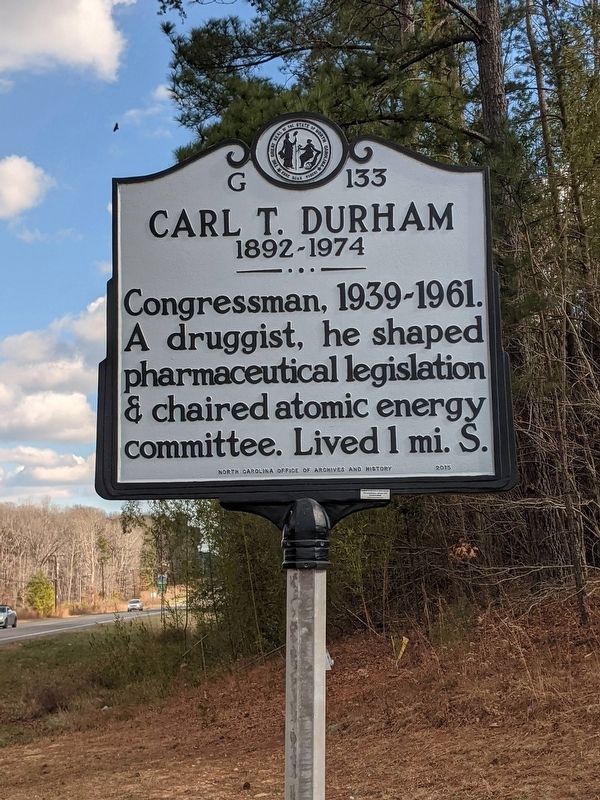
Photographed by Michael Buckner, January 14, 2022
1. Carl T. Durham Marker
Erected 2015 by North Carolina Office of Archives and History. (Marker Number G-133.)
Topics. This historical marker is listed in these topic lists: Air & Space • Science & Medicine.
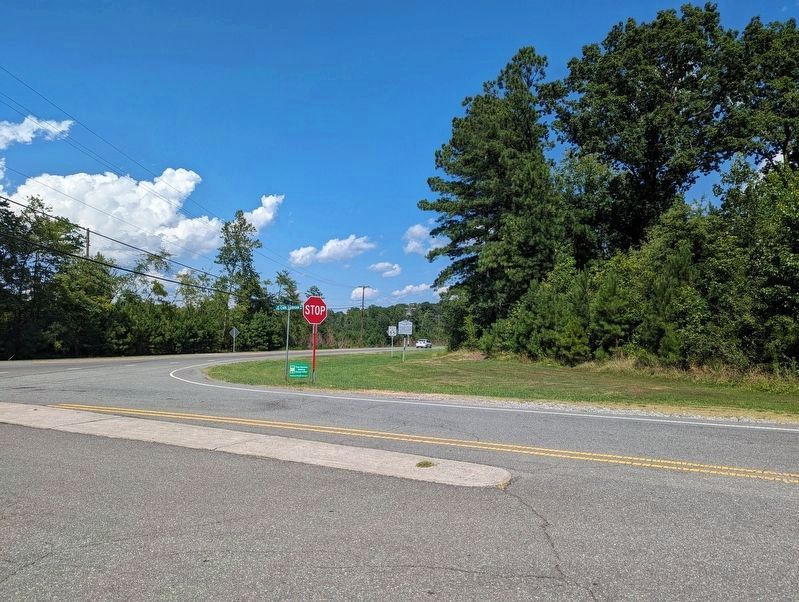
Location. 35° 55.439′ N, 79° 10.48′ W. Marker is in Chapel Hill, North Carolina, in Orange County. It is at the intersection of North Carolina Route 54 and Carl Durham Road, on the left when traveling west on North Carolina Route 54. Touch for map. Marker is at or near this postal address: 2823 NC-54 W, Chapel Hill NC 27516, United States of America. Touch for directions.

Regionally, this marker is in North Carolina’s Piedmont and in the Research Triangle. It is also in the American South and specifically in the Upper South. Globally, it is in North America, the Western Hemisphere, the Western World, and the Anglosphere. Historically, it finds itself in what was once the territory of the Mississippian Culture, one of the original Thirteen
this page online
Other nearby markers. At least 8 other markers are within 7 miles of this marker, measured as the crow flies: Thomas Lloyd (approx. 3.9 miles away); William Andrews (approx. 4.6 miles away); Matthew McCauley (approx. 5 miles away); Bingham School (approx. 5 miles away); Carrboro “Truth Plaque” (approx. 5½ miles away); Elizabeth Cotten (approx. 5.9 miles away); Hargraves (approx. 6.2 miles away); Navy B-1 Band (approx. 6.3 miles away). Touch for a list and map of all markers in Chapel Hill.
Also see . . . Carl T. Durham.
Born at White Cross in 1892, Carl Thomas Durham was a pharmacist and Democratic congressman from the Sixth District of North Carolina (Orange, Durham, Guilford, and Alamance Counties) from 1939-1961. Durham served on many committees but namely as charter member and later chairman of the Joint Committee on Atomic Energy, member of the House Armed Services Committee, U.S. representative on the International Atomic Energy Agency, and delegate to the 1954 Atoms for Peace Conference in Geneva. His influence can be most clearly identified(Submitted on May 11, 2023, by Michael Buckner of Durham, North Carolina.)on issues related to the armed services, civil defense, atomic energy, and pharmaceutical regulation. Three key contributions can be identified, as follows.Photographed by Mike Wintermantel, July 31, 20232. Carl T. Durham Marker
Credits. This page was last revised on August 1, 2023. It was originally submitted on May 11, 2023, by Michael Buckner of Durham, North Carolina. This page has been viewed 303 times since then and 34 times this year. Photos: 1. submitted on May 11, 2023, by Michael Buckner of Durham, North Carolina. 2. submitted on August 1, 2023, by Mike Wintermantel of Pittsburgh, Pennsylvania. • Bernard Fisher was the editor who published this page.
