Hillsborough in Orange County, North Carolina — The American South (South Atlantic)
Hillsborough Academy
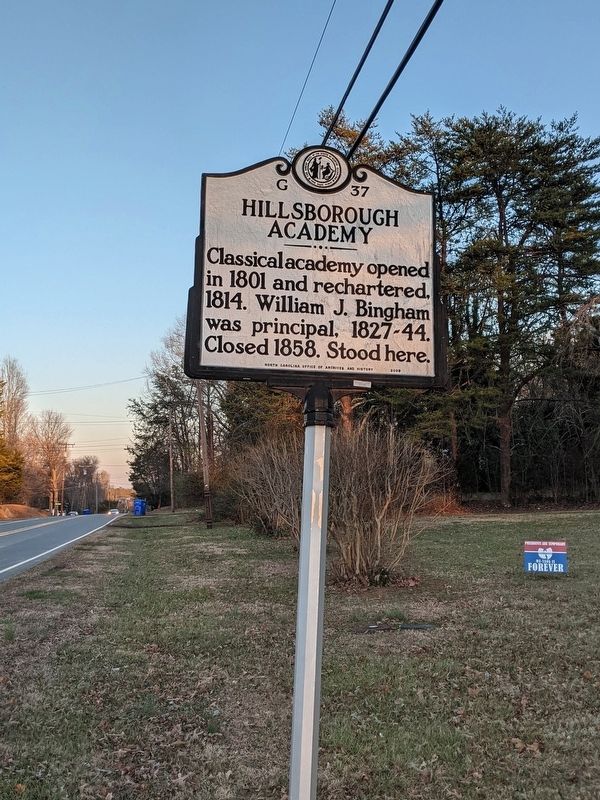
Photographed by Michael Buckner, March 2, 2022
1. Hillsborough Academy Marker
Erected 2009 by North Carolina Office of Archives and History. (Marker Number G-37.)
Topics. This historical marker is listed in this topic list: Education. A significant historical year for this entry is 1801.
Location. 36° 4.967′ N, 79° 6.319′ W. Marker is in Hillsborough, North Carolina, in Orange County. It is at the intersection of West Corbin Street and North Hassel Street, on the right when traveling east on West Corbin Street. Touch for map. Marker is at or near this postal address: 227 W Corbin St, Hillsborough NC 27278, United States of America. Touch for directions.

Regionally, this marker is in the Piedmont and in the Research Triangle. It is also in the American South and specifically in the Upper South. Globally, it is in North America, the Western Hemisphere, the Western World, and the Anglosphere. Historically, it finds itself in what was once the territory of the Mississippian Culture, one of the original Thirteen Colonies, one of the Confederate States of America,
this page online
Other nearby markers. At least 8 other markers are within walking distance of this marker: Welcome to The Burwell School (approx. 0.3 miles away); Elizabeth Keckly (approx. 0.4 miles away); Burwell School Historic Site (approx. 0.4 miles away); This Building Tells Many Stories (approx. 0.4 miles away); William Hooper Esquire (approx. 0.4 miles away); Constitutional Convention, 1788 (approx. 0.4 miles away); James Hogg (approx. 0.4 miles away); Nash-Hooper House (approx. half a mile away). Touch for a list and map of all markers in Hillsborough.
Also see . . . Hillsborough Academy.
Hillsborough Academy was the name given various schools established by prominent citizens of the town of Hillsborough over a period of 80 years. A school chartered in 1779 as Science Hall seems to have evolved into Hillsborough Academy by the time it opened in 1785. Subscriptions were raised among a number of North Carolinians for its establishment and the purchase of confiscated Loyalists' land, but the money was used only to repair the old Anglican church for use as the school building. The first principals of the academy were Benjamin Perkins and Solomon Pinto, both graduates of Yale. Zadoc Squire replaced Pinto as principal in 1787. The board of trustees included such illustrious eighteenth-century figures as William Hooper, Nathaniel Rochester, Thomas Hart, John Kinchen, Thomas Burke, James Hogg, and William Johnston. The curriculum had a practical bent but included classical subjects as well. Never a thriving institution, the school seems to have closed in 1790 after Zadoc's death.(Submitted on May 12, 2023, by Michael Buckner of Durham, North Carolina.)
Credits. This page was last revised on May 15, 2023. It was originally submitted on May 12, 2023, by Michael Buckner of Durham, North Carolina. This page has been viewed 317 times since then and 57 times this year. Photo 1. submitted on May 12, 2023, by Michael Buckner of Durham, North Carolina. • Bernard Fisher was the editor who published this page.
