Arthur in Arthur County, Nebraska — The American Midwest (Upper Plains)
Baled Hay Construction
Photographed by Cosmos Mariner, August 2, 2021
1. Baled Hay Construction Marker
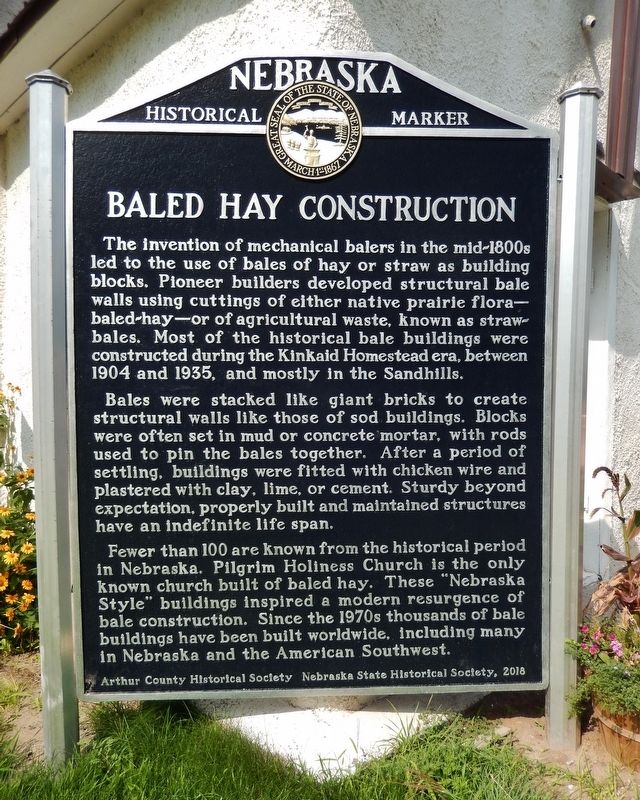
The invention of mechanical balers in the mid-1800s led to the use of bales of hay or straw as building blocks. Pioneer builders developed structural bale walls using cuttings of either native prairie flora — baled-hay — or of agricultural waste, known as straw bales. Most of the historical bale buildings were constructed during the Kinkaid Homestead era, between 1904 and 1935, and mostly in the Sandhills.
Bales were stacked like giant bricks to create structural walls like those of sod buildings. Blocks were often set in mud or concrete mortar, with rods used to pin the bales together. After a period of settling, buildings were fitted with chicken wire and plastered with clay, lime, or cement. Sturdy beyond expectation, properly built and maintained structures have an indefinite life span.
Fewer than 100 are known from the historical period in Nebraska. Pilgrim Holiness Church is the only known church built of baled hay. These "Nebraska Style" buildings inspired a modern resurgence of bale construction. Since the 1970s thousands of bale buildings have been built worldwide, including many in Nebraska and the American Southwest.
Erected 2018
this page online
Topics and series. This historical marker is listed in these topic lists: Architecture • Religion & Religious Structures • Settlements & Settlers. In addition, it is included in the Nebraska State Historical Society series list. A significant historical year for this entry is 1904.
Location. 41° 34.246′ N, 101° 41.315′ W. Marker is in Arthur, Nebraska, in Arthur County. It is at the intersection of Heath Street and Cedar Street, on the right when traveling west on Heath Street. Marker is located near the southwest corner of Pilgrim Holiness Church, facing Heath Street. Touch for map. Marker is at or near this postal address: 216 Cedar Street, Arthur NE 69121, United States of America. Touch for directions.

Regionally, this marker is in the Sand Hills. It is also in the American Midwest, in the Corn Belt, on the prairies, on the Great Plains, and specifically on the High Plains. Globally, it is in North America, the Western Hemisphere, the Western World, and the Anglosphere. Historically, it finds itself in what was
Photographed by Cosmos Mariner, August 2, 2021
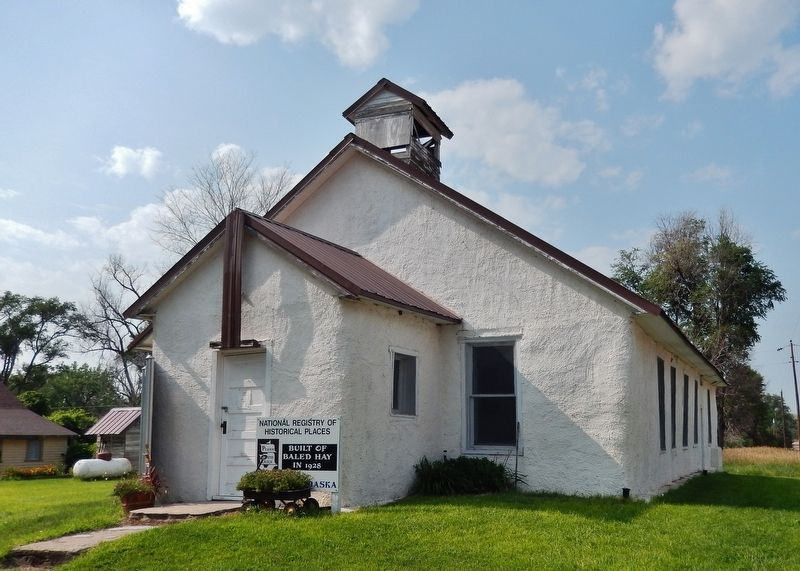
2. Pilgrim Holiness Church (southeast elevation)
Regarding Baled Hay Construction. National Register of Historic Places #79001434.
Also see . . .
1. Pilgrim Holiness Church. Wikipedia entry:
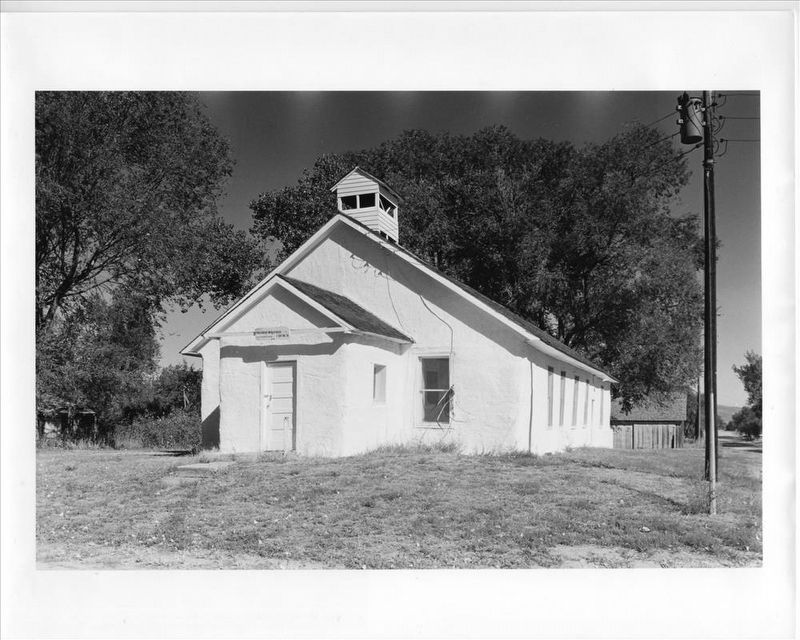
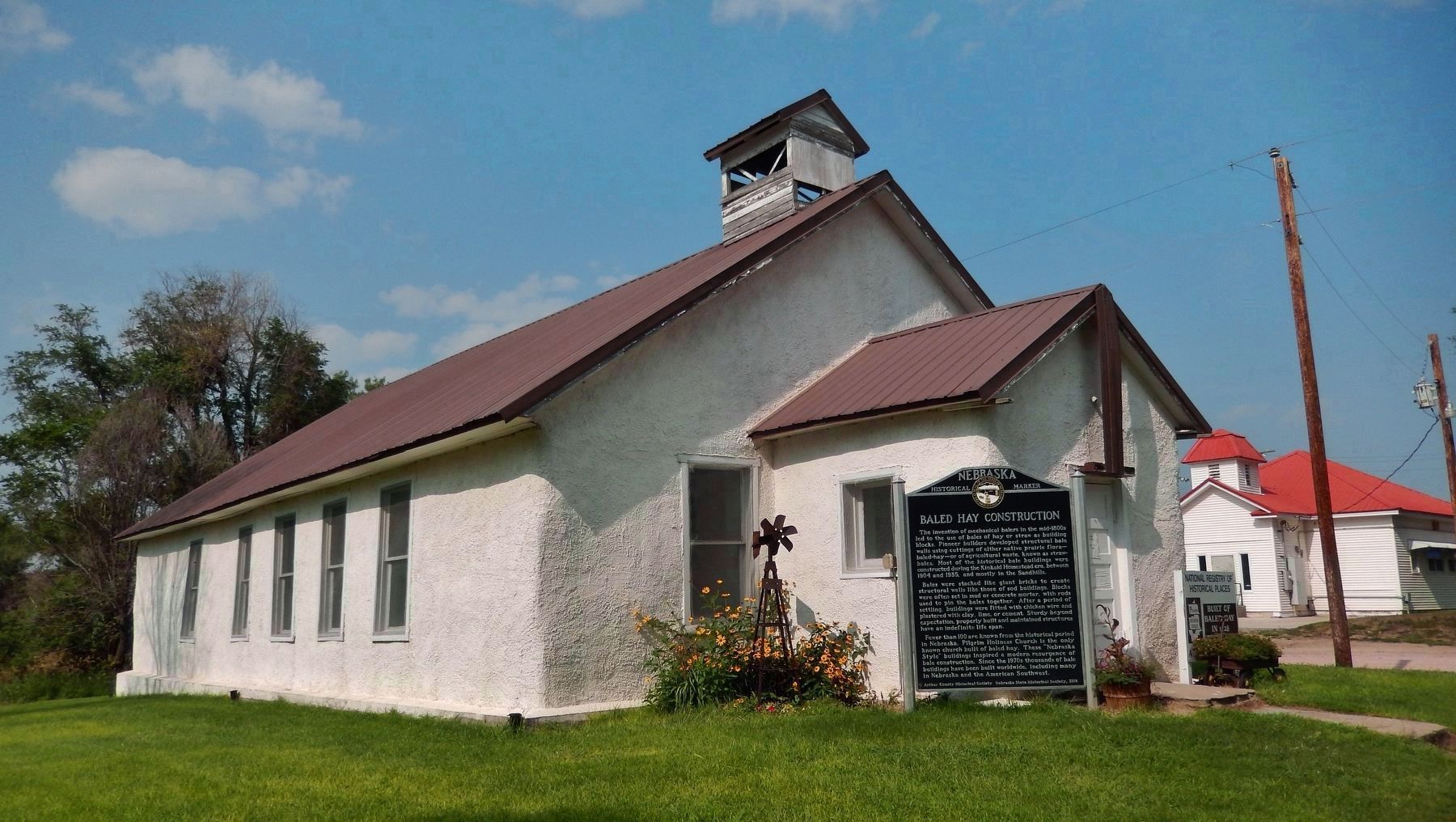
The Pilgrim Holiness Church, also known as the Baled Hay Church or the Baled Straw Church, is a church built in 1928 in Arthur, Nebraska. At a time and place in which conventional construction materials were expensive or unavailable, it was built out of baled rye straw. For its unique mode of construction, associated with the history of settlement of the Nebraska Sandhills, it is listed in the National Register of Historic Places. (Submitted on August 3, 2021, by Cosmos Mariner of Cape Canaveral, Florida.)
2. Baled Hay Church. Nebraska History Blog:
Planned by a group of Congregationalists in 1927, and built in 1928, the one-and-a-half story, front-gable building has two-feet-thick load-bearing walls comprised of baled rye straw “bricks” clad with plaster on the interior and stucco on the exterior. The rear of the church houses the former pastor’s residence, which includes a kitchen, a parlor, and a stairway leading to two small sleeping
via NPS, unknown
3. Baled Hay Construction Marker
NPGallery: Digital Asset Management System website entry
Click for more information.
Click for more information.
Photographed by Cosmos Mariner, August 2, 2021
4. Pilgrim Holiness Church (southwest elevation) & Baled Hay Construction Marker
Credits. This page was last revised on December 19, 2024. It was originally submitted on August 1, 2021, by Cosmos Mariner of Cape Canaveral, Florida. This page has been viewed 3,177 times since then and 374 times this year. Last updated on May 14, 2023, by Jeff Leichsenring of Garland, Texas. Photos: 1, 2. submitted on August 3, 2021, by Cosmos Mariner of Cape Canaveral, Florida. 3. submitted on November 17, 2021, by Larry Gertner of New York, New York. 4. submitted on August 3, 2021, by Cosmos Mariner of Cape Canaveral, Florida. • J. Makali Bruton was the editor who published this page.
