Near Machodoc in Westmoreland County, Virginia — The American South (Mid-Atlantic)
Nomini Hall
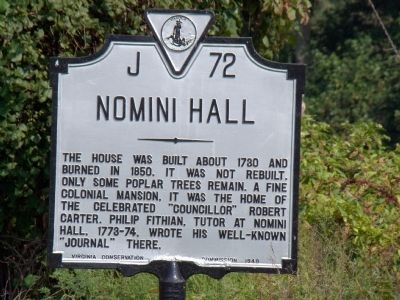
Photographed by J. J. Prats, August 30, 2009
1. Nomini Hall Marker
Erected 1948. (Marker Number J-72.)
Topics and series. This historical marker is listed in these topic lists: Colonial Era • Notable Buildings. In addition, it is included in the Virginia Department of Historic Resources (DHR) series list. A significant historical year for this entry is 1730.
Location. 38° 4.45′ N, 76° 40.967′ W. Marker is near Machodoc, Virginia, in Westmoreland County. It is at the intersection of Cople Highway (Virginia Route 202) and County Route 626, on the right when traveling east on Cople Highway. Touch for map. Marker is in this post office area: Hague VA 22469, United States of America. Touch for directions.

Regionally, this marker is on Virginia’s Northern Neck. It is also in the American South, specifically in the Upper South, in the Tidewater, in the Chesapeake Bay Region,
this page online
Other nearby markers. At least 8 other markers are within 3 miles of this marker, measured as the crow flies: Lee Hall (approx. 1.6 miles away); Richard Henry Lee’s Grave (approx. 2 miles away); The Glebe (approx. 2.3 miles away); Morgan Jones Kiln (approx. 2.3 miles away); a different marker also named Bushfield (approx. 2.3 miles away); Nominy Church (approx. 3.1 miles away); The War of 1812 / British Landing at Nomini Ferry (approx. 3.1 miles away); Zion Baptist Church (approx. 3.1 miles away).
Other markers no longer nearby. The Burnt House Field (was approx. 2 miles away but has been confirmed missing); Bushfield (was approx. 2.3 miles away but has been replaced with another marker now near it).
More about this marker. This marker was originally erected 6½
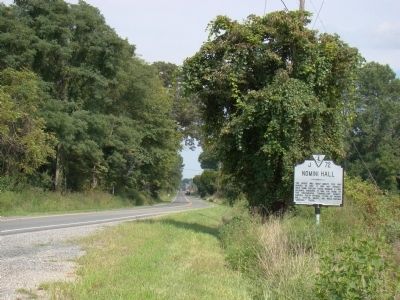
Photographed by J. J. Prats, August 30, 2009
2. Nomini Hall Marker
Also see . . .
1. Robert Carter III of Nomini Hall. “Following his return to Virginia, Carter in time repudiated the major institutions of colonial gentry society. Although he served for more than a decade on the governor’s council, he abruptly retired in 1772 to Nomini Hall, his father’s plantation on the Potomac River. In 1778 he deserted the Anglican church, becoming a Baptist. Though on occasion Carter defended slavery, he eventually freed his nearly 500 slaves. He gave up his life as a planter, escaping to Baltimore, the home of his wife Frances Tasker. There he became a Swedenborgian disciple. Carter’s story proves a point: the search for identity by the heirs of the Virginia gentry was difficult in a frontier society that had been created as
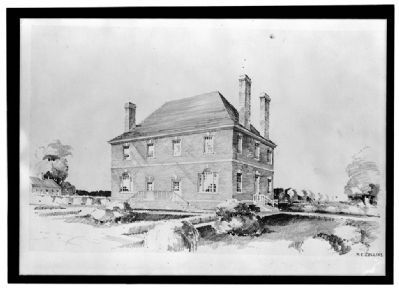
Historical American Building Survey, circa 1933
3. Drawing of the original Nomini Hall
2. Journal and Letters of Philip Vickers Fithian, 1773-1774: A Plantation Tutor of the Old Dominion. 1978 reprint of Philip Fithian’s journal. It begins: “In the ‘Golden Age,’ or half-century immediately preceding the American Revolution, a remarkable civilization reached it zenith in the broad coastal plain of eastern Virginia. Gradually, during a century of colonization and expansion, the heavily wooded tidewater had been converted into a land of settled order and accumulated wealth. Vast estates had been carved out of the wilderness and large plantations were everywhere the rule.
“Embraced by numerous arms of the Chesapeake [Bay] and covered by a network of wide rivers and creeks, this sylvan Venice abounded in safe and convenient water routes. . . . Ocean vessels could penetrate to the plantations in every part of the lowlands and carry cargoes thence straight to the wharves of London and other outports.” (Submitted on September 11, 2009.)
3. The History of Nomini Hall (official site). Contrary to what is mentioned on the marker, in 1850 a frame structure was rebuilt on the original location. (Submitted on July 25, 2014, by Kevin W. of Stafford, Virginia.)
4. Fire ravages Nomini Hall again. An article by Portsia Smith, published in The Freelance Star on July 23rd, 2014. Ironically, the rebuilt structure succumbed to the same fate as the original. (Submitted on July 25, 2014, by Kevin W. of Stafford, Virginia.)
Credits. This page was last revised on June 16, 2016. It was originally submitted on September 11, 2009, by J. J. Prats of Powell, Ohio. This page has been viewed 6,342 times since then and 249 times this year. Photos: 1, 2. submitted on September 11, 2009, by J. J. Prats of Powell, Ohio. 3. submitted on July 25, 2014, by Kevin W. of Stafford, Virginia.
